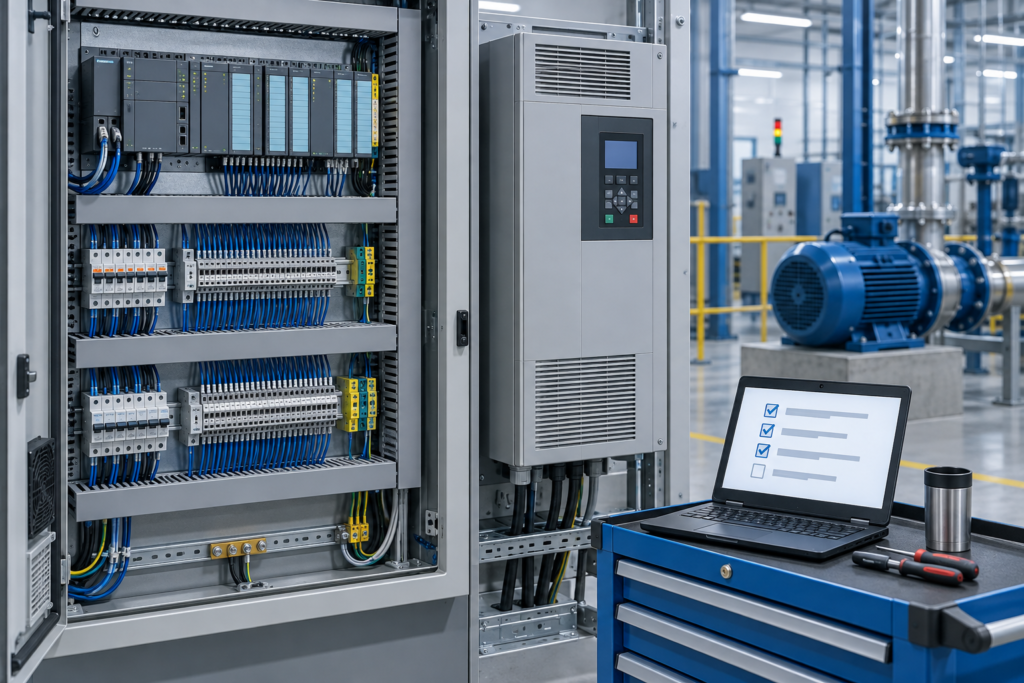
By Dovydas Kersys · Chapter 12 of 58 in Machine Commissioning.
Before you begin: Follow the machine documentation, risk assessment, site procedures and lockout/tagout requirements. Commissioning can expose personnel to electrical energy, stored pressure and unexpected motion. Never defeat a safety function merely to make a test easier. Examples and diagrams are generic and must be checked against the actual machine.
Before I/O tests, each field device should be physically ready. Sensors need proper targets and alignment; valves need correct plumbing; cylinders need free travel; contactors need correct coils; and mechanical loads must be safe to move.
Why this matters during commissioning
Commissioning is faster when the technician distinguishes “electrical identity correct” from “mechanically ready to function.”
Commissioning procedure
- Walk down every sensor and actuator against the layout and I/O list.
- Check sensor mounting, gap, target, cable routing and connector seating.
- Check valve tubing/hoses, port labels, flow controls and exhaust paths.
- Check motor coupling, guards, lubrication and free rotation where applicable.
- Check cylinder travel, stops, cushioning and mechanical interference.
- Confirm device labels match PLC/HMI tags.
Common failure patterns
- Sensor sees the wrong target.
- Reed switch mounted beyond cylinder magnet travel.
- Valve ports connected backwards.
- Actuator mechanically jammed while output appears electrically correct.
Evidence to record
- Device tag
- Physical condition
- Mechanical readiness
- Corrective action
- Loop-check status
FIELD RULE: Never use software forces to compensate for a field device that has not been mechanically verified.
PART III
PLC and I/O Commissioning
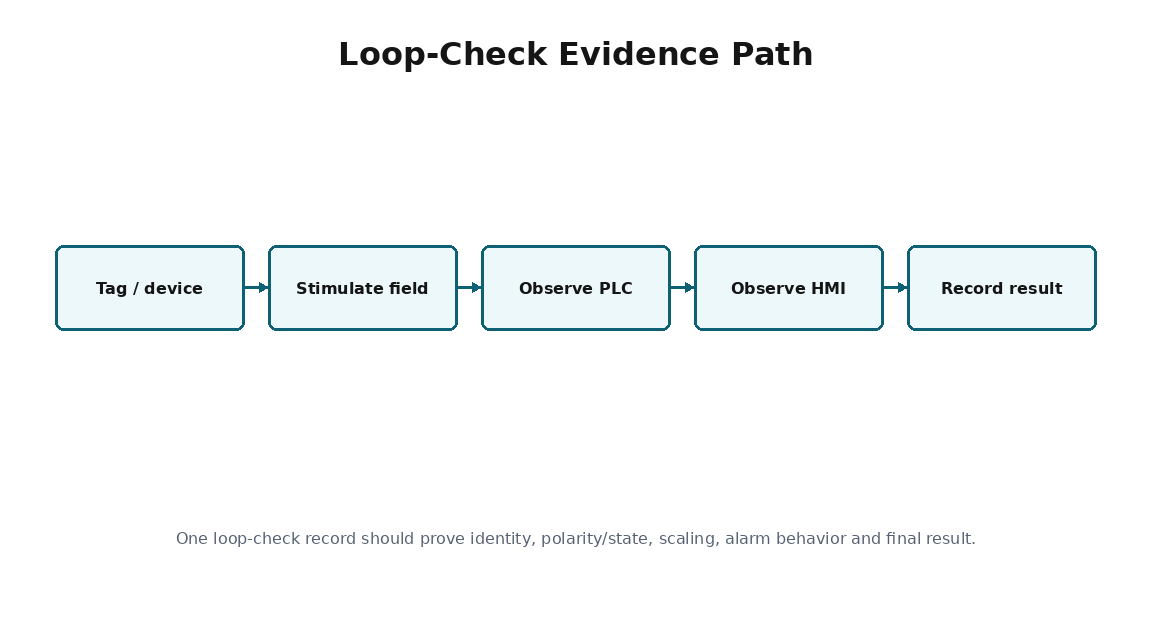
PLC and I/O Commissioning
Continue the series
- Previous chapter: 24 VDC Control Power: Commissioning Guide
- Next chapter: Software Backups and Version Control: Commissioning Guide
- Browse all Machine Commissioning chapters
Adapted from Machine Commissioning for Maintenance and Automation Technicians, by Dovydas Kersys. © 2026 Dovydas Kersys. Featured cover image is an AI-generated editorial illustration.