No Counts at All
The controller shows no movement even though the shaft turns.
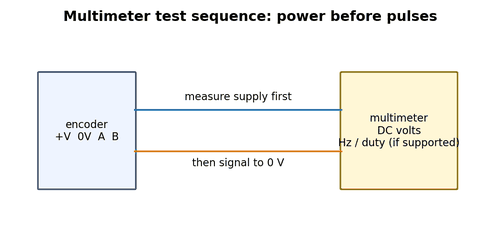
What to Check
- No encoder supply
- broken A channel
- wrong input common
- incompatible voltage/interface
- HSC disabled
- cable unplugged.
Diagnostic Sequence
- Check supply at encoder.
- Check A signal at encoder.
- Check A at receiver.
- Check raw HSC enable/configuration.
Common Mistakes
- Changing multiple things before reproducing the fault.
- Clearing diagnostic history before recording it.
- Assuming the encoder itself is always the failed component.
Field Rule: Do not replace the encoder until you know where the signal disappears.
Counts Only One Direction
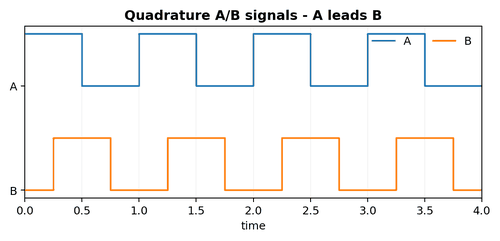
Forward count works, reverse does not or always counts positive.
What to Check
- Missing B channel
- wrong quadrature mode
- A/B wiring issue
- direction input configuration
- mechanical one-way slip.
Diagnostic Sequence
- Scope A/B both directions.
- Check B continuity and amplitude.
- Verify HSC quadrature mode.
- Inspect coupling during reversal.
Common Mistakes
- Changing multiple things before reproducing the fault.
- Clearing diagnostic history before recording it.
- Assuming the encoder itself is always the failed component.
Field Rule: A single healthy channel can hide a failed quadrature path.
Position Slowly Drifts
Position becomes increasingly wrong over many cycles.
What to Check
- Rare missed/false pulses
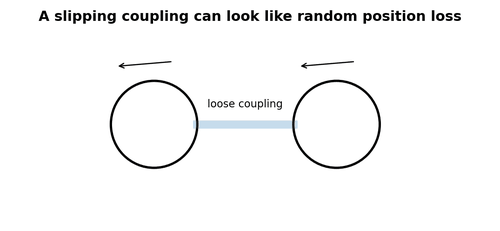
- mechanical slip
- scaling error
- reference correction logic
- cable intermittency.
Diagnostic Sequence
- Trend raw count over repeated identical cycles.
- Check stationary count for noise.
- Mark coupling.
- Repeat at lower speed/acceleration.
Common Mistakes
- Changing multiple things before reproducing the fault.
- Clearing diagnostic history before recording it.
- Assuming the encoder itself is always the failed component.
Field Rule: Determine whether the error is cumulative counts or a fixed mechanical offset.
Fault Only at High Speed
System works in jog but fails in production.
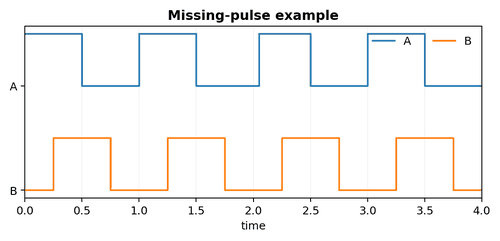
What to Check
- Input frequency limit
- slow rise time
- cable attenuation
- marginal voltage
- EMI
- bearing vibration.
Diagnostic Sequence
- Calculate maximum frequency.
- Scope at receiver at full speed.
- Check input filter.
- Compare temporary clean cable route.
Common Mistakes
- Changing multiple things before reproducing the fault.
- Clearing diagnostic history before recording it.
- Assuming the encoder itself is always the failed component.
Field Rule: Production-speed testing is essential for high-frequency faults.
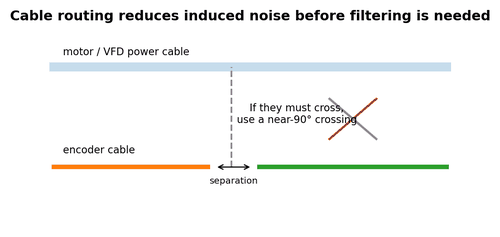
Fault Only When VFD Runs
Counts jump or drive reports feedback fault when a nearby VFD starts.
What to Check
- EMI coupling
- poor motor cable shield
- poor encoder shield bond
- common-mode voltage
- bad routing.
Diagnostic Sequence
- Observe stationary counts while VFD switches.
- Inspect routing and shield bonds.
- Use temporary separated encoder cable.
- Check VFD output cable grounding.
Common Mistakes
- Changing multiple things before reproducing the fault.
- Clearing diagnostic history before recording it.
- Assuming the encoder itself is always the failed component.
Field Rule: Noise is a system EMC problem, not automatically an encoder problem.
Fault at One Axis Position
Encoder fails only when carriage reaches a certain location.
What to Check
- Broken flex cable conductor
- connector strain
- drag-chain pinch
- mechanical obstruction.
Diagnostic Sequence
- Trend error vs position.
- Flex isolated cable carefully.
- Inspect bend radius/chain.
- Bypass with temporary cable.
Common Mistakes
- Changing multiple things before reproducing the fault.
- Clearing diagnostic history before recording it.
- Assuming the encoder itself is always the failed component.
Field Rule: Position-dependent electrical faults point strongly to moving cable.
Fault After Warm-Up
Feedback is good cold and fails after 20-60 minutes.
What to Check
- Thermal expansion
- encoder electronics
- power supply sag
- hot receiver module
- connector resistance.
Diagnostic Sequence
- Record temperature and time.
- Scope supply and signal cold/hot.
- Check cabinet cooling.
- Compare known-good channel.
Common Mistakes
- Changing multiple things before reproducing the fault.
- Clearing diagnostic history before recording it.
- Assuming the encoder itself is always the failed component.
Field Rule: Time and temperature are variables worth trending.
Random Drive Encoder Alarm
Drive occasionally trips with feedback error but no obvious pattern.
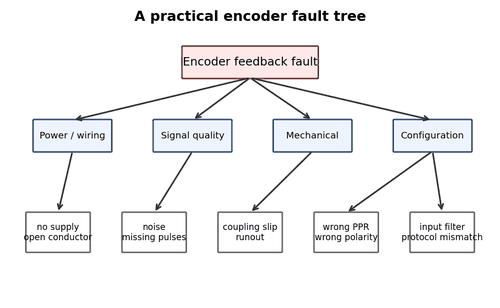
What to Check
- Short signal dropout
- serial CRC error
- connector vibration
- power dip
- cable noise.
Diagnostic Sequence
- Save alarm subcode/history.
- Trend feedback status.
- Use triggered scope.
- Inspect connectors and supply dips.
Common Mistakes
- Changing multiple things before reproducing the fault.
- Clearing diagnostic history before recording it.
- Assuming the encoder itself is always the failed component.
Field Rule: Preserve fault data before resetting the drive.
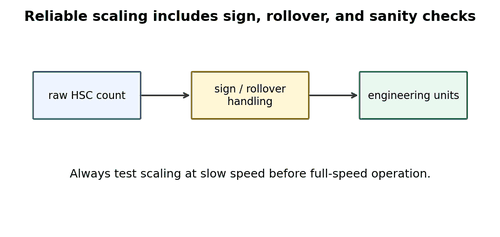
Speed Reads Half or Double
Measured speed is exactly 0.5×, 2×, or 4× expected.
What to Check
- Wrong PPR/CPR
- x1/x2/x4 mode
- gear ratio
- channel counting mode.
Diagnostic Sequence
- Rotate one exact revolution and compare raw counts.
- Check HSC mode.
- Check configured PPR and mechanical ratio.
Common Mistakes
- Changing multiple things before reproducing the fault.
- Clearing diagnostic history before recording it.
- Assuming the encoder itself is always the failed component.
Field Rule: Exact factors usually indicate configuration, not intermittent hardware.
Position Jumps by a Huge Value
Position suddenly changes by a large repeatable amount.
What to Check
- Counter rollover
- signed/unsigned conversion
- absolute wrap
- serial bit alignment
- data type overflow.
Diagnostic Sequence
- Inspect raw integer before/after jump.
- Check numeric range.
- Check absolute rollover point.
- Review type conversions.
Common Mistakes
- Changing multiple things before reproducing the fault.
- Clearing diagnostic history before recording it.
- Assuming the encoder itself is always the failed component.
Field Rule: Large deterministic jumps are often arithmetic or wraparound.
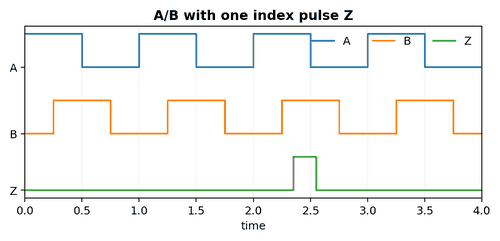
Home Position Is Inconsistent
Axis homes to slightly different positions each cycle.
What to Check
- Missed Z
- sensor hysteresis
- too-fast approach
- mechanical slip
- wrong index edge.
Diagnostic Sequence
- Monitor home sensor + Z.
- Reduce homing speed.
- Mark coupling.
- Check capture configuration.
Common Mistakes
- Changing multiple things before reproducing the fault.
- Clearing diagnostic history before recording it.
- Assuming the encoder itself is always the failed component.
Field Rule: Homing is a sequence of events; verify each one.
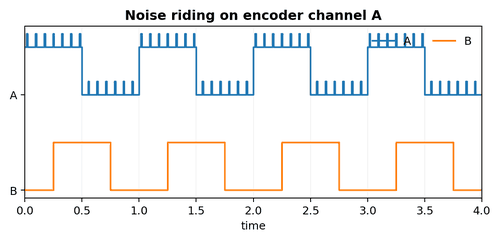
Counts While Shaft Is Stationary
Raw count changes with no mechanical motion.
What to Check
- EMI
- floating open-collector input
- wrong common
- unstable supply
- receiver noise.
Diagnostic Sequence
- Lock shaft safely.
- Observe count during contactor/VFD operation.
- Scope input.
- Check pull-up/reference/shield.
Common Mistakes
- Changing multiple things before reproducing the fault.
- Clearing diagnostic history before recording it.
- Assuming the encoder itself is always the failed component.
Field Rule: Stationary false counts are one of the clearest noise indicators.