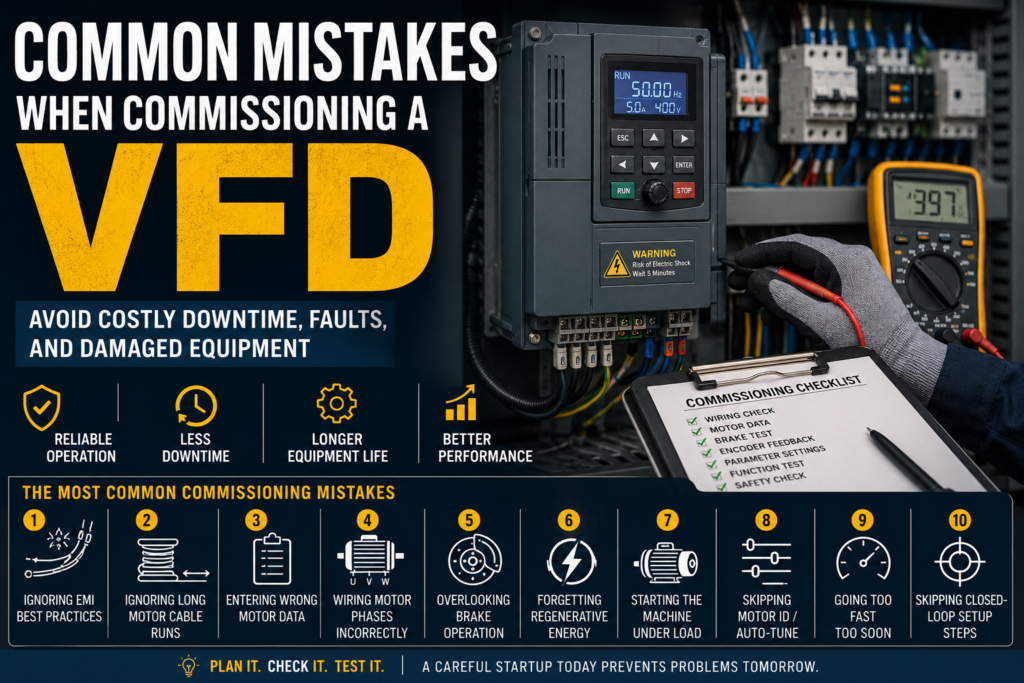
Commissioning a Variable Frequency Drive, or VFD, is not just about getting the motor to spin.
The goal is to make sure the motor runs safely, smoothly, and reliably. A small mistake during commissioning can later cause random faults, damaged motors, overheating, overcurrent trips, overvoltage trips, or machine downtime.
Many VFD problems are not caused by a bad drive. They are often caused by wiring mistakes, wrong motor data, poor cable routing, brake timing issues, or skipped setup steps.
In this post, we will look at the most common mistakes made during VFD commissioning and how to avoid them.
1. Ignoring EMI and Cable Routing
One common mistake is poor cable routing inside the electrical panel or machine.
VFDs create electrical noise because they switch the motor output very quickly. This noise is called EMI, or electromagnetic interference.
If motor power cables are installed too close to encoder cables, signal cables, or control wiring, noise can enter the control circuits.
This can cause problems like:
Random drive faults
Encoder loss faults
Unstable feedback signals
Communication problems
Incorrect sensor readings
Hard-to-find intermittent issues
These faults can be very annoying because the machine may run fine for a while, then suddenly stop for no clear reason.
How to avoid it
Keep motor power cables separate from control cables.
Use shielded cables where required.
Terminate cable shields correctly.
Avoid running encoder or feedback cables in the same tray as motor cables.
If power and signal cables must cross, cross them at 90 degrees.
Use filters or reactors if recommended by the drive manufacturer.
Good wiring layout can prevent many strange VFD problems before they ever happen.
2. Ignoring Long Motor Cable Runs
Long motor cables can create another problem.
When a VFD switches its output, voltage pulses travel through the motor cable. With long cable runs, reflected voltage waves can appear. These voltage spikes can stress the motor insulation.
In simple words, a long cable between the VFD and motor can make the motor see higher voltage stress than expected.
This can lead to:
Motor insulation damage
Motor overheating
Shorter motor life
Random drive faults
Motor failure over time
This is especially important when the motor is far away from the electrical cabinet.
How to avoid it
Check the drive manufacturer’s maximum motor cable length.
Use proper motor cable.
For long cable runs, use output reactors, dV/dt filters, or sine wave filters if needed.
Route motor cables away from sensitive control and feedback wiring.
Do not assume any cable length is acceptable. Long motor cables need proper design.
3. Entering Wrong Motor Data
Another very common mistake is entering incorrect motor data into the VFD.
The VFD needs correct motor nameplate information to control the motor properly.
Important motor data includes:
Motor voltage
Motor current
Motor frequency
Motor RPM
Motor power
Motor connection type
Motor power factor, if required
If this information is wrong, the drive may not control the motor correctly.
For example, if the motor is wired for one voltage but the VFD is programmed for another, the motor can draw too much current or fail during startup.
How to avoid it
Always compare the VFD parameters with the motor nameplate.
Check the motor terminal block jumper configuration.
Confirm if the motor is wired for star or delta, depending on the application.
Enter voltage, current, frequency, RPM, and power correctly.
If motor data is changed, repeat motor identification or auto-tune if required.
This is one of the simplest checks, but it is also one of the most important.
4. Wiring the Motor Phases Incorrectly
Motor phase wiring also matters.
For a basic open-loop motor, wrong phase order may only cause the motor to rotate in the wrong direction. That is usually easy to fix.
But in closed-loop systems, servo systems, or applications with encoder feedback, incorrect U/V/W phase wiring can cause serious control problems.
The drive may try to control the motor, but the motor feedback does not match what the drive expects.
This can cause:
Overcurrent faults
Encoder faults
Unstable motor movement
Wrong rotation direction
Poor torque control
Failure during startup
How to avoid it
Check U, V, and W motor wiring carefully.
Verify motor rotation direction at low speed.
In closed-loop systems, check encoder direction and motor phase sequence.
Follow the drive and motor wiring manual.
Do not swap motor phases randomly without understanding the control mode.
For feedback applications, motor phase sequence and encoder feedback must match.
5. Overlooking Brake Operation
Brake timing is very important in applications such as hoists, cranes, elevators, vertical axes, and holding loads.
If the brake does not open before the drive applies torque, the motor may try to rotate while the brake is still holding it.
This can cause an overcurrent fault.
The opposite problem is also dangerous. If the brake closes too late after stopping, the load may drift or move unexpectedly.
That can become a serious safety issue.
How to avoid it
Test brake opening time.
Test brake closing time.
Make sure torque is available before the brake releases.
Make sure the brake closes safely after the motor stops.
Adjust brake control delays if needed.
Check brake wiring and brake power supply.
Never ignore brake timing in lifting or vertical load applications.
A brake is not just an accessory. In many machines, it is a critical safety part of the system.
6. Forgetting About Regenerative Energy
Some loads can push energy back into the VFD.
This is called regenerative energy.
It often happens when the motor is slowing down a high-inertia load or when the load is driving the motor.
Common examples include:
Fans
Centrifuges
Saws
Rollers
Elevators
Hoists
Downhill conveyors
Large rotating machines
When this energy returns to the drive, it raises the DC bus voltage. If the drive has nowhere to put that energy, it may trip on overvoltage.
This is common when stopping heavy loads too quickly.
How to avoid it
Use a braking resistor for high-inertia or overhauling loads.
Use a regenerative drive or line regen unit for frequent energy regeneration.
Increase deceleration time if the stop is too aggressive.
Check DC bus voltage during stopping.
Size braking components correctly.
If a VFD trips on overvoltage during deceleration, the problem is often regenerative energy.
7. Starting the Machine Under Load
Another mistake is starting commissioning with the motor fully connected to the machine load.
This can make troubleshooting much harder.
If the drive trips immediately, you may not know whether the problem is the VFD setup, motor wiring, mechanical load, brake, pump pressure, gearbox, or something else.
Whenever possible, test the motor unloaded first.
How to avoid it
Start with the motor unloaded if possible.
If safe and practical, uncouple the motor from the machine.
Verify motor rotation direction.
Check basic speed control.
Confirm current is normal.
Only then connect the motor to the machine load.
This step helps separate electrical problems from mechanical problems.
If the motor runs correctly unloaded but faults when connected to the machine, the issue may be mechanical load, brake timing, pressure, friction, or machine setup.
8. Skipping Motor Identification or Auto-Tune
Many modern VFDs have a motor identification or auto-tune function.
This allows the drive to measure motor characteristics and build a better control model.
Some people skip this step to save time.
That can lead to poor motor performance later.
Skipping motor identification can cause:
Poor torque control
High current
Rough running
Weak low-speed performance
Unstable control
Incorrect motor response
How to avoid it
Run motor identification if the drive requires it.
Use the correct motor data before running auto-tune.
Follow the drive manual step by step.
Use static or rotating auto-tune depending on the application and safety situation.
Repeat auto-tune if motor data or wiring changes.
This is especially important for vector control, closed-loop control, and servo-type applications.
9. Going Too Fast Too Soon
After basic setup, it can be tempting to run the machine at full speed immediately.
That is risky.
If something is wrong, full-speed testing can damage the machine or create a safety issue.
Commissioning should be done gradually.
How to avoid it
Start at low speed.
Use conservative acceleration and deceleration ramps.
Check current during movement.
Check motor direction.
Check for vibration or unusual noise.
Test stopping behavior.
Increase speed step by step.
Only test full speed after basic operation is stable.
A slow and careful startup is much better than damaging equipment in the first five minutes.
10. Skipping Closed-Loop Setup Steps
In closed-loop applications, the drive uses encoder or feedback signals to control motor speed and position.
These systems need proper setup.
A common mistake is going directly into position control without first checking speed control.
If the velocity loop is unstable, position control will also be unstable.
How to avoid it
A good commissioning sequence is:
Check motor data.
Check motor wiring.
Check encoder wiring.
Verify motor direction.
Verify encoder direction.
Run motor identification.
Test open-loop operation if applicable.
Test low-speed movement.
Tune speed or velocity control.
Only then move to position control.
Closed-loop systems need a proper foundation before advanced control modes are tested.
Quick VFD Commissioning Checklist
Before blaming the drive, check these points:
Are power and control cables routed separately?
Are shielded cables used where needed?
Are shields terminated correctly?
Is the motor cable length within the drive manufacturer’s limits?
Do long motor cables need a dV/dt filter, sine wave filter, or reactor?
Are motor leads connected correctly?
Are motor jumpers set for the correct voltage?
Is the motor nameplate data entered correctly?
Is the brake opening before torque is applied?
Is the brake closing safely after the motor stops?
Is regenerative energy handled with a braking resistor or regen unit?
Was the motor tested unloaded before connecting it to the machine?
Was motor identification or auto-tune completed?
Was the motor tested at low speed before full-speed operation?
Are acceleration and deceleration ramps reasonable?
Is encoder feedback correct in closed-loop applications?
If you go through this checklist carefully, many VFD problems can be found before they become serious.
Final Thoughts
Commissioning a VFD is more than pressing start and checking if the motor turns.
A proper commissioning process helps protect the motor, drive, machine, and people working around the equipment.
The most common VFD commissioning mistakes include poor cable routing, incorrect motor data, wrong wiring, brake timing problems, unmanaged regenerative energy, starting under load, and skipping setup steps.
Most of these problems are preventable.
Take your time. Check the wiring. Enter the motor data correctly. Test the brake. Start unloaded if possible. Increase speed gradually. Watch the current. Follow the drive manual.
A careful commissioning process may take a little longer at the beginning, but it can save hours of troubleshooting later.
In industrial automation, a good startup is not rushed.
It is tested, checked, and controlled.