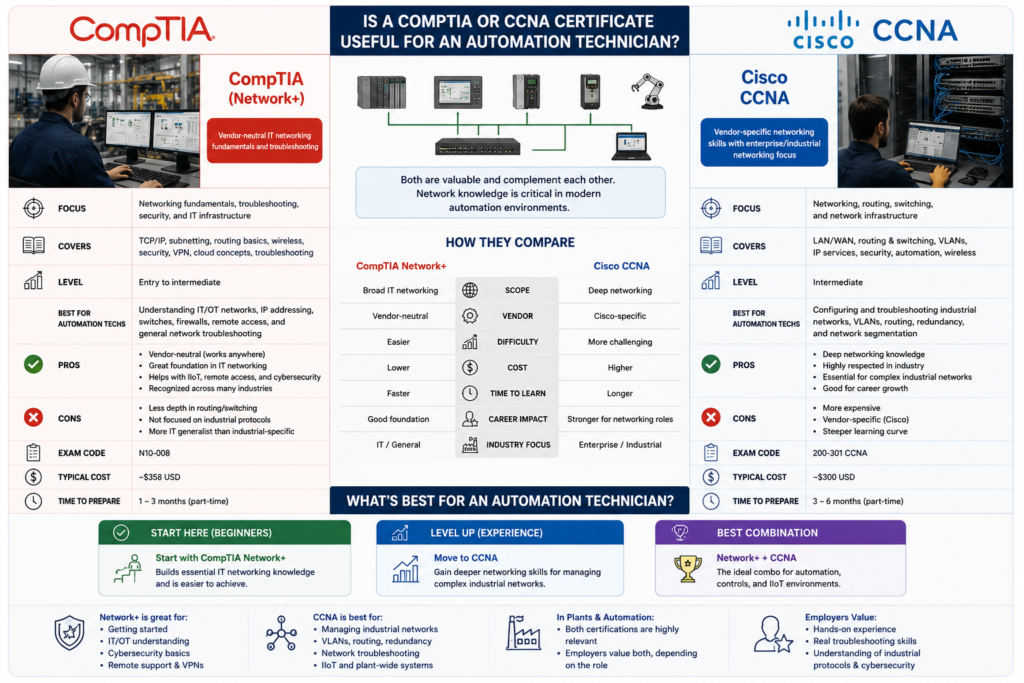
Industrial automation is no longer separated neatly from information technology.
PLCs communicate with HMIs, drives, remote I/O, SCADA servers, historians and manufacturing systems over Ethernet-based networks. Maintenance technicians increasingly encounter managed switches, virtual machines, Windows servers, firewalls and remote-access systems alongside ordinary sensors and contactors.
That makes IT and networking knowledge valuable.
It does not mean every automation technician needs a CCNA or a collection of CompTIA certificates.
For most plant-maintenance positions, these certifications are supporting qualifications. They become much more valuable when the job includes industrial networking, SCADA infrastructure, servers, IT/OT integration or cybersecurity.
Quick Comparison
| Certification | Relevance to automation technicians | Best use |
|---|---|---|
| CompTIA A+ | Low to moderate | Industrial PCs, HMI hardware and Windows troubleshooting |
| CompTIA Network+ | High for beginners | Broad vendor-neutral networking foundation |
| CompTIA Security+ | Moderate to high | OT cybersecurity and secure system administration |
| Cisco CCNA | High for network-heavy roles | Switching, routing, VLANs and serious network troubleshooting |
| Siemens or Rockwell networking training | Very high within the relevant platform | PROFINET or EtherNet/IP-specific work |
The correct choice depends on what you actually support.
CompTIA A+: Usually Not the Best First Choice
CompTIA A+ is primarily aimed at IT support.
The current A+ path requires passing two exams covering computer hardware, operating systems, software troubleshooting, basic networking, security, scripting, cloud concepts and user support. CompTIA recommends approximately 12 months of hands-on IT-support experience.
Some of that knowledge transfers to automation.
A+ can help when you maintain:
- Industrial PCs
- Windows-based HMIs
- Engineering workstations
- Panel PCs
- Barcode systems
- Printers and label systems
- USB and serial devices
- Local user accounts and operating-system settings
It may help you diagnose why an HMI application will not start, why a replacement computer cannot see the network or why a Windows service has failed.
However, much of A+ focuses on ordinary end-user IT equipment. It will not teach you how to trace a missing PLC permissive, configure a VFD, commission remote I/O or troubleshoot an industrial process.
For someone with no computer background, the knowledge may be useful. The full certification is rarely the best investment for a technician whose main responsibility is machinery.
CompTIA Network+: The Best General Starting Point
Network+ is usually the most relevant CompTIA qualification for automation technicians.
The current N10-009 exam covers:
- Ethernet and network models
- IPv4 addressing and subnetting
- Switches and routers
- VLANs and tagged links
- Spanning Tree
- TCP and UDP
- DHCP, DNS and NTP
- VPNs
- Network monitoring
- Packet capture
- Documentation
- Security
- Troubleshooting
Troubleshooting represents 24% of the examination, and the objectives include interface errors, VLAN problems, routing issues, cable testing, packet capture and switch commands.
Those skills transfer directly to faults such as:
- A PLC is reachable locally but not from the engineering network.
- An HMI has the wrong subnet mask.
- A managed switch port is assigned to the wrong VLAN.
- A network loop causes intermittent communication.
- A SCADA server loses communication after an infrastructure change.
- Duplicate IP addresses create unpredictable device failures.
- A fibre connection has link status but excessive errors.
Network+ is vendor-neutral. That is an advantage for learning fundamentals because it does not assume that every network uses Cisco equipment.
Its limitation is that it focuses on ordinary IT networking rather than industrial protocols.
It will not teach the platform-specific details of:
- PROFINET device names
- EtherNet/IP connections
- PROFIBUS diagnostics
- EtherCAT states
- Siemens MRP redundancy
- Rockwell device-level ring configuration
- Real-time industrial communication
- Safety traffic over industrial Ethernet
Network+ gives you the underlying language. You must still learn how your plant applies it.
CCNA: Stronger, but More Than Many Technicians Need
CCNA goes deeper than Network+ into configuring and operating networks.
Cisco’s current CCNA examination covers network fundamentals, network access, IP connectivity, IP services, security fundamentals, automation and programmability. Candidates are expected to understand areas such as switching, VLANs, routing, access-control concepts and network troubleshooting. The exam currently costs US$300, lasts 120 minutes and earns a certification valid for three years.
This knowledge is highly useful when an automation technician works with:
- Large plant networks
- Managed industrial switches
- Multiple VLANs
- Routed production areas
- Redundant network paths
- SCADA server networks
- Remote-access infrastructure
- Firewalls and access rules
- Plant-wide wireless systems
- IT/OT integration
CCNA also carries stronger recognition than a basic networking course because it is a widely established networking certification.
Current Siemens vacancies demonstrate where it becomes relevant. An industrial system network engineer position lists a networking certification such as CCNA, while a control-systems position involving DCS networking, VPNs, routers and terminal servers lists CCNA or CCNP as preferred.
Notice the type of jobs involved: industrial network and control-system infrastructure, not ordinary sensor replacement.
For a general maintenance technician, CCNA may be excessive. You could spend significant time learning enterprise routing topics that rarely appear inside a standalone machine network.
For a technician moving toward industrial network engineer, SCADA engineer or OT specialist, it can be an excellent investment.
CompTIA Security+: Useful for OT Cybersecurity
Security+ is not an industrial-security certification, but it provides a useful general foundation.
The current SY0-701 exam covers general security concepts, threats and vulnerabilities, security architecture, security operations, identity and access management, incident response and security programme management.
This knowledge becomes relevant when automation staff are responsible for:
- Secure remote vendor access
- User accounts and permissions
- Antivirus and application allow-listing
- PLC and HMI backup protection
- Network segmentation
- Patch planning
- Incident response
- Password and credential management
- SCADA server security
- Asset inventories
Security+ is most useful after you already understand networking. Studying attacks, firewall concepts and secure architecture without understanding IP communication creates shallow knowledge.
It is also still an IT-focused certificate. It does not replace training in industrial cybersecurity, control-system architecture or the ISA/IEC 62443 series.
Current Siemens network and cybersecurity vacancies list credentials such as CCNA and Security+ as advantages, but these positions also demand substantial networking and systems experience.
The certificate supports the experience. It does not create it.
What Employers Usually Value More
For a normal automation-technician position, employers will generally care more about whether you can:
- Read electrical drawings
- Troubleshoot 24 V DC circuits
- Work with Siemens or Allen-Bradley PLCs
- Configure VFDs
- Diagnose industrial-network faults
- Interpret HMI and SCADA alarms
- Replace and commission field devices
- Work safely around operating machinery
A CCNA does not compensate for weak electrical or PLC knowledge.
A practical priority order for a new technician is usually:
- Electrical and machine-safety fundamentals
- One PLC platform
- VFDs, sensors and motor controls
- Basic Ethernet and IP networking
- Industrial protocol troubleshooting
- Broader IT and cybersecurity qualifications
Certifications should be added where they support the type of work you want to perform.
Which One Should You Choose?
Choose Network+ when:
- Your networking knowledge is weak.
- You want a structured, vendor-neutral foundation.
- You regularly struggle with addresses, subnet masks, VLANs and basic network diagnosis.
- You are moving from mechanical or electrical maintenance toward connected automation systems.
Choose CCNA when:
- You already understand basic networking.
- Your plant uses managed Cisco or similar enterprise infrastructure.
- You want to move into industrial networking, SCADA or IT/OT engineering.
- Your work involves routed networks, VLAN design, firewalls or plant-wide troubleshooting.
Choose Security+ when:
- You already have solid networking fundamentals.
- You support SCADA servers, remote access or OT security.
- You are moving toward an OT cybersecurity position.
- Your employer is introducing formal cybersecurity responsibilities.
Choose A+ when:
- You have almost no computer-support knowledge.
- Your role includes maintaining industrial PCs and Windows-based equipment.
- You may also want the option of moving into general IT support.
A Better Combination Than Certification Alone
The strongest automation candidate does not simply list “CCNA” on a CV.
They can explain how they used the knowledge.
For example:
Segmented the controls network using VLANs, documented switch ports and traced an intermittent communication fault to a mismatched link configuration.
Or:
Created an IP-address inventory for PLCs, HMIs and drives and eliminated duplicate-address failures during machine commissioning.
That connects the certification to industrial results.
Final Verdict
Yes, CompTIA and CCNA certifications can be useful for an automation technician—but they are not equally useful.
Network+ is the best general starting point for someone who lacks networking fundamentals.
CCNA provides the strongest technical networking path and is particularly valuable for industrial-network, SCADA and IT/OT roles.
Security+ is worthwhile when your responsibilities are expanding into OT cybersecurity.
A+ has the weakest direct connection to machinery, although it can help with industrial computers and Windows-based systems.
For a standard maintenance technician, a PLC course, electrical qualification or industrial-networking course will often produce a faster career return.
For someone who wants to become the person called when the entire plant network stops communicating, CCNA may be one of the most useful non-automation certificates available.