A conductivity sensor is used to measure how well a liquid conducts electrical current.
In industrial automation and process control, conductivity measurement is very useful because it can tell us information about the liquid composition, concentration, cleanliness, or process condition.
Conductivity sensors are commonly used in:
Water treatment
Food and beverage production
Chemical processing
CIP cleaning systems
Rinse water monitoring
Media separation
Acid and caustic concentration monitoring
Process control
Quality monitoring
Industrial automation
The basic idea is simple:
More ions in the liquid = higher conductivity.
Fewer ions in the liquid = lower conductivity.
For example, pure water has very low conductivity, while salt water, acids, and caustic cleaning solutions have much higher conductivity.
What Is Conductivity?
Conductivity describes how easily a liquid allows electrical current to pass through it.
Liquids conduct electricity mainly because they contain charged particles called ions.
Examples of ions come from dissolved salts, acids, bases, minerals, and chemicals.
If a liquid has many ions, it usually has high conductivity.
If a liquid has very few ions, it has low conductivity.
This is why conductivity measurement is useful in process control. It can help detect changes in liquid concentration or identify different media in a pipe.
Conductivity Units
Conductivity is commonly shown in:
µS/cm — microsiemens per centimeter
mS/cm — millisiemens per centimeter
The relationship is:
1000 µS/cm = 1 mS/cm
Examples:
Pure water: very low conductivity
Drinking water: low to medium conductivity
Process water: depends on minerals and treatment
Salt solutions: higher conductivity
Acids and caustic solutions: often very high conductivity
Exact values depend on liquid composition and temperature.
Why Is Conductivity Measured?
Conductivity is measured because it gives useful information about the liquid.
It can be used for:
Checking water purity
Detecting chemical concentration
Monitoring cleaning processes
Separating different liquids
Detecting product changeover
Controlling dosing systems
Monitoring rinse quality
Checking process stability
Protecting equipment
Sending signals to PLC systems
For example, in a cleaning process, conductivity can help detect whether the pipe contains water, cleaning chemical, or product.
In water treatment, conductivity can help detect dissolved minerals or contamination.
Basic Types of Conductivity Sensors
There are two main conductivity measurement technologies:
Conductive conductivity sensors
Inductive conductivity sensors
Both measure conductivity, but they work differently.
1. Conductive Conductivity Sensors
A conductive conductivity sensor uses electrodes that are in direct electrical contact with the liquid.
The sensor applies an electrical signal between the electrodes and measures how easily current flows through the liquid.
If the liquid conducts well, more current flows.
If the liquid conducts poorly, less current flows.
Conductive sensors are commonly used for:
Low conductivity liquids
Water treatment
Pure water monitoring
General process water
Laboratory measurement
Low and medium conductivity ranges
How Conductive Conductivity Sensors Work
A simple conductive sensor has two or more electrodes.
The electrodes touch the liquid.
The transmitter applies a known electrical signal.
The liquid between the electrodes behaves like a resistance.
The electronics calculate conductivity from the measured resistance or conductance.
The principle is similar to Ohm’s law:
Current depends on voltage and resistance.
If the liquid has low resistance, it has high conductivity.
If the liquid has high resistance, it has low conductivity.
Limitations of Conductive Sensors
Conductive sensors are simple and accurate in the correct application, but they have limits.
Because the electrodes touch the liquid directly, problems can occur.
Common problems include:
Electrode coating
Deposits on electrodes
Polarization effects
Corrosion
Fouling
Incorrect measurement at high ion concentration
Cleaning problems
Measurement drift
At high conductivity levels, the electrode interface can create measurement errors.
This is often called polarization.
Deposits can also form an insulating layer on the electrodes. If that happens, the sensor may read incorrectly or stop measuring properly.
For example, caustic deposits, product buildup, or scaling can reduce electrode contact with the liquid.
2. Inductive Conductivity Sensors
An inductive conductivity sensor measures conductivity without direct metal electrode contact with the liquid.
Instead of using exposed electrodes, it uses electromagnetic induction.
This makes inductive sensors very useful for harsh or dirty liquids.
They are often used for:
High conductivity liquids
Acids
Caustic solutions
CIP cleaning chemicals
Food and beverage processes
Media separation
Dirty liquids
Liquids with deposits
Applications where electrodes would foul
Processes with high ion concentration
The biggest advantage is that the sensor does not need metal electrodes directly exposed to the liquid.
This reduces problems with polarization and electrode coating.
Conductive vs Inductive Conductivity Sensors
The choice depends mainly on the liquid and conductivity range.
Conductive sensors are usually better for:
Low conductivity measurement
Pure water
Clean water
Low ion concentration
Applications where electrodes stay clean
Inductive sensors are usually better for:
High conductivity measurement
Caustic and acid solutions
Dirty liquids
Cleaning chemicals
Liquids that cause deposits
Food and beverage CIP systems
Media separation
In simple terms:
Conductive sensors are good for low conductivity.
Inductive sensors are good for high conductivity and dirty applications.
Why Inductive Sensors Are Useful at High Conductivity
In high-conductivity liquids, conductive sensors can suffer from electrode polarization.
This means the electrode-liquid interface creates an additional unwanted effect that distorts the reading.
Deposits can also make the problem worse.
For example, sodium hydroxide or other cleaning chemicals can create layers on electrodes.
If an insulating layer forms, the sensor may no longer measure correctly.
Inductive sensors avoid many of these issues because they do not depend on direct electrode contact in the same way.
That is why inductive conductivity measurement is common in industrial cleaning and chemical processes.
Limitation of Inductive Conductivity Sensors
Inductive conductivity sensors are not ideal for very low conductivity liquids.
Their smallest useful range is usually higher than conductive sensors.
For example, an inductive sensor may be suitable from around:
500 µS/cm
or
0.5 mS/cm
Some can still detect changes around lower values, but for precise low-conductivity water measurement, a conductive sensor is usually better.
So the rule is:
Use conductive technology for low conductivity.
Use inductive technology for medium to high conductivity, dirty liquids, and chemical processes.
How an Inductive Conductivity Sensor Works
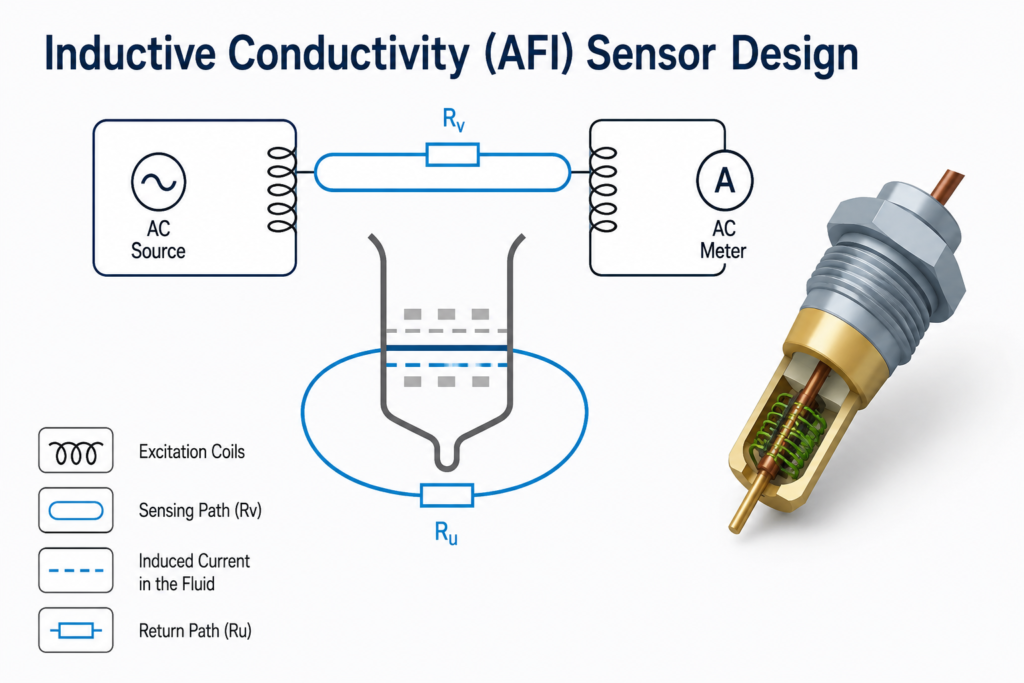
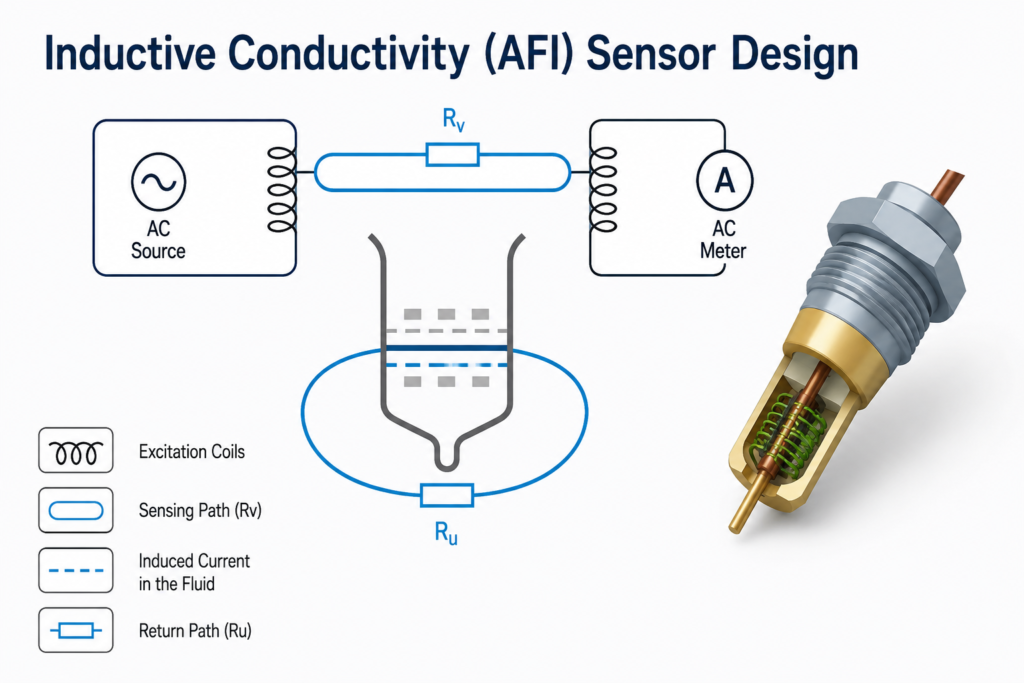
An inductive conductivity sensor uses two coils inside the sensor body.
These coils are usually sealed inside a chemically resistant housing.
The liquid flows through or around the sensor measurement opening.
The sensor works like two transformers connected through the liquid.
The first coil creates an alternating magnetic field.
This magnetic field induces an electrical current in the liquid.
The liquid current then creates a signal in the second coil.
The strength of this signal depends on how conductive the liquid is.
Higher conductivity creates a stronger signal.
Lower conductivity creates a weaker signal.
Simple Explanation
The process can be explained like this:
The transmitter energizes the first coil.
The first coil creates an alternating magnetic field.
The conductive liquid acts like a loop.
Current flows through the liquid loop.
The second coil detects the induced signal.
Electronics calculate conductivity from the signal.
The sensor does not need exposed metal electrodes.
That makes the design more resistant to coating, deposits, corrosion, and aggressive liquids.
Two-Coil Inductive Sensor Design
A typical inductive conductivity sensor contains:
Sensor body
Measurement opening or flow channel
First ring coil
Second ring coil
Temperature sensor
Transmitter electronics
Process connection
Cable or connector
The two coils are usually arranged so that the liquid forms part of the electromagnetic path.
The sensor electronics know the excitation signal and measure the resulting induced signal.
From this, the transmitter calculates conductivity.
What Is the Role of the Liquid Loop?
In an inductive conductivity sensor, the conductive liquid acts like a loop between two transformer stages.
The first coil transfers energy into the liquid.
The liquid’s conductivity determines how much current can flow.
The second coil detects the result.
If the liquid has high conductivity, the current loop is stronger.
If the liquid has low conductivity, the current loop is weaker.
This is how the sensor can measure conductivity without direct electrode contact.
Does the Liquid Need to Flow?
The inductive measurement principle does not usually require liquid movement.
The sensor can measure conductivity even if the liquid is standing still, as long as the sensor is properly filled and the liquid surrounds the measurement area.
However, in real process applications, flow direction and sensor orientation still matter.
Good flow helps with:
Cleaning
Avoiding trapped air
Avoiding deposits
Stable measurement
Good response time
For hygienic and cleaning applications, it is often best to align the sensor channel with the flow direction so liquid can clean the measuring area more effectively.
Temperature Measurement in Conductivity Sensors
Conductivity depends strongly on temperature.
For many aqueous liquids, conductivity changes significantly when temperature changes.
A common rule of thumb is:
Conductivity changes by about 2% per °C for many water-based solutions.
This means that if temperature is not compensated, the conductivity reading can change even when the liquid concentration stays the same.
Because of this, many conductivity sensors include an integrated temperature sensor.
Common temperature elements include:
Pt100
Pt1000
NTC
Digital temperature sensor
The temperature signal is used for temperature compensation.
It may also be sent to the PLC as a separate temperature value.
What Is Temperature Compensation?
Temperature compensation corrects the measured conductivity value to a reference temperature.
The most common reference temperature is:
25°C
This allows measurements to be compared more easily.
For example, if the same liquid is measured at 20°C and 40°C, the raw conductivity may be different because of temperature.
Temperature compensation calculates what the conductivity would be at the reference temperature.
This makes the reading more useful for process control.
Linear Temperature Compensation
Many systems use linear temperature compensation.
The formula is based on a temperature coefficient, usually shown in:
%/°C
or
%/K
For many aqueous solutions, a typical value may be around:
2%/°C
This means the conductivity changes by about 2 percent for every 1°C temperature change.
If temperature compensation is not wanted, the coefficient can be set to:
0%/°C
Then the sensor displays the raw uncompensated conductivity.
Non-Linear Temperature Compensation
Not all liquids behave linearly with temperature.
Some chemicals have a more complex relationship between conductivity and temperature.
For these applications, some transmitters allow:
Non-linear compensation
Polynomial compensation
Quadratic temperature coefficient
Liquid-specific compensation tables
User-defined compensation curves
This is useful when measuring acids, caustic solutions, or special process liquids where simple 2%/°C compensation is not accurate enough.
Why Temperature Compensation Matters
Imagine a process liquid with stable concentration.
The liquid gets warmer during operation.
The raw conductivity increases.
Without temperature compensation, the PLC may think the concentration increased.
But in reality, only the temperature changed.
This can cause wrong process decisions.
For example:
Wrong chemical dosing
Wrong media separation
False alarm
Wrong rinse detection
Incorrect quality decision
Temperature compensation helps prevent this.
Conductivity Sensor Outputs
Conductivity sensors and transmitters can provide different output signals.
Common outputs include:
4–20 mA
0–10V
Relay outputs
Digital switching outputs
IO-Link
Modbus
HART
PROFINET
EtherNet/IP
Local display values
In PLC systems, the most common signal is often 4–20 mA.
For example:
4 mA = 0 mS/cm
20 mA = 100 mS/cm
The PLC reads the analog signal and scales it into conductivity units.
Conductivity Sensor Connected to a PLC
A simple automation setup may look like this:
Conductivity sensor installed in the pipe.
Sensor transmitter measures conductivity and temperature.
Transmitter sends 4–20 mA to PLC.
PLC scales the signal into mS/cm or µS/cm.
HMI displays conductivity.
PLC uses conductivity for process decisions.
The PLC can use conductivity to:
Detect water or chemical
Control dosing
Start or stop rinsing
Separate product from cleaning liquid
Trigger alarms
Verify cleaning concentration
Monitor process water quality
Example: Conductivity in CIP Cleaning
CIP means Clean-in-Place.
It is common in food, beverage, dairy, pharmaceutical, and process industries.
A conductivity sensor can help identify which liquid is in the pipe.
For example:
Water has lower conductivity.
Caustic cleaning solution has high conductivity.
Acid cleaning solution has another conductivity range.
Product may have a different conductivity value.
The PLC can use this information to control valves and decide when to switch between process steps.
Example sequence:
Pre-rinse with water
Caustic wash
Intermediate rinse
Acid wash
Final rinse
Conductivity measurement helps detect when cleaning chemical is present and when rinse water is clean enough.
Example: Media Separation
In production lines, different liquids may pass through the same pipe.
A conductivity sensor can help detect the transition between them.
For example:
Product
Water
Cleaning solution
Acid
Caustic
Rinse liquid
When conductivity changes, the PLC can detect that the medium has changed.
This can be useful for:
Reducing product loss
Improving cleaning control
Saving water
Saving chemicals
Automating valve switching
Improving process reliability
Sensor Housing Materials
Conductivity sensors must be compatible with the process liquid.
Inductive sensors often use a sealed plastic or polymer body.
Common materials may include:
PEEK
PFA
PVDF
PTFE
Stainless steel process connections
Food-grade materials
The correct material depends on:
Chemical resistance
Temperature
Pressure
Hygienic requirements
Cleaning chemicals
Process connection type
Mechanical strength
PEEK is commonly used in demanding industrial and hygienic applications because it has good chemical and temperature resistance.
Installation Tips for Conductivity Sensors
Correct installation is important for reliable measurement.
General good practices include:
Install where the pipe stays full.
Avoid trapped air around the sensor.
Avoid dead zones with no liquid movement.
Follow flow direction recommendations.
Keep the measuring channel clean.
Avoid installation where deposits collect.
Use correct gasket and process connection.
Check chemical compatibility.
Keep cables away from high-power motor cables.
Follow grounding and shielding instructions.
Make sure temperature sensor contacts the process properly.
For inductive sensors, orienting the measurement opening with the flow can improve cleaning and reduce buildup.
Common Problems With Conductivity Measurement
Reading Too Low
Possible causes:
Sensor coating
Wrong range
Low liquid conductivity
Air pocket around sensor
Wrong temperature compensation
Wrong PLC scaling
Sensor not fully immersed
Damaged transmitter
Reading Too High
Possible causes:
Wrong calibration
Wrong temperature coefficient
Contaminated liquid
Chemical concentration too high
Conductive deposits
Electrical noise
Wrong PLC scaling
Short circuit in sensor cable
Reading Unstable
Possible causes:
Air bubbles
Partially filled pipe
Poor grounding
Electrical noise
Temperature changes
Deposits breaking loose
Bad connector
Wrong sensor range
Liquid not mixed properly
No Reading
Possible causes:
No power supply
Broken cable
Wrong wiring
Sensor not connected
Transmitter fault
Liquid below measurable range
Wrong sensor type for liquid
PLC analog input problem
Conductive or Inductive: Which One Should You Choose?
Choose a conductive conductivity sensor when:
Conductivity is low
The liquid is clean
You need precise low-range measurement
Electrodes will not foul quickly
The process is water treatment or pure water monitoring
Choose an inductive conductivity sensor when:
Conductivity is medium or high
The liquid is dirty
Deposits are possible
The liquid is acidic or caustic
There is a high ion concentration
The application is CIP cleaning
The sensor must be resistant to fouling
You need reliable measurement in harsh process liquids
What to Check Before Choosing a Conductivity Sensor
Before selecting a conductivity sensor, check:
Conductivity range
Minimum conductivity
Maximum conductivity
Liquid type
Chemical compatibility
Temperature range
Pressure range
Sensor material
Process connection
Hygienic requirements
Temperature compensation
Output signal
PLC compatibility
Display requirement
Cleaning process
Risk of deposits
Installation position
Cable length
Environmental protection
Calibration method
For automation systems, also check:
Do you need 4–20 mA?
Do you need relay outputs?
Do you need IO-Link or fieldbus?
Do you need a separate temperature output?
Do you need local display and menu settings?
What units will the PLC use: µS/cm or mS/cm?
Advantages of Conductivity Sensors
Conductivity sensors are useful because they give fast information about liquid condition.
Main advantages include:
Fast response
Useful for media detection
Good for process automation
Can monitor cleaning chemicals
Can help reduce water and chemical waste
Can detect concentration changes
Can provide continuous measurement
Can connect easily to PLC systems
Inductive conductivity sensors add more benefits in harsh applications:
No exposed metal electrodes
Less affected by coating
Good for high conductivity
Good for caustic and acid solutions
Suitable for many hygienic processes
Reliable in dirty or aggressive liquids
Limitations of Conductivity Sensors
Conductivity sensors are powerful, but they do not identify every liquid perfectly.
Limitations include:
Conductivity is not a full chemical analysis
Different liquids can have similar conductivity
Temperature compensation must be correct
Low conductivity needs correct sensor type
Deposits and air bubbles can still cause problems
Wrong PLC scaling can create false values
Calibration may be required
Chemical compatibility must be checked
Conductivity is best used when you know the process and expected conductivity ranges.
Final Thoughts
A conductivity sensor measures how well a liquid conducts electrical current.
This tells us useful information about the amount of ions in the liquid and can help with process control, media separation, cleaning control, and water treatment.
There are two main sensor technologies:
Conductive conductivity sensors use electrodes in direct contact with the liquid.
Inductive conductivity sensors use electromagnetic induction and do not need direct electrode contact.
Conductive sensors are usually better for low-conductivity liquids.
Inductive sensors are usually better for high-conductivity liquids, chemicals, dirty liquids, and applications where deposits may occur.
Temperature compensation is very important because conductivity changes with temperature. Many systems refer the reading back to 25°C so values can be compared properly.
For PLC and automation work, conductivity sensors are useful because they can send a simple signal such as 4–20 mA or digital data to the control system.
The most important idea is:
Conductivity measurement helps the automation system understand what kind of liquid is in the pipe and how concentrated it is.