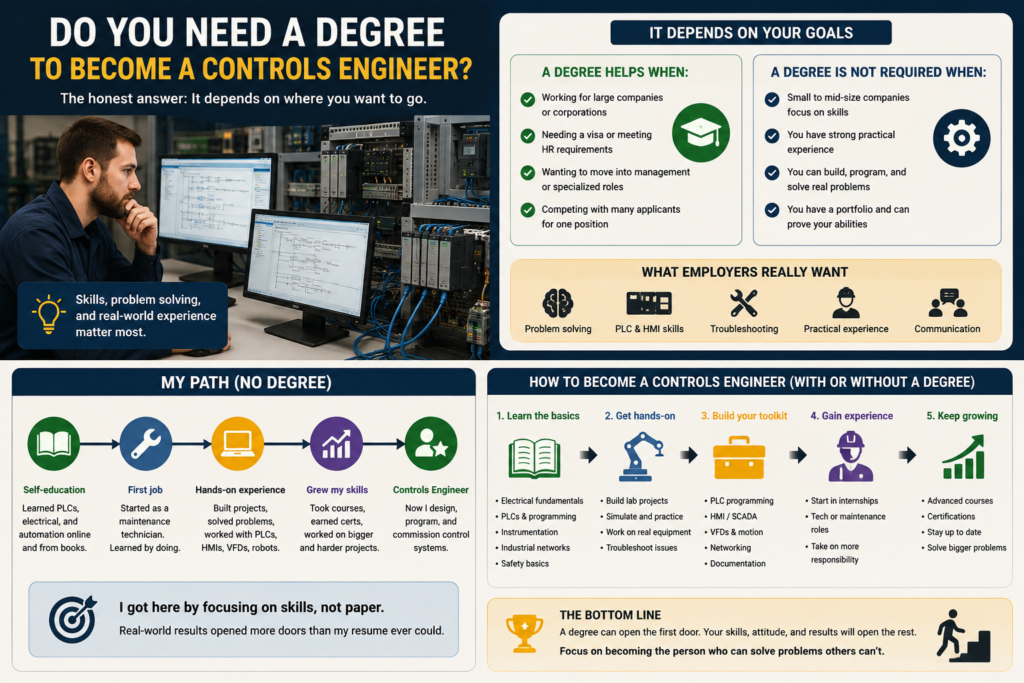
I did not enter industrial automation through the traditional route.
I did not finish university, collect an electrical engineering degree and walk straight into a controls-engineering position. My path started with practical electrical and maintenance work: troubleshooting machines, tracing faults, checking sensors, replacing components and trying to understand why equipment had stopped.
Later, I moved into more engineering-focused work involving electrical control panels, component selection, bills of materials, schematics and automation equipment.
That experience taught me something important:
You do not always need a degree to do controls-engineering work. However, not having one can make the path slower and close some doors.
Both parts of that answer matter.
Telling people that a degree is absolutely required is inaccurate. Plenty of technicians, electricians and maintenance engineers move into PLC programming and controls.
Telling people that qualifications do not matter at all is equally misleading. Some employers will reject an application before anyone reads about your practical experience.
The honest answer depends on the job, the employer, the country and what kind of controls engineer you want to become.
What Does a Controls Engineer Actually Do?
The title varies considerably between companies.
A controls engineer may be responsible for:
- PLC programming
- HMI and SCADA development
- VFD and servo configuration
- Electrical schematic design
- Control-panel specifications
- Industrial network configuration
- Machine commissioning
- Sensor and actuator selection
- Functional testing
- Machine troubleshooting
- Safety-system integration
- Technical documentation
- Customer support
- Production-line improvements
In a large engineering company, these responsibilities may be divided between several people.
One engineer writes PLC code. Another designs the electrical schematics. A commissioning engineer starts the machine at the customer’s site. A safety specialist validates the safety functions.
In a smaller company, one person may do nearly everything.
That is why two jobs with the same title can have completely different educational requirements.
My Route Into Automation
My own route began with industrial maintenance and electrical troubleshooting.
When a machine stopped, the job was not to discuss automation theory for three hours. The job was to find the fault and get production running again.
That meant learning how to check:
- Three-phase supplies
- Circuit breakers and fuses
- Contactors and overload relays
- 24 V DC power supplies
- Proximity and photoelectric sensors
- Solenoid valves
- Motors and VFDs
- PLC inputs and outputs
- Safety relays
- Electrical drawings
- Communication faults
At first, PLCs can look like mysterious boxes controlling everything.
After enough troubleshooting, you begin to see the complete chain:
Physical condition
→ Sensor
→ PLC input
→ Program logic
→ PLC output
→ Contactor, valve or drive
→ Machine movement
That practical understanding is valuable because controls engineering is not only about writing code.
A program can be perfectly logical while the machine still refuses to operate because:
- A sensor is misaligned
- A wire is broken
- An overload has tripped
- A contactor feedback contact is stuck
- A safety circuit is open
- A VFD is waiting for an enable signal
- A pneumatic cylinder cannot reach its limit switch
Maintenance work taught me to look at the complete machine rather than blaming the PLC immediately.
Later, I moved into work involving electrical-panel estimation and design decisions. That required another set of skills:
- Reading technical specifications
- Selecting breakers, contactors and protection devices
- Building bills of materials
- Comparing manufacturers
- Checking short-circuit ratings
- Understanding panel layouts
- Reviewing communication requirements
- Thinking about selectivity and coordination
- Turning a written specification into real components
That work was less about repairing one broken sensor and more about understanding how the complete electrical system should be assembled.
I still would not claim that this path makes a degree irrelevant. It means that industrial experience can develop many of the same practical skills employers expect from a controls engineer.
Can You Become a Controls Engineer Without a Degree?
Yes.
It is most realistic when you enter through a related technical role, such as:
- Industrial electrician
- Maintenance technician
- Automation technician
- PLC technician
- Field-service technician
- Panel builder
- Electrical designer
- Commissioning technician
- Instrumentation technician
These jobs expose you to real equipment.
You learn how machines are wired, how failures appear and how production environments differ from classroom examples.
From there, you can gradually take on more controls work:
Troubleshoot PLC I/O
→ Make small program changes
→ Configure drives
→ Build simple PLC projects
→ Commission machine sections
→ Design complete control sequences
Eventually, you may already be performing controls-engineering work before your official title changes.
Where Not Having a Degree Becomes a Problem
A degree is not always technically necessary, but it can still matter professionally.
1. Getting Through Human Resources
Some job advertisements state:
Bachelor’s degree in electrical engineering,
automation, mechatronics or a related field required
This may be a genuine technical requirement.
Sometimes it is simply an HR filter.
A hiring manager might value ten years of industrial experience, but your application may never reach that manager because the recruitment system rejected anyone without the specified qualification.
Smaller machine builders and system integrators are often more flexible than large international corporations.
A small company may ask:
Can you diagnose the machine and write the PLC program?
A large company may first ask:
Does your education match the requirement in our recruitment system?
Neither approach is automatically wrong. They simply create different entry barriers.
2. Getting Your First Engineering Title
Once someone has several years of successful controls experience, employers can judge real projects.
At the beginning, you have little evidence.
A degree gives employers a recognised signal that you have studied mathematics, electrical principles, control systems and engineering methods.
Without it, you need to replace that signal with something else:
- Relevant employment
- A strong project portfolio
- PLC training
- Electrical qualifications
- Manufacturer certificates
- References
- Commissioning experience
- Demonstrable troubleshooting knowledge
The first controls job is therefore usually the hardest one to obtain without a degree.
3. Moving Into Advanced Engineering Work
Some controls positions involve much more than ordinary ladder logic.
Examples include:
- Advanced motion control
- Robotics
- Process-control modelling
- Functional-safety calculations
- Power-system design
- Complex industrial networking
- Machine vision
- Control-loop tuning
- High-level software integration
- Regulated engineering work
A person can study these subjects independently, but a formal engineering education provides a structured foundation.
There is a difference between making a conveyor start and designing a stable multi-axis motion-control system.
Practical experience remains essential, but advanced theory becomes increasingly valuable as the systems become more complex.
4. Working Abroad
Educational requirements can become more important when applying internationally.
An employer may understand local technical qualifications but have no idea what your previous job title actually involved.
A degree is easier to recognise across borders.
Immigration and work-permit processes may also place weight on formal qualifications, depending on the country and role.
Someone with excellent practical experience can still face paperwork barriers that have little to do with whether they can program a PLC.
5. Reaching Certain Management or Specialist Positions
Some companies require degrees for positions such as:
- Senior controls engineer
- Lead engineer
- Engineering manager
- Project engineer
- Technical authority
- Functional-safety specialist
You may already possess the practical ability but still encounter an internal company policy that links promotion to educational qualifications.
That can be frustrating, but it is better to recognise the limitation early than pretend it never happens.
What a Degree Gives You
A good electrical, automation or mechatronics degree can provide structured knowledge in:
- Circuit theory
- Digital electronics
- Control theory
- Mathematics
- Signals and systems
- Power systems
- Programming
- Industrial communications
- Instrumentation
- Engineering documentation
- Project work
- Safety and standards
It can also provide:
- Access to internships
- University laboratories
- Industry contacts
- Recognised credentials
- A clearer route into graduate engineering roles
The value is not only the certificate.
The value is the foundation and the opportunities surrounding it.
However, earning a degree does not automatically make someone competent at industrial troubleshooting.
A graduate may understand control theory while having no idea why a 24 V sensor shows voltage on a multimeter but cannot drive a PLC input under load.
That is normal. Practical skill comes from practical exposure.
What Experience Gives You
Industrial experience teaches things that are difficult to reproduce in a classroom.
You learn that:
- Drawings are not always updated.
- Cable labels occasionally lie.
- A fault that “must be software” is often a loose wire.
- Operators usually know exactly when the problem began.
- Intermittent faults disappear when the laptop is connected.
- Replacing parts without measuring anything becomes expensive quickly.
- A machine can operate for years with logic nobody fully understands.
- The safest online edit is often no edit at all.
You also learn how production pressure affects engineering decisions.
A theoretically perfect solution may take three weeks. The factory may need a safe temporary repair within two hours and a permanent modification during the weekend shutdown.
That judgement is developed through experience.
The strongest controls engineers usually combine theory with practical understanding rather than treating one as a replacement for the other.
What Skills Matter More Than the Degree?
For many controls positions, employers care greatly about whether you can perform the actual work.
Electrical troubleshooting
You should understand:
- AC and DC circuits
- Relays and contactors
- Motor starters
- Overload protection
- Sensors
- Solenoid valves
- Control transformers
- Power supplies
- Basic motor testing
A controls engineer who cannot follow a circuit drawing is severely limited.
PLC programming
Learn at least one major platform properly.
Common examples include:
- Siemens TIA Portal
- Rockwell Studio 5000
- Mitsubishi GX Works
- Omron Sysmac Studio or CX-Programmer
- Schneider EcoStruxure
- CODESYS
Knowing one platform deeply is usually more useful than installing ten packages and completing one motor rung in each.
Machine sequences
You should be able to design and troubleshoot:
- Start-stop logic
- Permissives
- Interlocks
- Alarms
- Manual and automatic modes
- Step sequences
- Fault recovery
- Reset behaviour
- Restart prevention
The normal operating sequence is only half the job.
You also need to decide what happens when a sensor never activates, a motor fails to start or the operator opens a guard halfway through the cycle.
HMI development
A useful HMI should show:
- Machine status
- Active step
- Interlocks
- Alarm information
- Manual controls
- Setpoints
- Diagnostic information
A screen containing 200 coloured buttons is not automatically good engineering.
Industrial communication
At minimum, understand:
- Ethernet addressing
- Subnets
- PROFINET
- EtherNet/IP
- Modbus TCP
- Modbus RTU
- Device addressing
- Network diagnostics
You do not need to become a network architect immediately, but you should know how to separate a PLC problem from a network problem.
VFDs and motion equipment
Learn how to configure:
- Motor nameplate data
- Start and stop commands
- Speed references
- Acceleration and deceleration
- Fault resets
- Digital and analog I/O
- Fieldbus control
- Basic safe-torque-off interfaces
Servo systems require additional knowledge, but VFDs are a good starting point.
Safety awareness
You do not need to become a functional-safety expert on your first day.
You do need to understand that:
- Emergency stops are not ordinary PLC inputs.
- A standard PLC is not automatically a safety controller.
- Safety circuits must not be bypassed casually.
- Restart behaviour matters.
- Safety modifications require proper verification and validation.
- Production pressure does not cancel electrical hazards.
Knowing the boundary of your competence is part of competence.
How to Compete Without a Degree
Without a degree, you need visible evidence of ability.
Build complete projects
Do not stop after creating basic start-stop logic.
Build simulated projects such as:
- Conveyor with jam detection
- Two-pump alternating controller
- Tank filling and mixing sequence
- Motor control with manual and automatic modes
- Alarm system with reset and fault history
- VFD speed control with analog scaling
- Small HMI with diagnostics
- Multi-step machine sequence with timeouts
For each project, include:
- I/O list
- Sequence description
- Electrical concept
- PLC code
- HMI screens
- Alarm list
- Fault behaviour
- Short demonstration video
A completed project demonstrates far more than a course-completion certificate.
Use your current job as a bridge
The easiest transition is often not:
Unrelated job
→ Controls engineer
It is:
Maintenance or electrical role
→ More PLC responsibility
→ Automation technician
→ Controls engineer
Volunteer for controlled, appropriate tasks such as:
- Uploading and backing up PLC programs
- Updating I/O documentation
- Investigating recurring machine faults
- Configuring replacement drives
- Improving diagnostic alarms
- Testing sensors and actuators
- Assisting during commissioning
- Making small reviewed logic changes
Do not make unapproved production changes merely to gain experience. Learn through legitimate responsibility.
Document what you have done
Keep a private record of projects and problems solved without exposing employer-confidential information.
Record:
- What the machine did
- What symptoms appeared
- How you diagnosed the problem
- What measurements you took
- What the final cause was
- What was changed
- What you learned
This material becomes useful for interviews.
Instead of saying:
I know PLC troubleshooting.
You can explain:
A conveyor stopped intermittently because the PLC input appeared active without a stable field signal. I measured the sensor under load, found voltage dropping through a damaged connection and repaired the wiring before changing the program.
That sounds like experience because it is experience.
Learn to read documentation
Controls engineers spend a lot of time reading:
- Electrical schematics
- PLC manuals
- Drive manuals
- Communication manuals
- Device data sheets
- Standards
- Customer specifications
The ability to find the correct information is often more valuable than memorising hundreds of instruction codes.
Should You Still Get a Degree?
In my situation, I would not say that a degree is pointless simply because I have already entered technical engineering work.
Practical experience has allowed me to progress without starting through the traditional graduate route. It has also shown me where deeper electrical and automation knowledge would be useful.
A degree may still be worth pursuing when it would help you:
- Qualify for positions currently closed to you
- Build stronger theoretical knowledge
- Move into design or leadership roles
- Work internationally
- Access regulated or formal engineering responsibilities
- Reduce dependence on employers who accept experience instead of education
The decision depends on the cost, time commitment and career return.
Do not study for several years merely because you think nobody can touch a PLC without a degree.
Do not reject education merely because one company gave you an engineering title without one.
What I Would Do Starting Again
Starting again without a degree, I would follow this route:
1. Learn industrial electrical fundamentals.
2. Get practical experience around machinery.
3. Learn one PLC platform properly.
4. Practise troubleshooting real I/O.
5. Learn VFDs and industrial communications.
6. Build several complete automation projects.
7. Move into a technician or commissioning role.
8. Take responsibility for small controls modifications.
9. Document real results.
10. Decide whether a degree would unlock the next stage.
I would not spend two years only watching tutorials.
I would also not apply only for jobs titled Controls Engineer.
Useful entry titles include:
- Automation technician
- PLC technician
- Electrical maintenance technician
- Field-service engineer
- Commissioning technician
- Junior automation engineer
- Controls technician
- Panel design technician
The title matters less than whether the job moves you closer to real controls work.
Who Probably Does Need a Degree?
A degree is likely to be especially valuable when you:
- Have no related industrial experience
- Want to enter a large graduate programme
- Want to work in advanced control theory
- Plan to move into complex motion or robotics
- Want maximum international mobility
- Are targeting employers with strict educational filters
- Want formal engineering responsibilities
- Prefer a structured learning route
It is also sensible when you are young enough, financially able and genuinely interested in the subject.
Who May Be Able to Progress Without One?
A non-degree route may be realistic when you already have:
- Electrical or maintenance experience
- Access to industrial machinery
- PLC troubleshooting exposure
- Strong self-learning discipline
- Support from experienced engineers
- Opportunities to take on automation work
- A growing technical portfolio
In that situation, experience can become your entry qualification.
It may not replace a degree everywhere, but it can replace it in enough places to build a career.
Common Misconceptions
“You cannot be an engineer without a degree”
The legal and professional use of the title varies by country and industry.
In everyday industrial employment, many people perform controls-engineering work without holding a traditional engineering degree. Some formal or regulated responsibilities may still require recognised qualifications.
“Experience is always better than education”
Experience can be narrow.
Someone may have worked on the same production line for ten years without learning system design, advanced programming or engineering calculations.
Experience matters when you continue learning from it.
“A degree means you can program PLCs”
Most degrees are broader than PLC programming.
Graduates may still require substantial manufacturer-specific and practical training.
“Online courses are enough”
Courses can provide a starting point.
They do not reproduce production pressure, unsafe fault conditions, poor documentation, damaged cables or commissioning responsibility.
Projects and supervised practical work are necessary.
“Once you get the title, qualifications no longer matter”
Qualifications can still affect promotion, international applications and access to specialist roles.
Final Answer
Do you need a degree to become a controls engineer?
Not always.
I entered industrial automation through practical electrical, maintenance and troubleshooting work rather than through a completed engineering degree. That route allowed me to build real skills with machinery, control panels, PLCs, drives and electrical systems.
But it was not a shortcut.
Without a degree, you need to prove yourself through experience, projects, technical knowledge and results. Some employers will still reject you. Certain advanced, corporate or regulated roles will remain harder to access.
A degree gives you a stronger theoretical foundation and a recognised credential.
Experience teaches you how machines fail in the real world.
The best controls engineers eventually need both kinds of knowledge—even when they obtain them in a different order.
You may not need a degree to begin.
You should never stop learning as though you already have nothing left to prove.