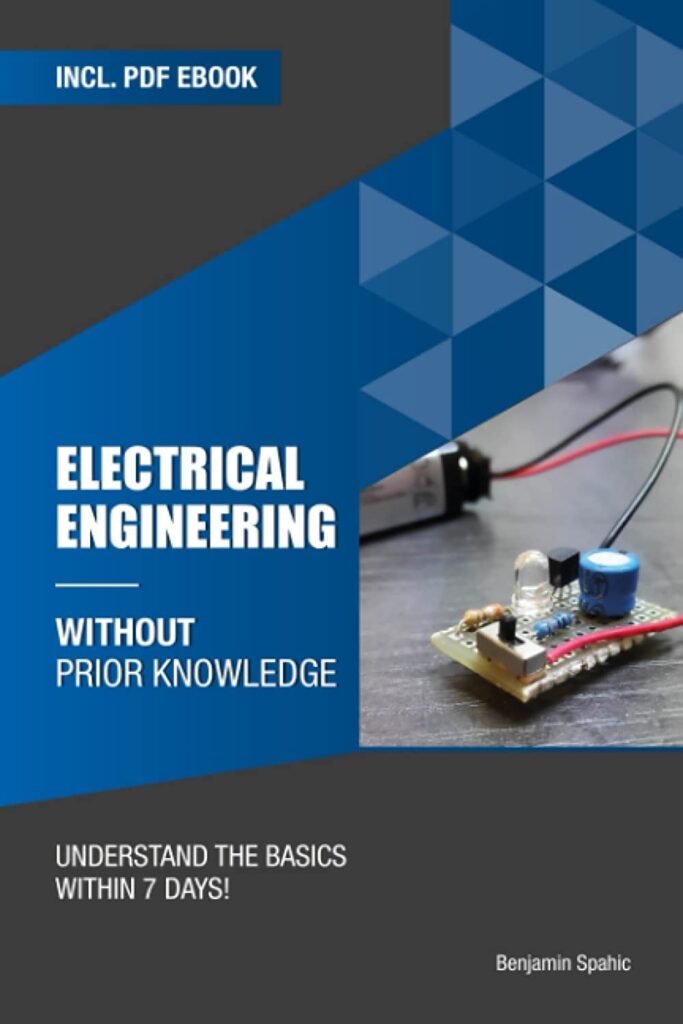
Electrical Engineering Without Prior Knowledge Review: Is It Worth Reading?
REVIEWS
Dovydas Kersys·Electrical & Automation Engineer·
Learning electrical engineering can feel overwhelming at first.
You open a traditional textbook and immediately meet circuit diagrams, formulas, strange symbols and explanations written as though you already completed two years of engineering school.
That is why I decided to read Electrical Engineering Without Prior Knowledge: Understand the Basics Within 7 Days by Benjamin Spahic.
After finishing it, I can say that I recommend it—especially for complete beginners who want a simple introduction before moving on to more technical books.
Affiliate disclosure: This article contains affiliate links. I may earn a commission if you purchase through one of these links, at no additional cost to you. As an Amazon Associate, I earn from qualifying purchases.
The book is designed to introduce the fundamentals of electrical engineering without assuming that the reader already understands advanced mathematics or physics.
According to the Amazon listing, the second edition contains approximately 42% more material than the earlier version and covers both direct-current and alternating-current theory. The paperback is 163 pages long and includes practical examples, exercises, formulas and highlighted memory aids.
Topics covered include:
Electrical current, voltage and power
Basic mathematics and physics
Direct-current circuits
Alternating-current fundamentals
Electrical circuit diagrams
Resistors and capacitors
Practical circuit examples
Everyday applications of electricity
The book is part of Benjamin Spahic’s Become an Engineer Without Prior Knowledge series.
My Experience Reading It
What I liked most was that the book does not immediately bury the reader under complicated theory.
The explanations are short, structured and generally easy to follow. Important formulas are introduced alongside practical examples, which makes the material feel less abstract.
I already had some experience with electrical systems, but I still found the book useful as a refresher. It helped organize several basic concepts that technicians often learn separately while working.
For someone completely new to electricity, it provides a sensible starting point.
You will learn what voltage, current, resistance and power actually mean before being expected to calculate them. The book also introduces circuit diagrams and common components, helping readers understand the basic language used in electrical engineering.
I would not call it a complete electrical-engineering education. No 163-page beginner’s guide can replace a university course, apprenticeship or several years of practical experience.
That is not really its purpose.
Its purpose is to help you understand the basics without making the subject feel impossible—and I think it succeeds.
Is It Really Possible to Learn the Basics in Seven Days?
The title promises that readers can understand the basics within seven days.
That is possible if you treat “the basics” realistically.
You are not going to become a qualified electrician or electrical engineer in one week. You will not be ready to design industrial power systems or safely repair live electrical installations.
You can, however, build a useful foundation.
Reading one section each day could help you understand:
Why current flows
How voltage differs from current
How resistance affects a circuit
How electrical power is calculated
What common electrical components do
How simple circuit diagrams are arranged
The exercises are also important. Reading formulas without using them rarely produces lasting understanding.
Take the time to complete the examples rather than rushing through the book merely to finish it within seven days.
Who Should Read This Book?
I would recommend this book to:
Complete beginners
Apprentice electricians
Automation technicians
Maintenance workers
Hobby electronics enthusiasts
Students considering electrical engineering
People preparing for more advanced electrical courses
It may also be useful for mechanical technicians who regularly work around motors, sensors and control panels but never received formal electrical training.
The book is less suitable for experienced engineers looking for advanced calculations, detailed motor theory, protection coordination or industrial automation programming.
It starts with fundamentals and remains beginner-focused.
What I Liked
The strongest parts of the book are:
Beginner-friendly language
Short and manageable chapters
Practical examples
Clear introduction to formulas
Coverage of both AC and DC concepts
Useful overview of common components
Compact length
The Amazon listing also states that paperback buyers receive the book in PDF format, although availability and redemption details should be confirmed on the current product page before purchasing.
What Could Be Better?
Readers should understand that the book provides an introduction rather than deep technical training.
Some topics are simplified, and advanced readers may find the pace too basic. You will probably need other resources after finishing it, particularly if you want to study:
Three-phase systems
Industrial motors
PLC programming
Electrical protection
Control-panel design
Electronics troubleshooting
National wiring regulations
The book gives you the map.
You will still need to travel much farther.
Final Verdict
I read Electrical Engineering Without Prior Knowledge, and I recommend it as an accessible first book for anyone beginning to study electricity.
It explains important concepts without making the reader feel as though an engineering degree is required before opening the first chapter.
The book is clear, compact and practical enough to build confidence. It will not make you an electrical engineer in seven days, but it can give you a solid understanding of the terms, formulas and components you will encounter in more advanced learning.
For beginners, apprentices and technicians wanting to strengthen their foundations, it is a worthwhile starting point.