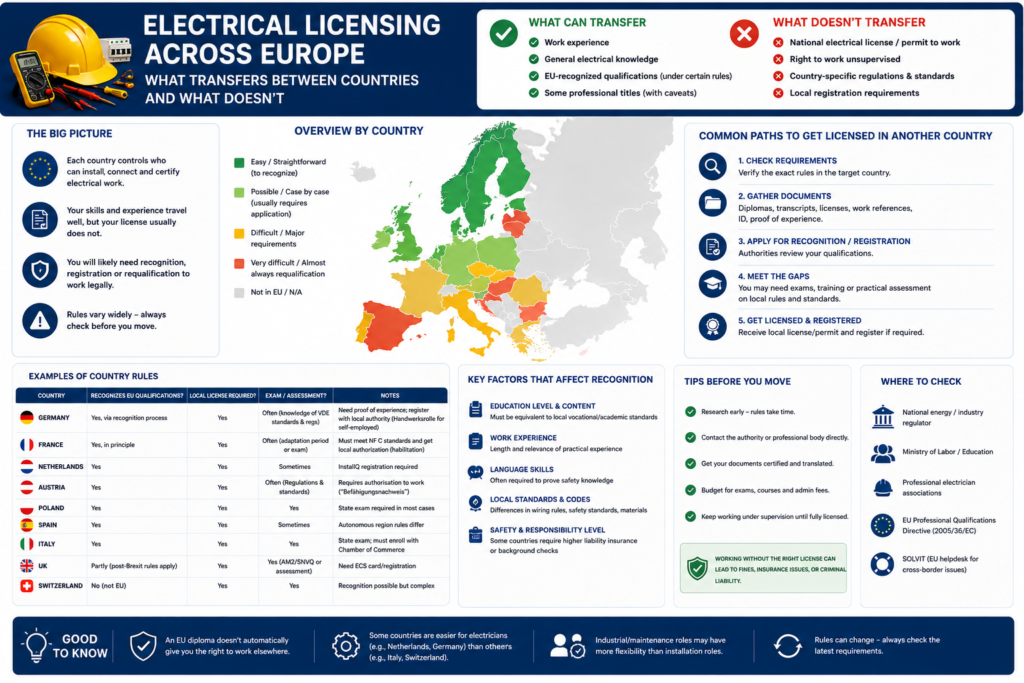
Europe does not have one universal electrician licence.
A qualification earned in Lithuania, Germany, Ireland or another European country may help you obtain work elsewhere, but it does not automatically give you the same legal authority in every country.
The confusion comes from treating several different documents as though they were interchangeable:
- Vocational diploma or apprenticeship certificate
- Professional-qualification recognition
- Personal electrical authorisation
- Employer-issued work authorisation
- Contractor or company registration
- Site-specific safety approval
Each document proves something different.
A qualified electrician may be employable in another country while still being unable to certify an installation, work independently or operate an electrical contracting business there.
The Basic EU Rule
Within the EU, professional qualifications are governed partly by Directive 2005/36/EC.
When a profession is regulated in the destination country, an EU citizen generally has the right to apply for recognition of a qualification obtained in another member state. The destination country compares the applicant’s education, training and professional rights with its own requirements.
That is a right to a recognition procedure, not automatic permission to work.
Automatic recognition applies mainly to seven sectoral professions with harmonised minimum training, including doctors, nurses, dentists, pharmacists, architects and veterinary surgeons. Electricians are not part of that automatic-recognition group.
Electricians also cannot currently use the European Professional Card. The card is available only for nurses responsible for general care, pharmacists, physiotherapists, mountain guides and real-estate agents.
What Usually Transfers
Your original qualification does not become worthless when you cross a border.
The following can normally be submitted as evidence:
- Vocational diploma
- Apprenticeship certificate
- Examination results
- Course syllabus
- Employment references
- Documented practical experience
- Existing licences or authorisations
- Evidence that you are legally permitted to work in your home country
Professional experience matters. Recognition authorities may consider both formal training and skills acquired through employment when comparing your background with the destination country’s requirements.
A recognised qualification can give you the same professional rights as someone holding the equivalent local qualification—but only within the country that issued the recognition decision. Recognition in Germany does not automatically authorise you in Norway, Ireland or Lithuania.
What Usually Does Not Transfer Automatically
The following should generally be treated as national rather than European:
| Qualification or permission | Does it normally transfer automatically? |
|---|---|
| Electrical vocational diploma | No, but it can be assessed |
| National electrician card | Usually not |
| Right to certify an installation | No |
| Contractor registration | No |
| Right to run an electrical business | No |
| Employer-issued electrical authorisation | No |
| High-voltage switching authority | No |
| Site safety authorisation | No |
| Manufacturer training | Recognised as training, not legal licensing |
A Siemens, Schneider or Rockwell certificate may help with employment, but it does not give legal authority to sign an electrical completion certificate.
Similarly, experience maintaining industrial machines does not automatically qualify someone to accept responsibility for building installations.
Regulated and Non-Regulated Work
The first question is not:
Is an electrician regulated in Europe?
The correct question is:
Is the exact activity I want to perform regulated in the destination country?
One country may regulate independent electrical contracting but not employed industrial-maintenance work. Another may regulate particular electrical professions, voltage levels or responsible-person roles.
Use the EU Regulated Professions Database and the destination country’s national contact point to identify the correct profession and competent authority. The database exists because occupational requirements differ significantly between member states.
When a profession is not regulated, formal recognition may not be legally required. The employer can still request qualification equivalence, local training or evidence of competence.
Country Examples
Germany
Germany illustrates why the exact job matters.
The official Recognition Finder lists industrial electrician as a non-regulated occupation. A person can therefore apply for jobs in that occupation without first obtaining mandatory professional recognition, although voluntary recognition may make the qualification easier for employers to understand.
However, different rules may apply when someone wants to become self-employed, use a protected engineering title or operate a business in a craft subject to authorisation. Certain master-craft roles require recognition before the individual can run the corresponding business.
This creates an important distinction:
Being allowed to work as an employed electrical technician is not necessarily the same as being allowed to operate an electrical contracting company.
Ireland
In Ireland, electrical contractors working within the controlled electrical-safety system must deal with Safe Electric.
A person holding qualifications from outside the Republic of Ireland must first have those qualifications recognised before applying to join the Safe Electric scheme as a Registered Electrical Contractor.
Registration also carries responsibilities beyond personal technical skill. Registered contractors must satisfy scheme requirements and issue completion certificates for relevant work. A foreign vocational diploma alone does not automatically provide that authority.
A foreign-trained electrician might therefore work for an Irish employer before being personally eligible to operate as a registered contractor, depending on the role and supervision arrangements.
Norway
Norway is in the European Economic Area but maintains a formal national approval system for electrical professionals.
People educated and trained abroad must apply to the Norwegian Directorate for Civil Protection for approval before practising the relevant regulated electrical profession. Applicants can seek permanent recognition or approval for temporary services. Temporary approval is issued for a maximum of 12 months.
Norway also separates personal approval from company registration. Businesses legally carrying out electrical-installation work must be entered in the Register of Electrical Enterprises.
This demonstrates the two-layer system found in several countries:
- The person must possess suitable competence.
- The company performing or accepting responsibility for the work may also require registration.
Lithuania
Lithuania has its own system for certifying employees who construct or operate energy installations.
The national framework defines categories of energy employees, qualification requirements, permitted activities and certification procedures. Certification is managed through authorised certification bodies and the VERT-operated EDAIS system.
A certificate issued by an approved certification body is valid across Lithuania. A certificate issued internally by an energy company authorises the employee only to perform the stated work under an employment contract with that company.
That Lithuanian certificate should therefore not be treated as a Europe-wide electrical licence. It is strong evidence of competence, but another country may still require its own recognition or authorisation procedure.
United Kingdom
The UK is no longer part of the EU professional-qualification recognition system.
Where a profession is regulated in the UK, someone with an EEA or Swiss qualification must apply to the appropriate UK regulator for recognition. The requirement can also apply to temporary or occasional services. Qualifications recognised in the UK before 1 January 2021 generally remain recognised under the protected arrangements.
The exact route depends on the occupation and on whether the work is performed in England, Scotland, Wales or Northern Ireland.
Permanent Work vs Temporary Projects
The process may differ depending on whether you are:
- Moving permanently
- Taking a six-month employment contract
- Travelling for one commissioning project
- Providing services through your own company
- Working under a locally registered contractor
EU rules allow countries to distinguish between permanent establishment and temporary or occasional service provision. A temporary worker may need to submit a declaration, evidence of insurance or qualification documents before beginning work. Safety-related professions may also face a prior qualification check.
Do not assume that a short commissioning trip avoids all local requirements.
Connecting a laptop to a PLC is different from modifying a mains installation, performing high-voltage switching or signing the completed electrical work.
What Happens When Qualifications Do Not Match?
The competent authority may find substantial differences between your training and the local qualification.
Depending on the profession and recognition system, it may require:
- An aptitude test
- An adaptation period under supervision
- Additional training
- Evidence of further professional experience
- Local regulatory or safety examinations
EU legislation provides for adaptation periods and aptitude tests as compensatory measures where significant qualification differences exist. Relevant professional experience must be considered before those measures are imposed.
This does not mean your original qualification has been rejected completely. It means specific gaps must be addressed.
A Practical Moving Checklist
Before accepting electrical work in another European country:
- Define the exact activity—not merely the title “electrician.”
- Check whether that activity is regulated.
- Identify the national competent authority.
- Ask whether the role is temporary or permanent.
- Confirm whether personal recognition is required.
- Check whether the employer or contracting company must be registered.
- Prepare diplomas, course transcripts and employment references.
- Arrange certified translations where requested.
- Confirm who may certify or sign off the work.
- Obtain local safety, regulatory and site training.
Do this before booking travel or promising the customer that your current authorisation will be accepted.
Final Verdict
Electrical qualifications do transfer across Europe as evidence of training and competence.
They do not usually transfer as automatic legal authority.
The safest way to think about it is:
Your diploma travels with you.
Your right to perform or certify specific work may not.
For industrial maintenance and automation roles, employers may accept foreign experience relatively easily, particularly when the work is performed within a company’s supervision structure.
Independent installation work, contractor registration, high-voltage responsibility and the right to issue compliance certificates are much more likely to require national recognition or authorisation.
Europe makes professional mobility possible.
It does not turn 30 different national electrical systems into one licence.