No chapter in this book matters more than this one. Industrial voltages and available fault currents are unforgiving, and the difference between a routine day and a fatality is often a single skipped step. This chapter is not a substitute for your site’s formal safety training and the applicable standards, but it lays out the principles that keep troubleshooters alive.
Shock and arc flash
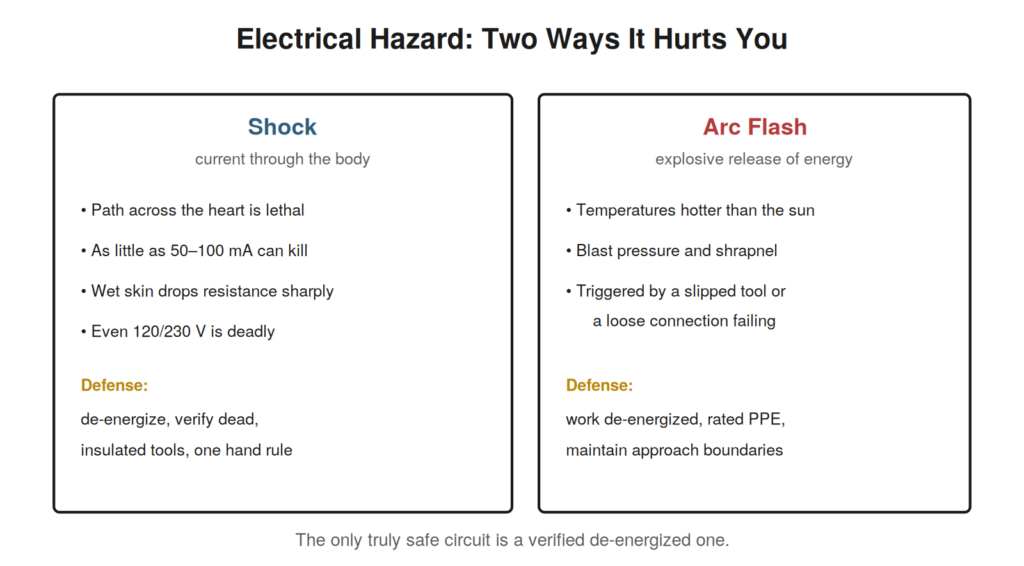
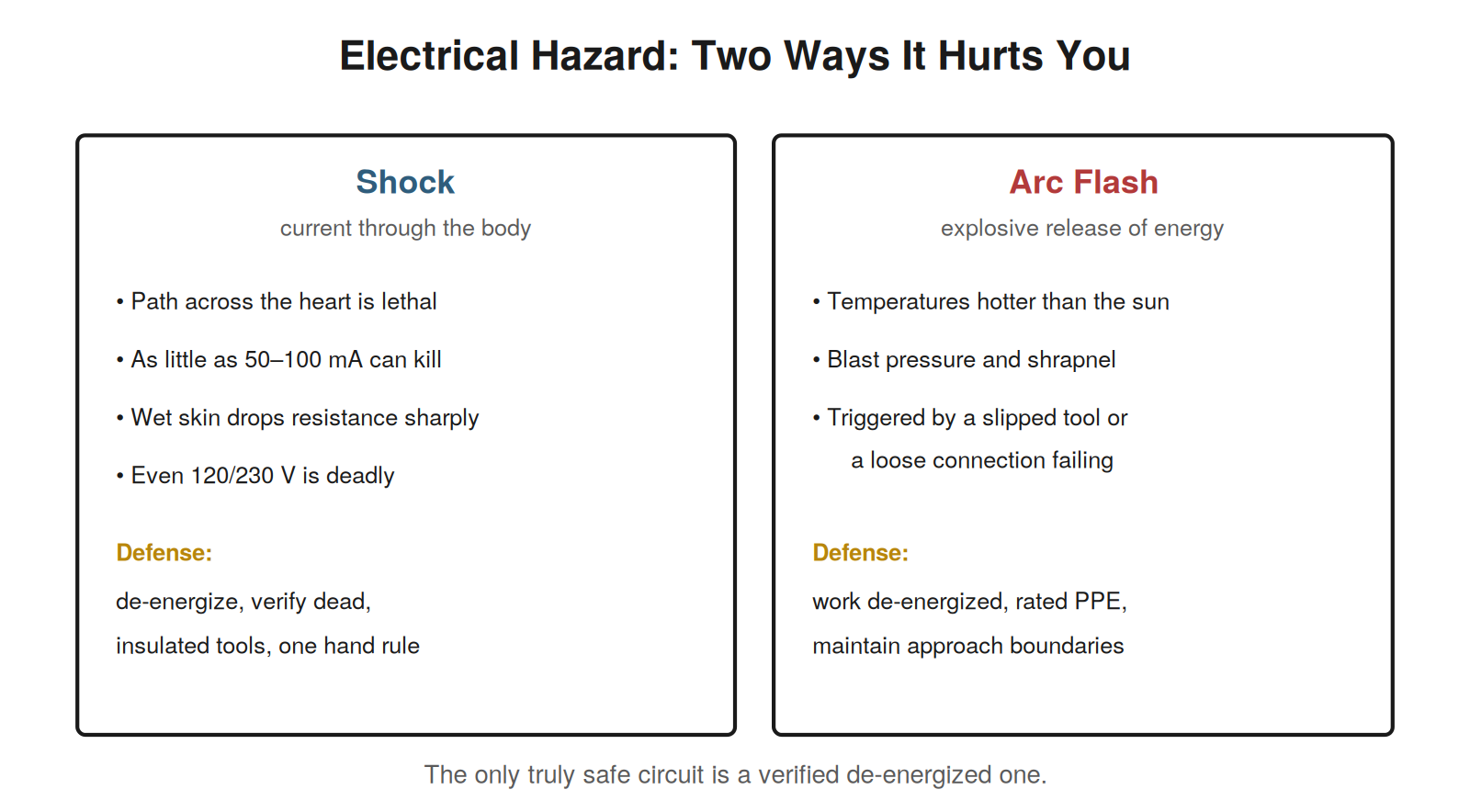
Electric shock is current passing through the body. It takes surprisingly little — on the order of tens of milliamps across the heart — to be fatal, and the danger rises sharply when skin is wet or contact is firm. Standard industrial voltages of 120, 230, 400, or 480 volts are all fully capable of killing. Arc flash is a different hazard: a fault that ionizes the air into a conductive plasma, releasing an explosive burst of heat, light, pressure, and molten metal. An arc flash can be triggered by something as small as a dropped tool bridging two conductors or a loose connection finally failing under load. Its temperatures exceed those at the surface of the sun, and its blast can throw a worker across a room.
Both hazards share one overwhelming defense: work on de-energized equipment whenever possible. The overwhelming majority of electrical injuries happen during live work that could have been done dead. When live work is genuinely unavoidable — because a fault only appears under power, for instance — it must be done with properly rated personal protective equipment, insulated tools, and a clear understanding of the approach boundaries and available fault energy, following your site’s energized-work permit process.
Lockout/Tagout: isolating energy
Lockout/tagout (LOTO) is the formal process of isolating and securing every energy source before work begins, so that equipment cannot be re-energized while someone is exposed to it. It applies not only to electrical energy but to every hazardous energy source: stored energy in capacitors and springs, pneumatic and hydraulic pressure, and gravity acting on raised loads. The sequence is consistent across sites even where the details differ.
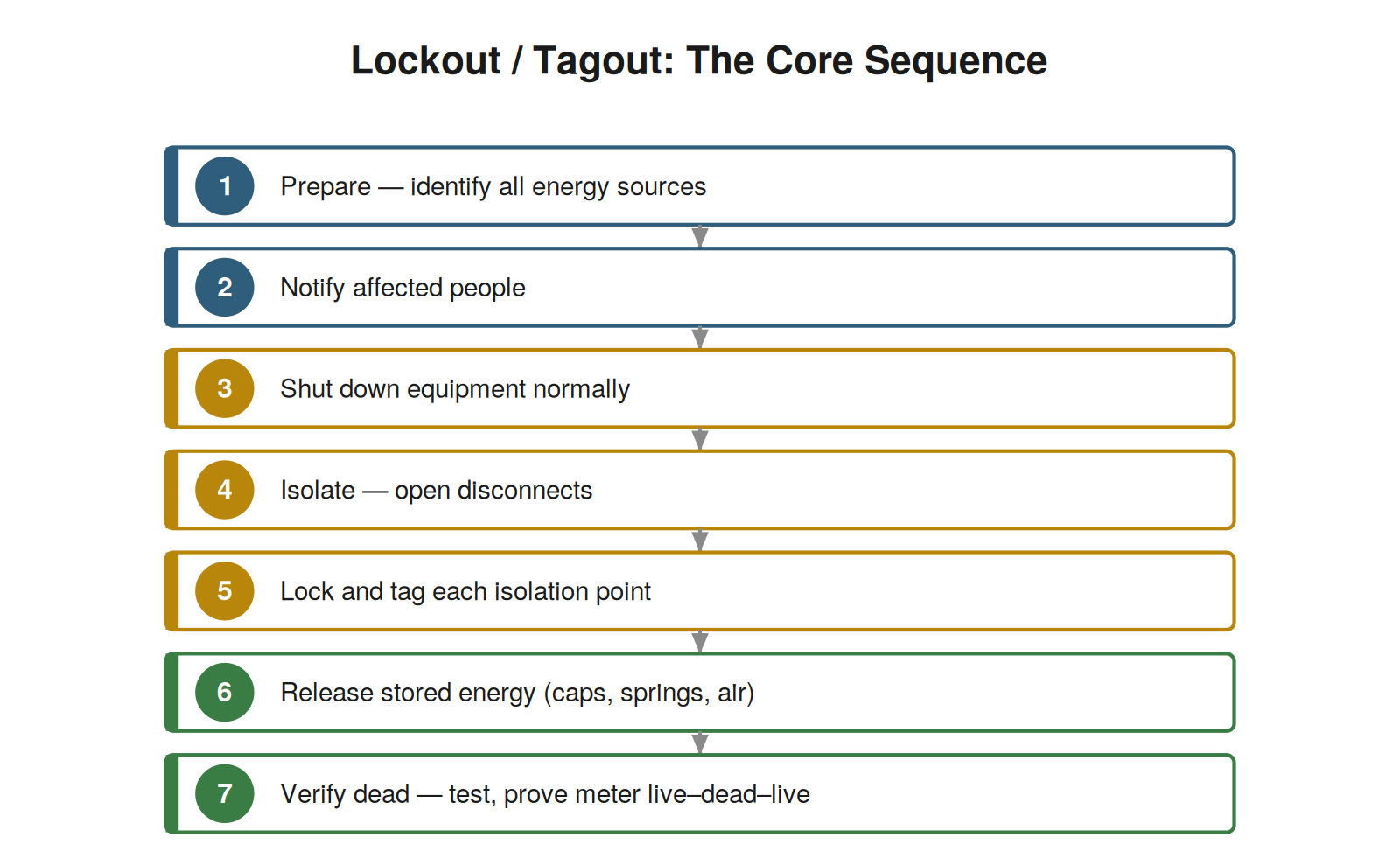
Prepare: identify every energy source feeding the equipment, including secondary and stored energy.
Notify everyone affected that the equipment is being locked out.
Shut the equipment down using its normal stop procedure.
Isolate every energy source — open the disconnects, close the valves, block the loads.
Lock and tag each isolation point with your own lock, so only you can remove it.
Release or restrain stored energy: discharge capacitors, bleed pressure, secure springs and raised loads.
Verify dead: test the circuit with a meter, and prove that meter on a known live source before and after the test.
LIVE–DEAD–LIVEVerifying dead is worthless if your meter is faulty. Prove the meter reads correctly on a known live source, test your isolated circuit and confirm it reads zero, then prove the meter again on the known live source. Only then is ‘dead’ trustworthy. |
The discipline that keeps you alive
Safety failures are rarely failures of knowledge; they are failures of discipline under pressure. The line is down, people are waiting, and the temptation to skip the lockout ‘just this once’ or to probe a live panel without the right gear is real and constant. The professional resists it every time, because the one time the shortcut goes wrong is the time that ends a career or a life. If you would not want your decision read aloud at an incident review, do not make it. Slowing down for a proper isolation has saved more workers than every interlock ever built.
A case file: the shortcut that nearly killed
A technician needs to check a contactor in a motor control center. The line is down, production is waiting, and rather than lock out the whole bucket he decides to ‘just have a quick look’ with the power on, reaching past energized bus to the contactor. His screwdriver slips and bridges two phases. The resulting arc flash burns his hand and forearm and destroys the bucket; only the fact that he had turned his face away by habit saves his eyes. Everything about this incident was preventable by the lockout that felt too slow in the moment. The thirty seconds saved by skipping isolation nearly cost a career and could have cost a life. This is the reality behind every safety rule in this book: the shortcuts feel efficient right up until the one time they go wrong, and electrical energy gives no second warning.
Arc flash is about energy, not just voltage
It is tempting to judge danger by voltage alone, but arc flash severity depends heavily on the available fault current and how long the fault lasts, not just the voltage. A location fed by a large transformer with a lot of available fault current can produce a devastating arc flash even at relatively modest voltage, because the energy released depends on how much current can flow into the fault. This is why arc-flash hazard analysis considers the available fault energy at each location, and why approach boundaries and PPE requirements are specific to the equipment rather than uniform. For the troubleshooter, the practical lesson is that you cannot judge arc-flash danger by voltage alone; a 480-volt motor control center fed from a large service can be more dangerous than a higher-voltage circuit with limited fault current, and the equipment’s own hazard labeling, where present, is the guide.
The one-hand habit and other live-work discipline
When live measurement is genuinely unavoidable, certain habits reduce the risk. Keeping one hand out of the work — the ‘one-hand rule’ — avoids creating a current path across the chest through both arms and the heart. Using meter leads with proper finger guards and minimal exposed tip reduces the chance of bridging. Standing on a dry, insulated surface and being aware of what is behind and around you matters. Working with a second person present who knows how to cut power and render aid turns a potential fatality into a survivable incident. And treating every conductor as live until proven dead, even ones you believe are isolated, is the habit that catches the isolation that was not as complete as assumed. None of these replace working de-energized; they are the disciplines for the times when, despite every effort, the fault can only be found alive.
Stored energy: the hazard after the power is off
Turning off and locking out the electrical supply is necessary but not always sufficient, because energy can remain stored in the equipment after the source is isolated. Capacitors — in power-factor correction, in drives, in power supplies — can hold a dangerous charge for some time after power is removed, and a drive’s DC bus in particular can remain at a lethal voltage well after the input is isolated. Springs can hold mechanical energy, raised loads hold gravitational energy, and pneumatic and hydraulic systems hold pressure. A proper lockout accounts for all of these: discharging capacitors and drive buses through the proper means and confirming they are discharged, restraining or releasing springs, lowering or blocking raised loads, and bleeding pressure. The technician who locks out the electrical supply and immediately reaches into a drive can still be injured by the charge stored in its DC bus, which is why verifying dead means verifying the actual points to be worked on are dead, including stored-energy elements, not merely that the upstream supply is isolated.
The value of a second person
Much electrical safety practice comes down to a simple principle: do not work alone on hazardous energy. A second person present who knows how to isolate power and render aid transforms the consequences of an accident, turning a potential fatality into a survivable incident, because many electrical injuries become deaths only through the delay in cutting power and getting help. Beyond emergencies, a second person provides a check on the work itself — a second view on whether the isolation is complete, whether a step was missed, whether a decision is sound. The pressure to work alone to save time is real, especially for a task that seems minor, but hazardous energy does not distinguish minor tasks from major ones, and the presence of another trained person is among the most effective safety measures available. When the work involves real electrical hazard, arranging for a second person is not excessive caution; it is basic professional practice that has saved many lives.
When live work is genuinely necessary
Some faults reveal themselves only under power — a voltage that is present but wrong, a signal that appears only while running, an intermittent fault that vanishes when the equipment stops — and for these, some measurement on energized equipment may be genuinely necessary. The professional approach to unavoidable live work is not to treat it casually but to manage it deliberately, following the site’s energized-work permit process and its requirements. This means using properly rated PPE for the available fault energy at that location, insulated tools, and safe technique such as the one-hand habit; it means understanding the approach boundaries and the arc-flash hazard of the specific equipment; it means never working live alone; and it means limiting the live work strictly to the measurement that genuinely requires power, de-energizing again for anything else. The distinction that matters is between live work that is genuinely necessary, done with full precautions, and live work chosen for convenience because de-energizing felt slow. The first is a managed professional necessity; the second is the shortcut that fills incident reports. When you must work live, do it with every precaution the hazard demands, and no more live than the fault truly requires.
The culture of stopping
Beyond any specific procedure, the deepest safety practice is a culture in which stopping is always acceptable — where any worker can halt a job over a safety concern without penalty, and where taking the time to isolate properly is respected rather than seen as slow. Most serious electrical incidents trace not to ignorance of the rules but to pressure overriding them: the line is down, people are waiting, and the shortcut that skips the lockout or reaches into the live panel feels justified by the urgency. A safety culture counters this by making clear, in practice and not just in policy, that no production target justifies an injury, that the worker who stops to isolate properly is doing their job correctly, and that raising a safety concern is welcomed rather than punished. For the individual troubleshooter, internalizing this culture means giving yourself permission to stop — to take the time for the proper isolation, to get a second person, to refuse the unsafe shortcut — even when the pressure pushes the other way, and it means extending that permission to others. The one time a shortcut goes wrong is the time that ends a career or a life, and a culture in which stopping is always acceptable is what makes it possible to resist the shortcut every time, which is what safety ultimately requires: not resisting it usually, but every time, because electrical energy punishes the single exception.
Approach boundaries and why distance matters
Working safely around energized equipment involves not only what you touch but how close you get, because both shock and arc-flash hazards extend into the space around live parts. For shock, there is a distance within which approaching an exposed live part is hazardous, and closer distances that only qualified people using proper protection may enter. For arc flash, there is a boundary within which the energy released by an arc could cause a serious burn, and entering it requires appropriate protection rated for the energy at that location. These approach boundaries formalize a simple truth: proximity to energized parts is itself a hazard, independent of deliberate contact, because an arc can reach out and a slip can bridge a gap. The practical discipline is to be aware of what is energized around you and to maintain safe distance from it, treating the space near live parts as hazardous rather than only the parts themselves. This awareness matters especially during troubleshooting, when attention is absorbed by the fault and it is easy to forget the energized bus behind you or the live terminals beside the one you are working on. Respecting approach boundaries — keeping clear of energized parts you are not deliberately and safely working on — is part of the spatial awareness that keeps a troubleshooter safe in a live environment, and it complements the primary discipline of working de-energized whenever the work allows.
A structured summary of safe work
The safety material assembles into a structure a troubleshooter can hold as a constant discipline. The foundational rule is to work de-energized whenever possible, because the overwhelming majority of electrical injuries occur during live work that could have been done dead, and the only truly safe circuit is one verified de-energized. The isolation of energy follows the lockout/tagout sequence: identify every energy source, notify those affected, shut down normally, isolate every source, lock and tag each isolation point, release or restrain stored energy, and verify dead. Verification uses the live–dead–live method, proving the meter on a known live source before and after testing the isolated circuit, because a faulty meter reading zero on a live circuit invites a fatal mistake. Stored energy — in capacitors, drive DC buses, springs, raised loads, and pressure — must be accounted for, because isolating the supply does not discharge what the equipment holds. When live work is genuinely unavoidable, it is managed deliberately with rated PPE, insulated tools, safe technique, awareness of approach boundaries and arc-flash energy, and never worked alone. And underlying all of it is the discipline to resist the shortcut under pressure every time, supported by a culture in which stopping to work safely is always acceptable. This structure — de-energize by default, isolate through the full sequence, verify with live–dead–live, account for stored energy, manage unavoidable live work with full precautions, and hold the discipline every time — is the framework within which all the troubleshooting in this book takes place, because no fault is worth an injury and the methods that find faults are built to be used safely.