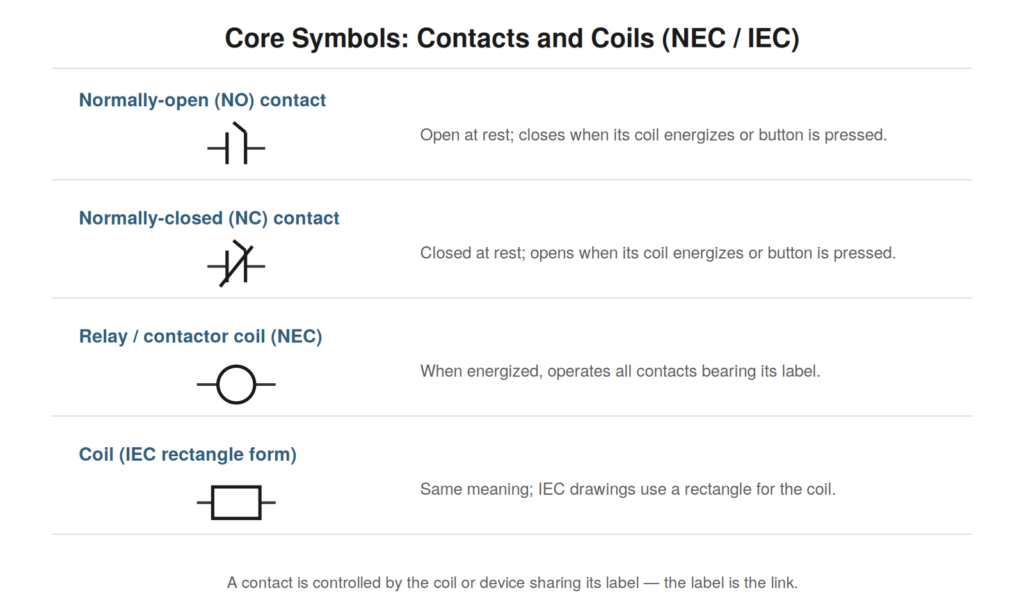
Every schematic is written in a language whose words are symbols. Just as you cannot read a sentence without knowing what the words mean, you cannot read a schematic without knowing what its symbols represent. Fortunately the vocabulary is finite and highly standardized, and a few dozen core symbols cover the overwhelming majority of what you will meet. This chapter introduces how symbols work; the next part of the book covers the specific symbols in detail.
Symbols encode function
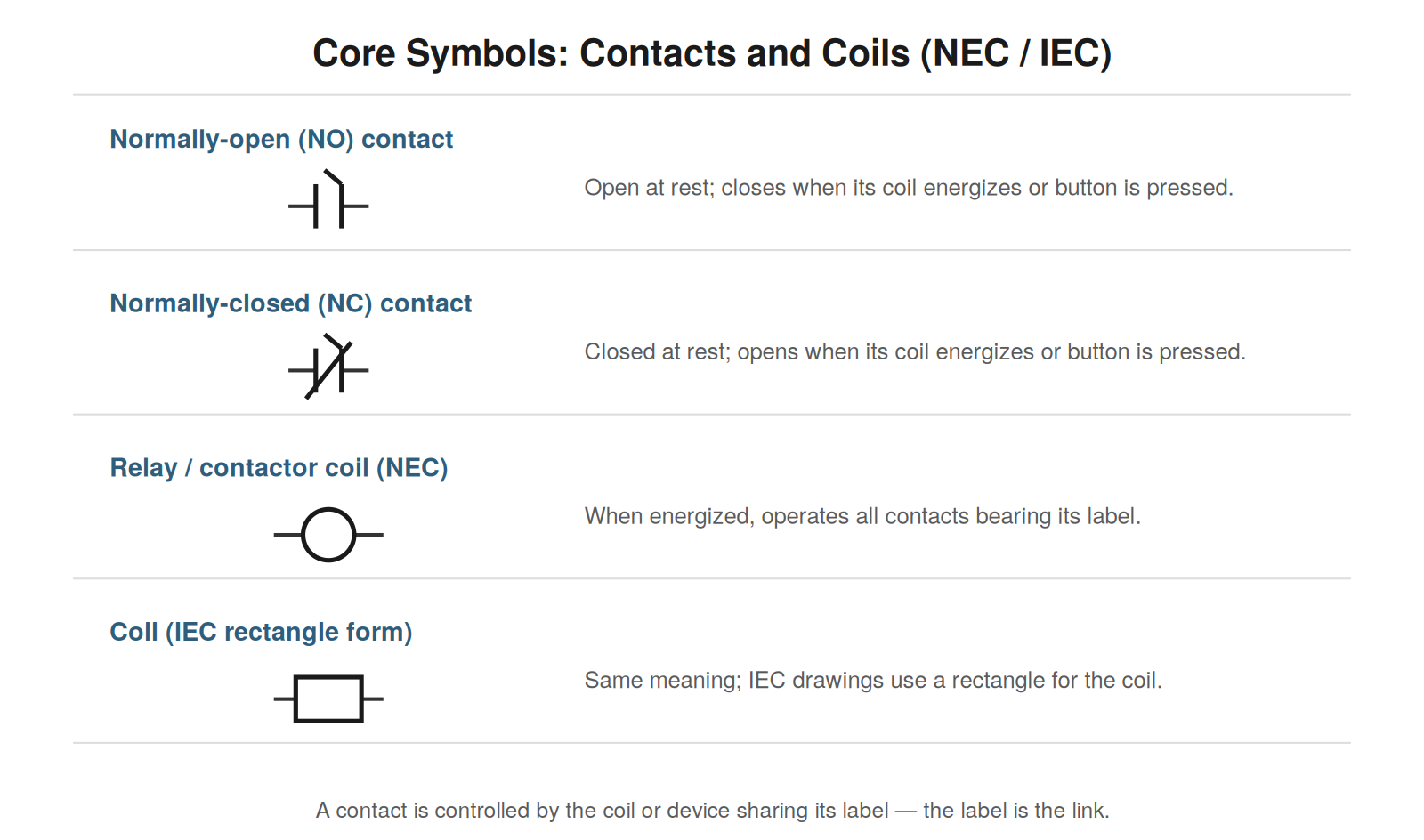
Each symbol represents a component by its electrical function, drawn in a standardized way so that anyone who knows the language recognizes it instantly. A contact is drawn as a pair of terminals that either touch or do not; a coil as a circle or rectangle; a fuse as a small rectangle; a motor as a circle with an ‘M’. The symbol does not attempt to depict the physical device — it captures what the device does in the circuit. Once you learn to see symbols as function rather than as abstract marks, the drawing begins to speak: this is a switch, this is a coil that operates when energized, this is a load that does work. The symbols are the words, and learning them is learning to read.
NEC and IEC conventions
Two families of symbol conventions dominate industrial drawings. North American practice, tied to the National Electrical Code (NEC) region, grew up around ladder logic and uses one set of symbol styles. International practice, following the IEC standards used across Europe and much of the world, uses somewhat different styles — most visibly, IEC drawings often use rectangles for coils and components where NEC drawings use circles and zigzags. The good news is that the two conventions express the same underlying meaning: a contact is a contact, a coil is a coil, whichever style draws it. This book shows both forms side by side where they differ, and once you understand the meaning, reading either convention is a matter of recognizing its particular way of drawing the same ideas. A technician who knows both is at home with any drawing the modern plant contains.
THE LEGEND IS THE AUTHORITYSymbol conventions vary not only between NEC and IEC but between companies, industries, and eras. Every good drawing set includes a legend or symbol sheet defining the symbols it uses, and that legend is the final authority for that drawing. Use this book to learn the common vocabulary, but always check the drawing’s own legend for its specific conventions. |
Reading a symbol in context
A symbol’s full meaning often depends on its label and its context as much as its shape. A contact drawn as normally-open tells you its resting state, but its label tells you what controls it — which coil or device operates it — and that label is the thread connecting it to the rest of the drawing. Two contacts drawn identically may behave completely differently because they bear different labels and are therefore operated by different things. Reading a schematic well means reading not just the shape of each symbol but its label and its place in the circuit, because the shape gives the type of component and the label and context give its specific role. This combination of standardized shape and specific label is how a finite vocabulary of symbols expresses the endless variety of real circuits.
Why standardization matters
The great value of symbol standardization is that a drawing made by one person, in one company, for one machine, can be read by another person entirely — because both share the same vocabulary of symbols. A normally-open contact means the same thing on a drawing from one manufacturer as on a drawing from another, so the skill of reading, once learned, transfers across drawings, machines, and industries. This is why learning the standard symbols is such a good investment: you are not learning to read one machine’s drawing but to read the shared language in which industrial drawings are written. The standardization is not perfect — conventions vary between NEC and IEC, between companies, between eras — but it is strong enough that a technician fluent in the common symbols can pick up an unfamiliar drawing and read it, which is exactly the portable, durable skill this book aims to build.
Learning symbols by function, not memorization
The best way to learn symbols is not rote memorization but understanding the function each represents, because a symbol understood by its function is remembered naturally and recognized even in unfamiliar variations. A contact is drawn to suggest two terminals that touch or separate; once you see it as ‘a switch that opens or closes,’ the symbol makes sense and sticks. A coil is drawn as a simple enclosed shape because it represents an electromagnet that operates when energized; understanding that function makes the symbol meaningful. When you learn symbols by the function they represent rather than as arbitrary marks to memorize, you not only remember them better but can often interpret a symbol you have not seen before by reasoning from its appearance to its likely function, and you read fluently because each symbol carries meaning rather than requiring a mental lookup. This function-first approach is how the symbols in this book are taught, and it is the approach that builds lasting fluency.
Reading exercise: identifying symbols in context
A good exercise for building symbol fluency is to take any drawing and, before reading the circuit, simply identify every symbol on it — naming each by function. This contact is normally-open, this one normally-closed, this is a coil, this a fuse, this a motor, this a lamp. Doing this deliberately, until every symbol on the sheet is named, builds the recognition that makes later circuit-reading fluent, because you cannot read the logic while still puzzling over what each symbol is. With practice, the identification becomes instant and unconscious, and you read symbols the way you read letters — without effort, seeing straight through to meaning. Beginners benefit from doing this identification explicitly; experienced readers do it automatically. The exercise also surfaces any unfamiliar symbols, prompting a check of the legend, so that you never read a circuit while uncertain about one of its symbols. Symbol identification is the foundational layer of reading, and practicing it directly, on real drawings, is the fastest way to make it automatic.
Handling unfamiliar or nonstandard symbols
Sooner or later every reader meets a symbol they do not recognize, and knowing how to handle it is part of the skill. The first and best resource is the drawing’s own legend, which should define every symbol the drawing uses — so an unfamiliar symbol prompts a check of the legend, where its meaning is given. If the legend does not clarify it, reasoning from the symbol’s appearance and context often suggests its function: a symbol in the power path near the motor is likely power-related, one in a control rung likely a contact or coil of some kind. Comparing it to familiar symbols it resembles can help, as can noting its label, which may indicate the device type. The key is not to guess silently and read on with a misunderstanding, but to resolve the unfamiliar symbol — via the legend, reasoning, or asking — before relying on it. Nonstandard and unfamiliar symbols are a normal part of real drawings, and handling them by consulting the legend and reasoning from context, rather than guessing or ignoring, is what keeps your reading accurate when the vocabulary extends beyond the common core.
Building a personal symbol reference
A practical aid to symbol fluency, especially early on, is building your own symbol reference — a personal chart of the symbols you encounter, with their meanings in your own words. While standard references and the drawings’ legends exist, compiling your own reinforces learning through the act of building it, and produces a chart tailored to the symbols you actually meet in your work. As you encounter each symbol, adding it to your reference with its meaning cements it in memory and gives you a quick lookup for the future. Over time the reference grows to cover the symbols relevant to your equipment, becoming a personalized tool more useful to you than a generic chart. The exercise of building it — actively noting each symbol and articulating its meaning — is itself valuable learning, more effective than passively consulting a reference someone else made. Whether kept on paper or in your head, this personal accumulation of symbols and their meanings is how your working vocabulary grows, and deliberately building it accelerates the growth. The symbols you compile yourself are the ones you remember, because compiling them is a form of active learning that passive reading cannot match.
Case: a symbol misread and the consequence
A cautionary case shows the cost of misreading a symbol. A technician troubleshooting a circuit misread a normally-closed contact as normally-open, inverting their understanding of that part of the logic. Reasoning from the wrong reading, they expected the contact to be open when it should be closed, concluded the circuit was behaving wrongly when it was actually behaving correctly, and spent considerable time chasing a fault that did not exist — all from misreading one symbol’s type. When the error was caught and the contact read correctly as normally-closed, the logic made sense and the actual fault (elsewhere) was found quickly. The lesson is the importance of reading each symbol correctly, especially the resting state of contacts, because a single misread symbol propagates into a wrong understanding of the logic and a misdirected search. This is why the book emphasizes reading contact types carefully: the difference between normally-open and normally-closed is one small mark, but misreading it inverts the logic and can send you chasing phantoms. Careful, correct symbol reading is the foundation, and this case shows what happens when it fails — wasted effort chasing a fault conjured by a misreading rather than found in the circuit.
The pitfall of assuming instead of checking
A pitfall that trips even experienced readers is assuming a symbol’s meaning instead of checking it — reading a symbol as what you expect rather than confirming what it is. Familiarity breeds assumption: you have seen this symbol many times, so you read it quickly as its usual meaning, occasionally missing that this instance is different — a different contact type, a nonstandard symbol, a label that changes its role. The antidote is to check rather than assume, especially the details that matter: the resting state of contacts, the labels that determine roles, unfamiliar symbols against the legend. This does not mean reading slowly and laboriously forever — fluency does make reading fast — but it means keeping the habit of confirming the details that, if assumed wrong, invert the logic. The best readers combine speed with accuracy by reading fluently but checking the critical details, never assuming a contact’s resting state or a symbol’s meaning where getting it wrong would mislead. Assuming instead of checking is a subtle pitfall because it comes from the very familiarity that makes reading fast, and guarding against it — confirming the critical details even when you think you know — is what keeps fluent reading accurate rather than fast but occasionally wrong.