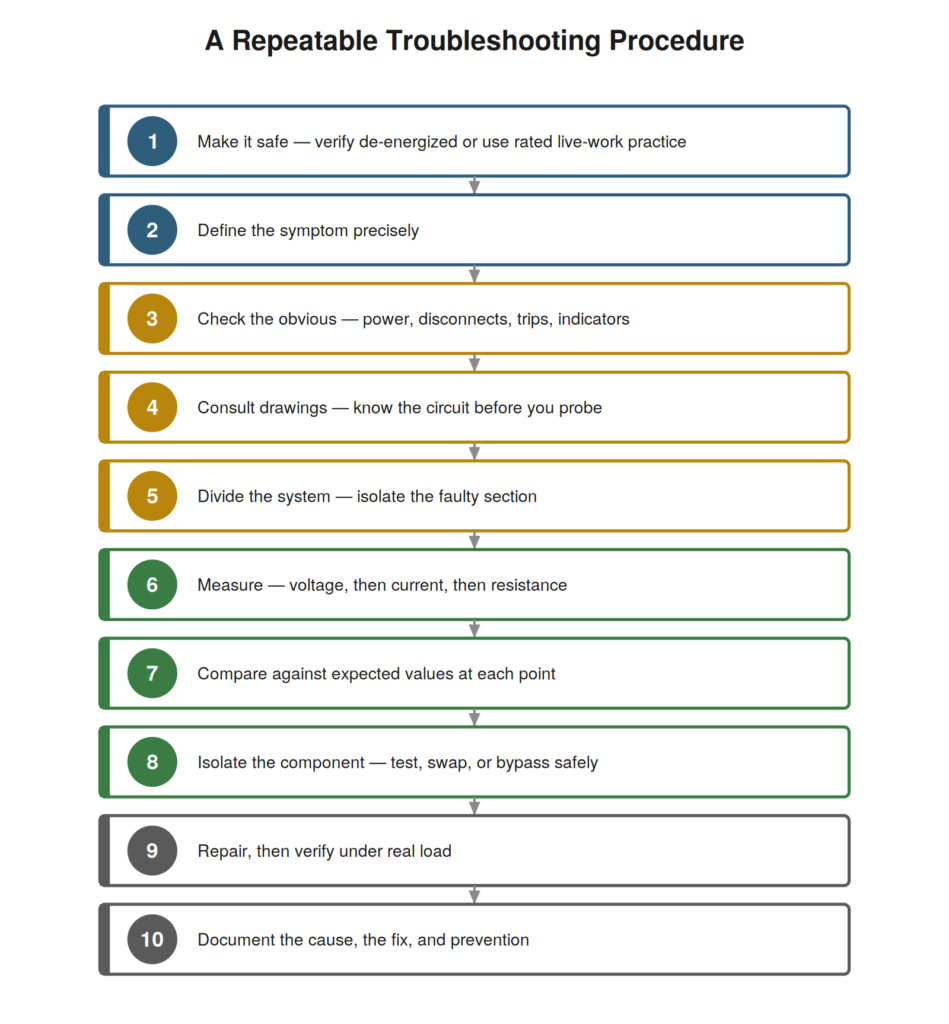
Everything in this book condenses into a single procedure that can be run on almost any industrial electrical fault. Its value is not that any step is clever, but that following the steps in order stops you from skipping the check that would have saved an hour and keeps you rational when a stopped line and a waiting supervisor are pressing on you.
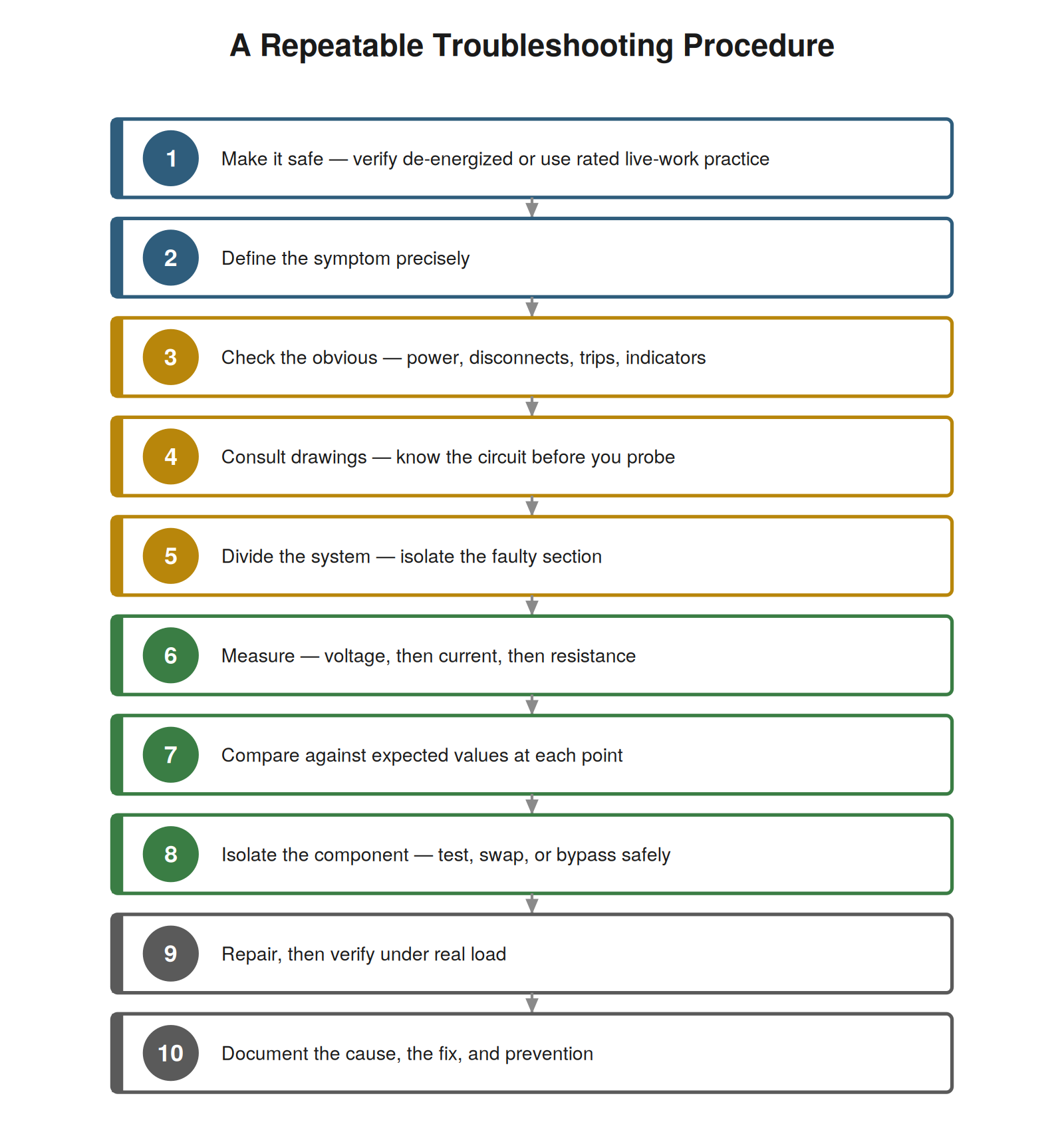
The steps, expanded
Make it safe. Identify energy sources and either verify de-energized with lockout or use rated live-work practice. Safety precedes everything.
Define the symptom precisely. ‘It’s broken’ is not a symptom; ‘the motor hums but will not start and the overload has tripped’ is.
Check the obvious. Power present, disconnects on, no tripped protection, indicators and E-stops sensible. A large share of faults end here.
Consult the drawings. Understand the circuit — what feeds the fault, what conditions it needs — before you probe, so every measurement is chosen.
Divide the system. Split the circuit at a sensible midpoint and test there to isolate the faulty section, halving the search.
Measure in order. Voltage first (is power present?), then current (how much is flowing?), then resistance (is the path intact, power off?).
Compare against expected values. At each point, compare what you measure against what should be there; a disagreement localizes the fault.
Isolate the component. Confirm the failed component by test, substitution, or safe bypass — never leave protection or safety defeated.
Repair and verify. Fix the confirmed cause, then run the equipment under real load to prove the fix, not merely at idle.
Document. Record the symptom, the cause, the fix, and anything that would prevent recurrence. Close the loop.
Why the order matters
The power of the procedure is entirely in its order. Safety comes first because no repair justifies an injury. Defining the symptom precisely comes before testing because a vague symptom scatters the search. Checking the obvious precedes deeper work because it is fast and catches a surprising share of faults. Consulting the drawings comes before probing so that measurements are chosen rather than random. Dividing and measuring form the core narrowing, each step halving what remains. Following this order prevents the two great failures of troubleshooting — acting before understanding, and getting lost in the middle — because each step either solves the problem or narrows it before the next begins. Under pressure, the order is what keeps you methodical when instinct wants to grab a part and start swapping.
Adapting and internalizing the procedure
The procedure is a foundation to internalize, not a checklist to consult. Run it on easy faults, when the stakes are low, until the sequence becomes automatic — then it will hold under the pressure of a crisis, when the pull to abandon method and start guessing is strongest. With experience the steps run faster: the obvious checks become instinctive, the drawings are read fluently, the measurement points are chosen shrewdly. But the sequence remains, because its value never expires. The experienced troubleshooter who looks like they are working on intuition is in truth running this same disciplined sequence so fluently and with so much accumulated judgment that it appears effortless — which is the goal to aim for, not a mythical sixth sense but a deeply practiced method.
A full walkthrough on a real fault
Consider the procedure applied end to end to a common fault. A conveyor motor will not start. Step one, safety: the technician confirms the state of the equipment and applies lockout before opening any enclosure, or uses rated practice if a live check is genuinely needed. Step two, define the symptom: not ‘the conveyor is broken’ but ‘the motor does not start, does not hum, and the control panel shows no obvious fault.’ Step three, check the obvious: main power present, disconnect on, no tripped protection visible, E-stops released — and here the overload is found tripped. Step four, consult the drawings: the technician confirms how the overload sits in the control circuit and what its tripping does. Step five, divide the system: the tripped overload localizes the fault to the motor circuit and raises the question of why it tripped. Step six, measure: with the overload reset and the motor started under observation, the running current is measured and found high on all three phases. Step seven, compare: the current is well above the nameplate, confirming the motor is overloaded rather than suffering an electrical fault. Step eight, isolate: turning the motor by hand when safely de-energized reveals a stiff, dragging rotation — a failing bearing. Step nine, repair and verify: the bearing is replaced and the motor run under real load, with the current now back to normal. Step ten, document: the technician records the tripped overload, the high current, the failing bearing, the repair, and a note to check that motor’s bearings at the next interval. Ten ordered steps carried the job from a dead conveyor to a verified, documented repair, with the tripped overload and the high current pointing the way at each stage.
Knowing when to escalate
Part of a good procedure is recognizing its own limits. If the steps have localized a fault to something beyond your scope, training, or authority — a high-voltage issue, a fault requiring engineering, a safety system that must not be bypassed, a problem needing specialized equipment — the professional move is to escalate cleanly rather than push past your limits. A good escalation is valuable in itself: you hand over exactly what you observed, what you measured, what you ruled out, and where you believe the fault lies, turning the handoff into a head start for whoever takes it next rather than a fresh start. Knowing the boundary of safe and competent action, and stopping cleanly at it with a clear handover, is a mark of skill rather than its absence, and it reflects the same discipline as the rest of the procedure. No production pressure justifies working beyond your competence on a hazard you are not equipped to handle safely.
The procedure as protection against your own worst instincts
The deepest reason to hold to a repeatable procedure is that it protects you from your own worst instincts under pressure, which is precisely when those instincts are most dangerous. Every troubleshooter, faced with a stopped line and a waiting supervisor, feels the pull to skip the careful steps and grab the part that failed last time, to act rather than think, to look busy rather than be methodical. These instincts feel like decisiveness but are actually the two great failures of troubleshooting — acting before understanding and getting lost in the middle — dressed up as urgency. The procedure exists to overrule them: by committing in advance to safety first, to defining the symptom, to checking the obvious, to consulting the drawings, to dividing and measuring in order, you remove the moment-to-moment temptation to abandon method, because the method is already decided. This is why internalizing the procedure until it runs automatically matters so much: automatic method holds under the pressure that would shatter deliberate method, and the troubleshooter who has made the sequence a habit keeps their head when everyone around them, including their own instincts, is urging them to lose it. The procedure is not a constraint on skill; it is the framework that lets skill operate when it is most needed and most at risk of being abandoned.
Why measure voltage, then current, then resistance
The measurement step of the procedure specifies an order — voltage first, then current, then resistance — and that order is deliberate, reflecting both safety and diagnostic logic. Voltage comes first because it is measured on a live circuit and answers the most basic question: is power present where it should be? A great many faults are resolved at this step alone, by finding power absent where it should be present and localizing where it stops. Current comes second because it too is measured live, typically with a clamp, and answers whether power that is present is actually doing work and how much — distinguishing a healthy loaded circuit from one where the load has failed or is faulted. Resistance comes last because, unlike the first two, it must be measured on a de-energized circuit, so it belongs after the live measurements both for safety and because by then the fault has often been localized enough that a targeted resistance check on an isolated section confirms the specific failure. Following this order means live measurements that require power are done while power is available and the circuit is intact, and de-energized resistance measurements are done after isolation, on the localized section, which is both the safe sequence and the efficient one. The order is not arbitrary; it moves from the broadest live question to the most specific de-energized confirmation, in the sequence that is safest and that narrows the fault most efficiently at each step.
From procedure to expertise
The repeatable procedure is presented as ten explicit steps, but its ultimate purpose is to be absorbed so thoroughly that it stops feeling like steps at all and becomes simply how you work. The novice follows the steps consciously, checking each against a mental list; the expert runs the same sequence so fluently, with so much accumulated judgment layered onto it, that it appears to an observer like intuition or a sixth sense. This appearance is misleading in an instructive way: the expert is not skipping the method but executing it so smoothly and rapidly, informed by experience about where faults tend to hide and which checks tend to pay, that the deliberate structure has become invisible. The path from novice to expert is not the abandonment of the procedure but its internalization — running it on easy faults until it is automatic, accumulating the experience that makes each step faster and shrewder, until the sequence holds effortlessly under the pressure that would shatter conscious method. The goal to aim for is not a mythical intuition that bypasses method but a deeply practiced method that has become second nature, because that is what the apparent intuition of the expert actually is. The procedure, in other words, is not training wheels to be discarded once you are good; it is the permanent structure of good troubleshooting, and becoming expert means making it so much a part of how you work that you no longer notice you are following it, even as it carries you reliably to the cause of fault after fault.