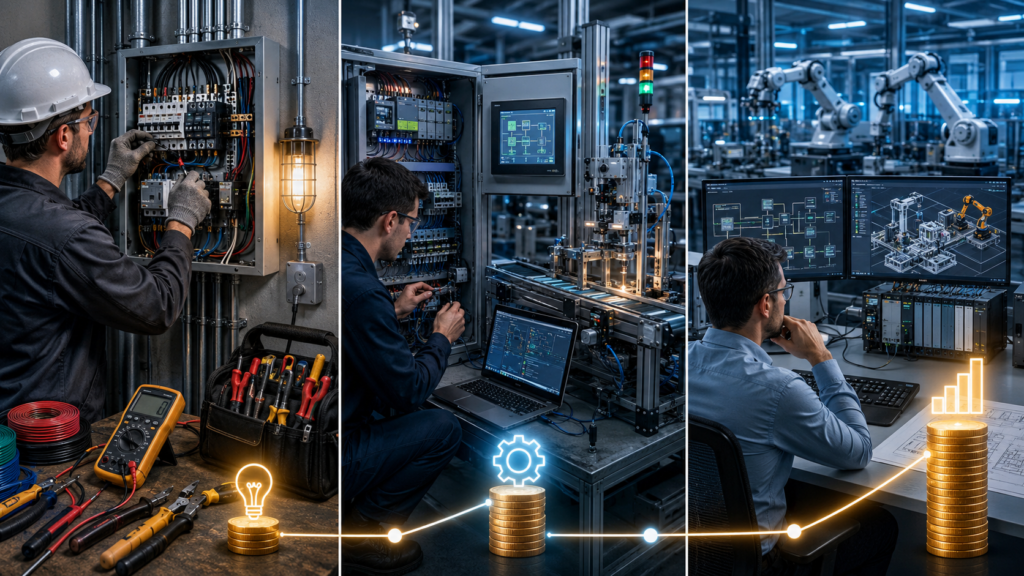
An industrial electrician, automation technician and controls engineer may all stand in front of the same stopped machine.
They may even open the same electrical drawing and connect to the same PLC.
The difference is usually not that one person understands electricity and the others do not. The difference is where each role’s responsibility begins and ends.
A simplified comparison is:
Electrician
→ Installs, wires, tests and repairs the electrical system

Automation technician
→ Maintains and troubleshoots the machine’s automated control system

Controls engineer
→ Designs, programs, integrates and modifies that control system
Real factories are rarely this tidy. An experienced industrial electrician may troubleshoot PLC logic. An automation technician may redesign a control circuit. A controls engineer may spend half the day replacing sensors during commissioning.
Job titles are inconsistent, so the actual duties matter more than the words printed on the contract.
Quick Comparison
| Area | Electrician | Automation technician | Controls engineer |
|---|---|---|---|
| Main responsibility | Electrical installation and repair | Automated-equipment maintenance and troubleshooting | Control-system design, programming and integration |
| Typical workplace | Construction site, factory or service location | Factory, warehouse or production line | Office, factory, customer site or commissioning location |
| Electrical wiring | Major part of the job | Regularly works with control wiring | Designs or specifies it; may assist physically |
| PLC programming | Usually limited or secondary | Troubleshooting and small changes | Major responsibility |
| HMI development | Uncommon | Basic changes and diagnostics | Designs complete applications |
| VFD work | Installation and replacement | Configuration and fault finding | Selection, integration and advanced setup |
| Mechanical work | Some | Often significant | Normally limited |
| Design responsibility | Usually follows drawings | May improve existing systems | Creates specifications, drawings and control concepts |
| Typical education | Apprenticeship or technical training | Technical certificate or associate-level training | Bachelor’s degree commonly requested |
| U.S. pay benchmark | $62,350 median | Roughly $70,760–$77,180 proxy | Roughly $101,140–$111,910 proxy |
The pay figures use official U.S. occupational categories because neither “automation technician” nor “controls engineer” has one perfect nationwide statistical category. Automation technicians commonly fall within mechatronics, robotics or electrical-engineering technician classifications, while controls engineers are often classified with electrical, mechatronics or industrial engineers.
What Does an Electrician Do?
An electrician installs, maintains and repairs electrical systems.
Depending on the job, that may involve:
- Power distribution
- Lighting
- Cable trays and conduits
- Motors
- Control panels
- Disconnects
- Circuit breakers
- Transformers
- Earthing and bonding
- Testing and inspection
- Fault finding
In industrial environments, electricians may also work with contactors, overload relays, sensors, VFDs, PLC I/O and safety circuits.
The electrician’s strongest area is normally the physical electrical installation:
Supply
→ Protection
→ Cable
→ Panel
→ Motor or field device
A good industrial electrician can look at a schematic, locate the correct terminals, test the circuit safely and determine whether the problem is in the supply, wiring or connected equipment.
Typical electrician tasks
An industrial electrician might:
- Install a new motor cable
- Replace a damaged contactor
- Find a phase-loss condition
- Test insulation resistance
- Wire a new proximity sensor
- Replace a failed VFD
- Modify a control-panel circuit
- Verify protective bonding
- Find a short circuit
- Test an emergency-stop circuit
- Assist with machine commissioning
The U.S. Bureau of Labor Statistics describes apprenticeship as the most common training route for electricians, although some enter through technical school, and licensing is required in many jurisdictions.
What an electrician may not normally own
The electrician may not be responsible for:
- Designing the machine sequence
- Writing the complete PLC application
- Developing an HMI
- Selecting the control architecture
- Creating industrial network configurations
- Performing a Performance Level or SIL calculation
- Managing the complete controls project
That does not mean an electrician cannot learn these skills.
Many excellent automation technicians and controls engineers began as electricians because electrical troubleshooting provides an extremely strong foundation.
What Does an Automation Technician Do?
An automation technician sits between electrical maintenance and controls engineering.
The role may also be advertised as:
- Controls technician
- PLC technician
- Instrumentation and controls technician
- Mechatronics technician
- Robotics technician
- Electrical and instrumentation technician
- Process control technician
O*NET groups titles such as Automation Technician, PLC Technician and Instrumentation and Controls Technician with workers who build, install, test and maintain robotic or automated production systems.
The automation technician’s main job is normally to keep automated equipment operating.
That requires understanding the full control chain:
Sensor
→ PLC input
→ Program condition
→ PLC output
→ Relay, valve or drive
→ Machine movement
Typical automation technician tasks
An automation technician may:
- Diagnose PLC input and output faults
- Monitor ladder logic
- Replace sensors and actuators
- Back up PLC and HMI programs
- Configure replacement VFDs
- Troubleshoot industrial networks
- Calibrate instruments
- Test safety relays
- Replace remote-I/O modules
- Make approved PLC changes
- Adjust HMI parameters
- Assist engineers during commissioning
- Analyse recurring machine failures
- Perform preventive maintenance on automated equipment
BLS describes mechatronics technicians as workers who install, repair, upgrade and test electronic or computer-controlled mechanical systems. Electrical-engineering technicians may also install and maintain control systems, test equipment and resolve design-related problems.
The technician is usually closer to production
A factory automation technician may receive a call such as:
Line 4 will not restart after the product jam was cleared.
The technician may need to check:
- Safety-circuit status
- PLC operating mode
- Active alarms
- Sequence step
- Sensor states
- Motor feedback
- VFD status
- Pneumatic pressure
- Reset conditions
The problem may be electrical, mechanical, pneumatic, software-related or a combination of several things.
That broad troubleshooting responsibility is what separates many automation technicians from electricians who primarily focus on the electrical installation.
How much programming does a technician do?
It varies enormously.
One employer may permit technicians only to monitor logic and replace hardware.
Another may expect them to:
- Add timers
- Modify interlocks
- Create alarm logic
- Change HMI screens
- Configure drives
- Commission complete machine sections
A technician making regular program modifications may be doing work similar to a junior controls engineer, even when the official title has not changed.
What Does a Controls Engineer Do?
A controls engineer designs, programs and integrates automated control systems.
O*NET includes titles such as Automation Engineer, Control Systems Engineer, Controls Engineering Specialist and Process Controls Engineer within mechatronics-engineering work involving the design and development of industrial automation and control systems.
A controls engineer might be responsible for the complete system:
Customer requirements
→ Electrical design
→ Hardware selection
→ PLC program
→ HMI application
→ Networks
→ Testing
→ Commissioning
→ Documentation
Typical controls-engineering tasks
A controls engineer may:
- Write PLC programs
- Develop HMI and SCADA systems
- Design machine sequences
- Create I/O lists
- Select PLCs and remote I/O
- Specify sensors and actuators
- Configure VFDs and servo drives
- Design industrial networks
- Review electrical schematics
- Define alarms and diagnostics
- Integrate robots and vision systems
- Coordinate safety functions
- Perform factory acceptance testing
- Commission equipment on site
- Train operators and technicians
- Manage project changes
- Prepare technical documentation
The role generally contains more design responsibility than the technician position.
The engineer is expected not only to repair a fault, but also to decide how the system should have been designed to avoid the fault—or at least diagnose it better next time.
Controls engineering is not only PLC programming
PLC code may be a major part of the role, but a controls engineer also needs to understand:
- Electrical circuits
- Machine operation
- Motors and drives
- Pneumatics and hydraulics
- Industrial communication
- Control-panel hardware
- Risk assessment
- Operator behaviour
- Fault recovery
- Commissioning
- Documentation
A perfectly written PLC program is not useful when the selected sensor cannot survive the environment, the motor is undersized or the electrical panel overheats.
The engineer must consider the complete system.
How the Three Roles Handle the Same Problem
Suppose a conveyor motor will not start.
Electrician’s approach
The electrician may check:
Three-phase supply present?
Breaker closed?
Contactor operating?
Overload tripped?
Motor cable healthy?
Motor windings healthy?
Control voltage present?
The electrician is mainly proving whether the physical power and control circuits are functioning.
Automation technician’s approach
The technician may check:
PLC output commanded?
Safety circuit healthy?
VFD ready?
Motor feedback present?
Sequence permissives satisfied?
Sensor blocking the start?
Communication healthy?
The technician combines field measurements with PLC and drive diagnostics.
Controls engineer’s approach
The controls engineer may investigate the same items, but may also ask:
Is the start sequence designed correctly?
Is the missing permissive visible on the HMI?
Should there be a timeout alarm?
Is motor feedback being interpreted correctly?
Does the program recover safely after this failure?
Should the circuit or program be redesigned?
The roles overlap during troubleshooting, but the controls engineer normally has greater authority and responsibility to alter the system design.
New Conveyor Installation Example
The difference becomes clearer during a new project.
Electrician
The electrician may:
- Install cable trays
- Pull power and control cables
- Mount field devices
- Terminate the motor and sensors
- Install the panel
- Test continuity and insulation
- Verify earthing
- Energise the installation safely
Automation technician
The technician may:
- Check every I/O signal
- Configure the VFD
- Set sensor positions
- Test manual controls
- Verify network devices
- Assist with sequence testing
- Diagnose commissioning faults
- Document final settings
Controls engineer
The controls engineer may:
- Define the control architecture
- Create the I/O list
- Design the sequence
- Write PLC and HMI software
- Select the drive-control method
- Configure communications
- Define alarms
- Coordinate safety behaviour
- Lead commissioning
- Obtain customer acceptance
None of these roles is unnecessary.
A brilliant PLC program cannot compensate for incorrectly terminated wiring. Perfect wiring cannot compensate for a machine sequence that was never designed properly.
Skills Compared
Electrical knowledge
| Skill | Electrician | Automation technician | Controls engineer |
|---|---|---|---|
| Three-phase power | Essential | Important | Important |
| Cable sizing | Essential | Useful | Often required for design review |
| Breakers and protection | Essential | Important | Important for system design |
| Contactors and starters | Essential | Essential | Essential |
| Electrical testing | Essential | Essential | Important |
| Panel wiring | Essential | Common | Useful |
| Schematics | Essential | Essential | Must read and often create them |
The electrician generally has the deepest practical focus on installation rules, wiring and electrical testing.
The controls engineer may understand the system design but not necessarily have the electrician’s installation speed or field craftsmanship.
Automation skills
| Skill | Electrician | Automation technician | Controls engineer |
|---|---|---|---|
| PLC monitoring | Sometimes | Essential | Essential |
| PLC programming | Basic or optional | Basic to intermediate | Intermediate to advanced |
| HMI development | Rare | Basic to intermediate | Intermediate to advanced |
| VFD configuration | Common | Essential | Essential |
| Servo systems | Occasional | Basic to intermediate | Intermediate to advanced |
| Industrial networking | Basic | Intermediate | Intermediate to advanced |
| SCADA | Rare | Basic | Common |
| Robot integration | Rare | Troubleshooting | Integration and programming |
Mechanical and process understanding
Automation technicians often develop the broadest immediate troubleshooting range because they work directly with:
- Electrical systems
- Mechanical equipment
- Pneumatics
- Hydraulics
- Instrumentation
- PLC logic
- Production processes
Controls engineers also need this knowledge, but some engineering roles become more specialised or office-based.
An electrician working mainly in construction may have less exposure to machine sequences than an industrial electrician who has spent years in manufacturing.
Education Compared
Electrician
The usual route is practical and structured:
Technical school or apprenticeship
→ Supervised work
→ Qualification or licence
→ Journeyperson-level experience
BLS reports that most electricians learn through apprenticeships and that licensing requirements apply in many U.S. states.
The apprenticeship route is particularly strong because the worker gains real experience while learning technical theory.
Automation technician
Common qualifications include:
- Industrial automation certificate
- Mechatronics qualification
- Electrical or electronic engineering technology
- Instrumentation training
- Associate degree
- Industrial maintenance diploma
- Electrician qualification plus PLC experience
BLS states that electro-mechanical and mechatronics technicians typically need an associate degree or postsecondary certificate. Electrical-engineering technologists and technicians commonly need an associate degree, although requirements can range from a high-school diploma to a bachelor’s degree depending on the employer and responsibilities.
Practical factory experience can be as important as the certificate, especially in troubleshooting-heavy positions.
Controls engineer
Many employers request a bachelor’s degree in:
- Electrical engineering
- Automation engineering
- Mechatronics
- Control engineering
- Mechanical engineering
- Computer engineering
- Industrial engineering
BLS states that electrical engineers typically need at least a bachelor’s degree, and industrial engineers normally need a bachelor’s degree in industrial engineering or a related engineering discipline.
It is still possible to progress into controls engineering through experience.
A common nontraditional route is:
Industrial electrician
→ Automation technician
→ Senior controls technician
→ Controls engineer
The difficulty is that some employers use a degree as a strict recruitment filter, even when an experienced technician can perform much of the work.
Pay Compared
Salary comparisons need careful handling because these titles overlap.
A person called an “electrician” at one factory may perform work that another company assigns to an “automation technician.” A highly experienced controls technician may earn more than a junior controls engineer.
The following figures are U.S. national benchmarks and should not be treated as guaranteed salaries.
Electrician pay
The median annual wage for U.S. electricians was $62,350 in May 2024.
The lowest 10% earned less than $39,430, while the highest 10% earned more than $106,030. Electricians working in manufacturing had a median of $71,820, demonstrating that industrial sector and employer type can make a substantial difference.
Automation technician pay
There is no single BLS category named “automation technician,” so two useful proxies are:
| Related occupation | U.S. median annual pay |
|---|---|
| Electro-mechanical and mechatronics technologists and technicians | $70,760 |
| Electrical and electronic engineering technologists and technicians | $77,180 |
The mechatronics-technician category ranged from below $47,770 at the lowest 10% to above $109,580 at the highest 10%. Electrical and electronic engineering technologists and technicians ranged from below $48,250 to above $111,790.
A reasonable broad national benchmark for an automation-technician-type role is therefore approximately:
$70,000–$77,000 medianActual pay depends heavily on whether the job includes shift work, PLC programming, instrumentation, robotics, travel, standby duty or commissioning.
Controls engineer pay
Controls engineers can be classified under several engineering occupations.
Two useful benchmarks are:
| Related occupation | U.S. median annual pay |
|---|---|
| Industrial engineers | $101,140 |
| Electrical engineers | $111,910 |
Industrial engineers ranged from below $70,000 at the lowest 10% to above $157,140 at the highest 10%. Electrical engineers ranged from below $74,670 to above $175,460.
This suggests a broad national proxy of approximately:
$101,000–$112,000 medianfor engineering-level controls work, while recognising that a junior PLC programmer at a small machine builder may earn less and an experienced specialist in motion control, process automation or commissioning may earn substantially more.
Salary Summary
| Role | U.S. national pay benchmark | Important caveat |
|---|---|---|
| Electrician | $62,350 median | Overtime, licensing and self-employment can change earnings greatly |
| Automation technician | $70,760–$77,180 proxy | No exact national title match |
| Controls engineer | $101,140–$111,910 proxy | Classification varies between electrical, mechatronics and industrial engineering |
These are base occupational comparisons, not total-compensation guarantees.
Why the Highest-Paid Person May Not Be the Engineer
The normal ranking appears to be:
Electrician
<
Automation technician
<
Controls engineer
That is often true for base salary, but not always for total annual earnings.
An industrial electrician may earn more than a junior engineer because of:
- Overtime
- Night-shift premium
- Union agreements
- Emergency callouts
- Hazardous-location work
- Specialist licences
- Self-employment
An automation technician may earn more because of:
- Rotating shifts
- Weekend standby
- Robotics expertise
- Instrumentation skills
- Production bonuses
- Regular overtime
A controls engineer may earn more through:
- Project responsibility
- Commissioning travel
- Specialist programming
- Management duties
- International assignments
- Billable field work
- Advanced motion or process expertise
The hourly rate, annual salary and actual lifestyle can tell three different stories.
A commissioning engineer may receive a good annual income while spending half the year in hotels. A factory technician may earn less on paper but work ten minutes from home with a predictable schedule.
Work Environment Compared
Electrician
Typical conditions include:
- Physical installation work
- Ladders and access platforms
- Cable pulling
- Dust and weather
- Tight working spaces
- Live-system testing under controlled procedures
- Construction or shutdown deadlines
The work is generally more physical than the other two roles.
Automation technician
Typical conditions include:
- Factory noise
- Shift work
- Breakdown pressure
- Working around operating machinery
- A mixture of laptop and hands-on work
- Fault calls during production
- Preventive-maintenance tasks
- Occasional dirty or uncomfortable environments
The technician may spend one hour online with a PLC and the next hour inside a conveyor replacing a damaged sensor cable.
Controls engineer
Typical conditions include:
- PLC and HMI programming
- Design meetings
- Electrical-document review
- Factory acceptance testing
- Customer communication
- Commissioning travel
- Long hours near project completion
- Responsibility for software and system behaviour
The work may be less physically demanding, but the project and commissioning pressure can be higher.
Responsibility Compared
Electrician’s responsibility
The electrician is responsible for work such as:
- Safe installation
- Correct conductor termination
- Compliance with electrical rules
- Accurate testing
- Reliable repairs
- Protection and bonding
- Following approved drawings
An electrical installation error can create fire, equipment-damage or electric-shock risk.
Automation technician’s responsibility
The technician is responsible for:
- Accurate diagnosis
- Safe restoration of production
- Correct replacement settings
- Controlled software changes
- Program backups
- Preventing repeated failures
- Escalating problems beyond their authority
A rushed technician can easily turn a small breakdown into a larger one by downloading the wrong PLC project or bypassing an interlock.
Controls engineer’s responsibility
The engineer may be responsible for:
- System architecture
- Program behaviour
- Failure response
- Equipment selection
- Sequence design
- Network design
- Software version control
- Commissioning results
- Customer requirements
- Technical documentation
A controls-engineering mistake may be repeated across every machine built from the same design.
Which Role Is Hardest?
There is no objective answer.
Each role is difficult in a different way.
Electrician
The difficulty comes from:
- Physical work
- Electrical hazards
- Installation accuracy
- Regulations
- Fault finding
- Working under site conditions
Automation technician
The difficulty comes from:
- Broad technical coverage
- Intermittent faults
- Production pressure
- Shift work
- Limited troubleshooting time
- Old machines with poor documentation
Controls engineer
The difficulty comes from:
- Designing systems from incomplete requirements
- Programming fault recovery
- Project deadlines
- Customer changes
- Software responsibility
- Commissioning unknown machinery
- Balancing safety, production and cost
The controls engineer may have the highest theoretical and design burden.
The automation technician may face the most immediate troubleshooting pressure.
The electrician may carry the greatest amount of physical installation work and direct exposure to electrical hazards.
Which Role Should You Choose?
Choose electrician when you enjoy:
- Working with tools
- Building real installations
- Power and control wiring
- Electrical testing
- Visible physical progress
- Moving between different work sites
- A structured apprenticeship path
This is also an excellent foundation for entering industrial automation later.
Choose automation technician when you enjoy:
- Troubleshooting machines
- Mixing electrical and software work
- PLC monitoring
- Sensors and actuators
- VFDs and robots
- Finding the cause of breakdowns
- Being close to production
This is probably the strongest choice for someone who wants practical automation work without immediately taking on full engineering-project responsibility.
Choose controls engineer when you enjoy:
- Programming
- Designing sequences
- Solving system-level problems
- Creating new machines
- Electrical and software integration
- Technical documentation
- Commissioning
- Project ownership
The role usually offers the highest salary ceiling, but also brings greater design responsibility and potentially more travel.
Best Route Into Controls Engineering
Someone without automation experience does not always need to jump directly into an engineering title.
A practical route is:
Electrician
→ Industrial electrician
→ Automation technician
→ Controls engineer
The electrician stage builds:
- Safe working habits
- Wiring knowledge
- Motor-control understanding
- Drawing-reading ability
- Practical testing skills
The technician stage adds:
- PLC troubleshooting
- HMI diagnostics
- Drive configuration
- Industrial communication
- Machine-sequence knowledge
The engineering stage adds:
- System design
- Advanced programming
- Hardware selection
- Project ownership
- Commissioning leadership
- Documentation and validation
This route can produce a very capable controls engineer because it combines practical and design experience.
The main disadvantage is that some employers may still require a formal engineering degree for the final step.
Can an Electrician Program PLCs?
Yes.
There is no technical law preventing an electrician from learning PLC programming.
However, knowing how to create a timer rung is different from being ready to modify production machinery independently.
The electrician also needs to understand:
- Program structure
- Machine sequence
- Interlocks
- Fault recovery
- Data handling
- Version control
- Online-edit risk
- Safety-system boundaries
PLC programming is a learnable skill, but production responsibility must be earned gradually.
Can an Automation Technician Become a Controls Engineer?
Yes, and it is one of the most natural career transitions in the industry.
A strong technician already understands:
- How machines fail
- What operators need
- Which alarms are useful
- How sensors behave in real installations
- Why field wiring matters
- What makes troubleshooting difficult
To move into engineering, the technician usually needs to strengthen:
- Structured PLC programming
- Electrical design
- HMI development
- Network architecture
- Project documentation
- Hardware selection
- Safety standards
- Commissioning leadership
- Project planning
A degree may improve access to engineering positions, but a portfolio of successful controls projects can also carry significant weight with practical employers.
Common Misunderstandings
“The controls engineer is the electrician’s boss”
Not necessarily.
They may report to entirely different departments. The electrician may be a senior contractor with decades of experience, while the controls engineer is responsible only for software.
Project responsibility and organisational authority are not the same thing.
“Automation technicians only replace sensors”
A good automation technician may troubleshoot PLC code, networks, drives, robots, instrumentation and machine sequences.
Some technician roles are effectively controls-engineering roles with a different title.
“Controls engineers do not need electrical knowledge”
A controls engineer who cannot understand a schematic, test an I/O circuit or recognise an incorrect contactor arrangement is severely limited.
Software and hardware meet at the terminals.
“Electricians earn less because the work is less skilled”
The skill set is different, not lesser.
Electrical installation, safe isolation, testing and fault finding require substantial training and responsibility.
“The engineering title guarantees high pay”
A title alone guarantees very little.
Industry, location, experience, travel, overtime, employer size and actual responsibility matter far more than whether the job title includes the word “engineer.”
Final Comparison
The simplest distinction is:
Electrician
= Builds and repairs the electrical installation
Automation technician
= Keeps the automated machine runningControls engineer
= Designs and programs how the automated machine operatesThere is considerable overlap.
The electrician may troubleshoot PLC outputs.
The technician may write PLC code.
The engineer may terminate wires during commissioning because the machine needs to run and everybody else has gone home.
In general:
- Electrician offers the most direct hands-on electrical career.
- Automation technician provides the strongest mixture of troubleshooting, electrical work and PLC diagnostics.
- Controls engineer normally carries the greatest design responsibility and highest salary ceiling.
The best role is not simply the one with the largest median salary.
It is the one whose daily work, responsibility, education path and lifestyle fit you.