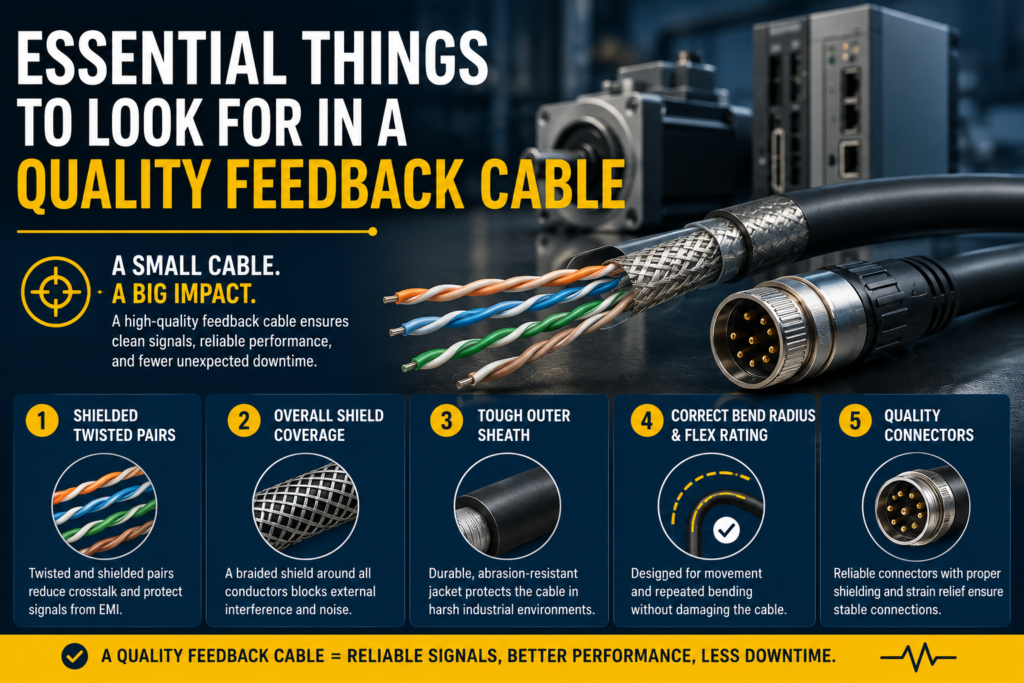
A feedback cable may look like a small part of a servo system, but it can have a big effect on performance.
You can have a good servo motor, a good servo drive, and a strong gearbox, but if the feedback cable is poor quality, the whole system can still suffer.
That is because the feedback cable carries the position or speed signal from the motor encoder back to the drive or controller. If that signal becomes weak, noisy, or unreliable, the drive may not control the motor correctly.
In simple terms:
Bad feedback signal = bad motor control.
This can lead to random faults, poor accuracy, unstable motion, and long troubleshooting sessions that nobody enjoys.
In this post, we will look at five important things to check when choosing a feedback cable for servo motors, encoders, and industrial automation systems.
Why Feedback Cable Quality Matters
Servo systems depend on accurate feedback.
The encoder tells the drive where the motor shaft is, how fast it is moving, and sometimes which direction it is moving. The drive uses this information to control the motor precisely.
If the feedback signal is clean and stable, the system can run smoothly.
If the signal is noisy or damaged, problems can start.
Poor feedback cables can cause:
Intermittent encoder faults
Random drive trips
Poor positioning accuracy
Unstable motor movement
Noise-related problems
Shorter cable life
Safety risks in critical applications
Difficult troubleshooting
This is why feedback cables should not be treated like ordinary wires.
In industrial environments, cables are exposed to electrical noise, vibration, movement, oil, sharp edges, heat, and mechanical stress. A low-quality cable may work during testing, but fail later when the machine is running every day.
A good feedback cable helps protect signal quality and improves the reliability of the complete servo system.
1. Shielded Twisted Pairs
Many encoder and feedback signals use differential signal pairs.
A differential pair has two opposite signals. For example, one wire carries the main signal, and the other wire carries the inverted version of that signal.
This is common with encoder channels such as:
A and A-not
B and B-not
Z and Z-not
Twisting these wires together helps reduce electrical noise. The twist helps cancel out interference that may be picked up along the cable.
But twisting alone is not always enough.
In a good feedback cable, each signal pair should also be shielded. This gives the pair extra protection against electromagnetic interference, also called EMI.
This is especially important in industrial machines because feedback cables are often installed near:
VFDs
Servo drives
Motor cables
Contactors
Relays
Power supplies
Braking resistors
High-current wiring
All of these can create electrical noise.
Shielded twisted pairs help keep the encoder signal clean before it reaches the drive or controller.
For high-resolution encoders and precise positioning systems, this becomes even more important. A small signal problem can turn into a big motion problem.
2. Overall Shield Around the Cable
A good feedback cable should also have an overall shield around all conductors.
This shield protects the complete cable from outside noise.
Think of it like an extra protective layer around the whole cable bundle.
Many high-quality feedback cables use a braided shield. A braided shield is often preferred because it is flexible and durable. It also provides good protection against high-frequency electrical noise.
The overall shield is usually connected to ground, depending on the drive, motor, and encoder manufacturer’s wiring instructions.
The purpose of the shield is to give electrical noise a path to ground instead of allowing that noise to enter the feedback signals.
This is very important when feedback cables are installed in the same control cabinet or cable tray as high-power equipment.
Without proper shielding, the encoder signal may become unstable. The drive may then see incorrect feedback and trigger faults.
In many cases, random encoder faults are not caused by the encoder itself. They are caused by poor cable shielding, bad grounding, or incorrect cable routing.
3. Strong Outer Sheath Material
The outside of the feedback cable matters too.
In factories and machines, cables do not live in perfect conditions. They may rub against metal edges, move inside cable chains, touch oil, get pulled during maintenance, or be exposed to dust, coolant, cleaning chemicals, and vibration.
That is why the cable jacket, also called the outer sheath, must be tough enough for the environment.
A good feedback cable should have an outer sheath that resists:
Abrasion
Cuts
Cracking
Oil
Chemicals
Coolant
Moisture
Mechanical wear
Common sheath materials include polyurethane, PVC, TPE, and other industrial cable materials. The best choice depends on the application.
For example:
A machine tool may need oil-resistant cable.
A food processing machine may need washdown-resistant cable.
A robot or gantry may need a highly flexible cable.
A chemical plant may need a cable with stronger chemical resistance.
Do not choose a cable only by the connector type or number of wires.
Check the cable jacket material too.
A cable that is electrically correct but mechanically weak can still fail early.
4. Correct Bend Radius and Flex Rating
Every cable has a minimum bend radius.
The bend radius tells you how tightly the cable can be bent without damaging it.
If the cable is bent too sharply, the conductors inside can become stressed. The shield can also become damaged. Over time, this can cause broken wires, poor signal quality, or intermittent faults.
This is especially important in moving applications such as:
Robots
Gantry systems
CNC machines
Pick-and-place machines
Cable carriers
Moving axes
Automated production equipment
For static installations, bend radius still matters, but it is usually easier to control.
For moving installations, you also need to check the cable’s flex rating or bending cycle rating.
This tells you how many times the cable is designed to bend during operation.
A normal static cable may not survive long inside a moving cable chain. It may look fine from the outside but fail internally after repeated motion.
When choosing a feedback cable, check:
Minimum bend radius
Static or dynamic cable rating
Number of bending cycles
Temperature range
Cable chain compatibility
Torsion rating if the cable twists
Also remember that temperature affects flexibility. A cable that bends easily at room temperature may become stiff in a cold environment.
If the cable is used in moving equipment, choose a cable designed for continuous flexing.
5. Quality Connectors
The connector is another important part of the feedback cable.
A feedback cable can have excellent shielding and conductors, but if the connector is poor quality or badly installed, the signal can still suffer.
Good feedback connectors should provide:
Strong mechanical connection
Proper strain relief
Good shield connection
Reliable pin contact
Protection against vibration
Correct IP rating for the environment
Low risk of miswiring
Pre-made feedback cables with factory-installed connectors are often the best option. They are usually tested before delivery and reduce the chance of wiring mistakes during installation.
This can save time and prevent problems in the field.
Field-terminated connectors can work, but they require more care. Shield termination, pin crimping, soldering, and connector assembly must be done correctly.
A small mistake can create a hard-to-find problem later.
In industrial machines, connectors may also need protection from oil, dust, water, vibration, or repeated plugging and unplugging.
Always choose connectors that match the environment, not just the electrical pinout.
What If You Need to Add or Replace a Connector?
Sometimes a pre-made cable is not possible.
Maybe the cable must pass through a small opening. Maybe the machine uses a special connector. Maybe a damaged connector needs to be replaced in the field.
In these cases, field modification may be necessary.
When modifying a feedback cable, keep these points in mind:
Follow the connector manufacturer’s instructions
Use the correct crimping or soldering tools
Maintain the cable shield as much as possible
Keep twisted pairs twisted close to the connector
Avoid cutting shields too far back
Use proper strain relief
Avoid loose or exposed shield wires
Test the cable after modification
One complete cable run is usually better than using terminal blocks, junction boxes, or breakout boxes.
Why?
Because every break in the cable can become a weak point. It can also reduce shielding quality and create a place where electrical noise enters the feedback signal.
If you must use a junction point, make sure it is designed for shielded feedback signals and installed correctly.
After modifying a feedback cable, test it properly before running the machine.
Useful checks include:
Continuity test
Pinout check
Shield connection check
Insulation resistance test
Signal quality check if equipment is available
Field modifications should be done by qualified personnel because feedback signals are sensitive.
Common Problems Caused by Poor Feedback Cables
A bad or low-quality feedback cable can create many different symptoms.
Some common ones include:
Encoder faults
Position errors
Speed feedback faults
Motor vibration
Unstable servo control
Random drive trips
Noise-related alarms
Machine stops during movement
Faults that only happen sometimes
Faults that get worse at higher speed
Faults after cable movement or machine vibration
These problems can be frustrating because they are not always constant.
The machine may run fine for an hour, then suddenly fault. Then it may restart and run again.
That is why feedback cable quality is so important.
A poor cable can make troubleshooting much harder than it needs to be.
Feedback Cable Installation Tips
Choosing a good cable is only part of the job. Installation is just as important.
Here are some practical tips:
Use the shortest practical cable length
Avoid routing feedback cables next to motor power cables
Cross power cables at 90 degrees if needed
Use proper shield grounding
Do not create unnecessary cable loops
Avoid sharp bends
Protect cables from sharp metal edges
Use cable glands and strain relief
Keep connectors clean and tight
Do not pull the cable by the connector
Use cable chain rated cable for moving applications
Follow the drive and encoder wiring manual
A high-quality cable installed badly can still cause problems.
Good cable routing and proper shielding practice make a big difference.
Final Thoughts
A feedback cable may not be the most exciting part of a servo system, but it is one of the most important.
The drive depends on the feedback signal to control the motor. If that signal is poor, the whole system can become unreliable.
When choosing a feedback cable, pay attention to these five things:
Shielded twisted pairs
Overall cable shield
Tough outer sheath
Correct bend radius and flex rating
Quality connectors
Do not save a small amount of money on a weak cable if it can cause hours of downtime later.
In industrial automation, reliable feedback is everything.
A good feedback cable helps the servo system run smoothly, reduces random faults, improves accuracy, and makes the machine easier to maintain.
It is a small component, but it can make or break the performance of the whole system.