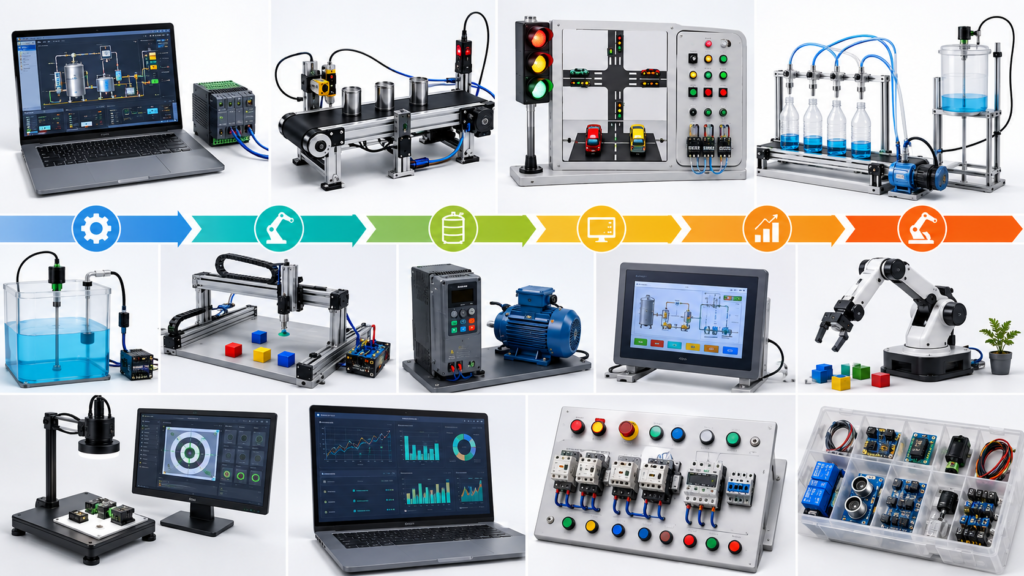
A final-year automation project does not need an industrial robot, a large PLC rack, or a fully equipped laboratory to be impressive.
Many students assume that the most valuable project is the one with the most hardware. In practice, lecturers and employers are often more interested in how well the project is designed, tested, documented, and explained.
A small project with clear control logic, realistic alarms, useful data, and good fault handling can demonstrate more skill than an expensive machine that only performs a basic sequence.
The following project ideas can be completed using PLC simulation software, low-cost microcontrollers, basic 24 V components, virtual HMIs, or a combination of software and simple hardware.
1. Virtual Production Line Simulator
Create a simulated production line with several stages, such as feeding, processing, inspection, sorting, and packaging.
The system can be developed entirely in PLC simulation software. Each station should have its own sequence, operating state, alarms, and interlocks.
Useful features include:
- Manual and automatic modes
- Product tracking
- Jam detection
- Station handshaking
- Fault recovery
- Production counters
- HMI control and status pages
This project is valuable because it demonstrates complete machine architecture without requiring a physical conveyor system.
2. Smart Water Tank Control System
Develop a system that controls filling and draining between two or more tanks.
Use simulated level sensors or low-cost float switches. Add pump protection, high-level alarms, low-level alarms, and dry-running prevention.
A more advanced version could include analog level measurement, pump speed control, or automatic pump rotation.
The project can also compare simple on-off control with proportional or PID control.
3. Energy Monitoring Dashboard
Create an energy-monitoring system for a small factory, workshop, or building.
The project can use simulated data instead of real power meters. Generate values for voltage, current, power factor, active power, and energy consumption.
Display the information through an HMI, SCADA package, or web dashboard.
Possible features include:
- Daily and weekly energy totals
- Peak-demand alarms
- Energy cost calculation
- Machine-by-machine comparison
- Historical trends
- Automatic reports
This is a strong project because energy efficiency is relevant across many industries.
4. Predictive Maintenance Demonstrator
Build a system that estimates when equipment may require maintenance.
You do not need an expensive vibration-analysis kit. The project can use simulated motor temperature, operating hours, start counts, overload events, and vibration values.
The program could generate maintenance warnings when conditions exceed defined limits.
For example, a motor may require inspection after a certain number of operating hours or after repeated high-temperature events.
The goal is not to create a perfect predictive algorithm. It is to demonstrate condition monitoring, data collection, alarm logic, and maintenance planning.
5. Automated Greenhouse Controller
Design a greenhouse automation system that controls temperature, lighting, ventilation, irrigation, and humidity.
Low-cost temperature and humidity sensors can be used, but the full project can also run with simulated inputs.
The controller could include:
- Day and night temperature settings
- Timed irrigation
- Soil moisture control
- Fan and heater operation
- High-temperature alarms
- Water tank monitoring
- Manual override controls
A simple HMI or web interface can show environmental values and system status.
6. Traffic Junction With Adaptive Timing
A normal traffic-light project is usually too simple for a final-year assignment. An adaptive traffic-control system is more suitable.
Use simulated vehicle sensors to estimate traffic volume on different roads. The system should change green-light duration according to demand.
Additional features may include:
- Pedestrian crossing requests
- Emergency-vehicle priority
- Night operating mode
- Fault detection for failed signals
- Traffic statistics
- Manual control from an HMI
This project combines sequencing, timing, prioritisation, and data analysis.
7. Low-Cost Building Management System
Create a small building automation system for lighting, heating, ventilation, and room occupancy.
The project could represent an office, classroom, warehouse, or apartment building.
Use simulated room temperatures, occupancy sensors, light sensors, and energy prices.
The controller could reduce heating in unused rooms, turn off lights automatically, and schedule ventilation according to occupancy.
A SCADA or browser-based dashboard can provide central monitoring.
8. Conveyor Sorting System in Simulation
Develop a conveyor system that sorts products by colour, size, weight, barcode, or product type.
The entire machine can be simulated using PLC software, a digital factory simulator, or animated HMI objects.
The PLC should track the product between the detection point and sorting station.
Include faults such as:
- Product missing from expected position
- Sensor blocked
- Sorting actuator timeout
- Conveyor jam
- Incorrect product sequence
Product tracking makes this project more challenging than a simple conveyor animation.
9. Automated Parking Management System
Create a parking system that counts available spaces and directs vehicles to free locations.
The project could use low-cost infrared sensors, pushbuttons, or simulated inputs.
Features may include:
- Vehicle entry and exit counting
- Maximum capacity control
- Space availability display
- Entry barrier control
- Reserved spaces
- Overstay alarms
- Daily usage statistics
An advanced version could include simulated licence-plate identification or online booking.
10. Industrial Alarm Management System
Develop an alarm-handling system for a simulated machine or process.
Instead of simply turning on a red lamp, create professional alarm behaviour.
The system should distinguish between:
- Active alarms
- Unacknowledged alarms
- Acknowledged alarms
- Cleared alarms
- Warning and trip conditions
Include timestamps, alarm history, first-fault recording, and user acknowledgement.
This topic is highly relevant because poor alarm design causes confusion during real machine breakdowns.
11. Automatic Batch Mixing Process
Simulate a batch system that fills a tank with several ingredients, mixes them, heats or cools the product, and then discharges it.
Different recipes can use different quantities, temperatures, and mixing times.
The project could include:
- Recipe selection
- Automatic and manual operation
- Batch pause and restart
- Ingredient shortage alarms
- Temperature control
- Batch reports
- Operator access levels
This project demonstrates sequencing, analog values, recipe handling, and process control.
12. PLC and SCADA Communication Project
Create a system where a PLC exchanges information with a SCADA application or another controller.
The hardware requirements can be minimal because both devices may be simulated.
Possible communication methods include Modbus TCP, OPC UA, PROFINET, EtherNet/IP, or MQTT.
The system should detect lost communication and respond safely.
For example, it may stop accepting remote commands, hold the last safe output, or activate a communication alarm.
13. Remote Pump Station Monitoring
Design a remote monitoring system for several water or wastewater pump stations.
Each station can be represented by a simulated PLC or software block.
The central system should display:
- Tank levels
- Pump status
- Flow values
- Fault alarms
- Communication condition
- Operating hours
- Energy use
The project can also include automatic pump rotation and remote reset controls.
14. Machine Downtime Analysis System
Create a system that records why a machine stops and calculates downtime.
The PLC can generate machine states such as running, waiting, blocked, faulted, stopped by operator, or starved of material.
A dashboard can calculate:
- Total operating time
- Downtime by cause
- Number of stops
- Average stop duration
- Availability percentage
- Most common fault
This is a practical project because manufacturers often want better visibility into production losses.
15. Overall Equipment Effectiveness Calculator
Build an OEE monitoring system that calculates availability, performance, and quality.
The data can be simulated or entered from a small training machine.
The project should track:
- Planned production time
- Actual running time
- Total product count
- Good product count
- Rejected product count
- Ideal cycle time
Display the OEE result and show which factor is reducing performance.
16. Digital Twin of a Simple Machine
Create a software model that behaves like a real industrial machine.
The digital twin could represent an elevator, conveyor, filling machine, pump system, or warehouse station.
The PLC program controls the virtual machine, while the simulation sends back realistic sensor signals.
Add mechanical delays, random faults, blocked sensors, and actuator failures.
This allows the programmer to test logic and fault handling without real equipment.
17. Secure Remote Access Demonstrator
Develop a small project showing how remote access to industrial equipment can be controlled securely.
The project may include:
- User authentication
- Different access levels
- Remote connection logging
- Read-only and control permissions
- Automatic session timeout
- Alarm notification
- Local enable switch simulation
The focus should be on safe access design rather than advanced cybersecurity research.
18. Automatic Generator Control Simulator
Create a simulated standby-generator control system.
The controller should detect mains failure, start the generator, wait for stable voltage, transfer the load, and return to mains when power is restored.
Include start failures, low fuel, high temperature, low oil pressure, and unsuccessful transfer alarms.
Because the project is simulated, there is no need to work with dangerous mains or generator voltages.
19. Industrial Recipe Management System
Build a system for creating, editing, saving, and loading production recipes.
Recipes might contain speed, temperature, pressure, timing, and quantity settings.
The system should prevent invalid values and record which operator changed a recipe.
This project can be combined with a mixing process, packaging machine, or virtual production line.
20. Fault-Finding Training Simulator
Create an educational tool that teaches students or maintenance technicians how to troubleshoot automation faults.
The simulator could randomly generate problems such as:
- Failed sensor
- Open safety circuit
- Motor overload
- Communication loss
- Incorrect mode selection
- Broken actuator feedback
- PLC output blocked by an interlock
The user investigates the system and selects the likely cause.
This can become a strong final-year project because it combines automation knowledge, software design, and education.
How to Make a Low-Cost Project Look Professional
The difference between a basic student exercise and a strong final-year project is usually not the hardware. It is the depth of the work.
A good project should include a clear problem statement, functional specification, I/O list, program structure, HMI design, alarm list, risk discussion, test procedure, and final evaluation.
Document how the system behaves during normal operation and during faults.
Test situations such as:
- Sensor failure
- Communication loss
- Power restart
- Invalid operator input
- Actuator timeout
- Emergency stop activation
- Unexpected sequence interruption
Screenshots, trend graphs, test results, and program diagrams can provide evidence that the project works.
A short demonstration video can also help lecturers and future employers understand the system.
Choosing the Best Topic
Choose a topic that matches the skills you want to demonstrate.
For a PLC programming career, focus on machine sequences, interlocks, alarms, HMI design, and troubleshooting.
For process automation, choose tanks, pumps, temperature control, batch systems, or PID control.
For Industry 4.0 interests, choose data collection, OEE, remote monitoring, energy dashboards, or digital twins.
Do not choose a massive project simply because it sounds impressive. A smaller system that is complete, stable, and well documented is usually a better final-year project than an unfinished smart factory.
The strongest automation project is one you can demonstrate clearly, explain confidently, and troubleshoot when something goes wrong.