A beginner does not need an expensive professional scan platform or a drawer full of specialty electrical tools. A useful starting kit is a reliable digital multimeter, a basic OBD-II scan tool, a test light suitable for the circuit being tested, small back-probe pins or approved probing leads, a battery terminal brush, simple hand tools, spare fuses of the correct type and rating, and a flashlight.
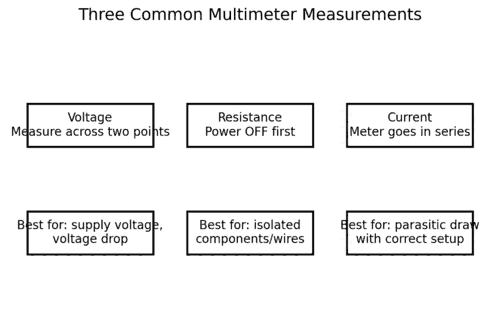
The multimeter is the most important electrical tool because it lets you measure voltage, resistance, continuity, and—when set up correctly—current. It can answer questions that visual inspection cannot. A fuse that looks good may still be open. A cable that looks clean may have too much resistance. A battery that powers the radio may still collapse under starter load.
What to Look For
Do not confuse a reading with a conclusion. A meter showing 12 volts proves voltage is present at that moment; it does not automatically prove the circuit can deliver enough current under load.
Do not pierce insulation casually. Piercing a wire can create a path for moisture and corrosion. Whenever possible, test at connectors, designated test points, fuse tabs, battery posts, or with proper back-probing methods. Avoid forcing oversized probes into female terminals because this can spread them and create a new intermittent fault.
Before measuring anything, decide what you are trying to prove. Random meter probing produces random numbers. A good test has a question behind it: is battery voltage reaching this relay? Is this ground path dropping too much voltage? Is this fuse powered on both sides?
Beginner Diagnostic Checklist
- Verify the exact symptom before touching anything.
- Check battery condition and obvious power/ground connections when relevant.
- Check the correct fuse and connector condition.
Stop and get help if: you cannot identify a safe test point or the vehicle may move unexpectedly.