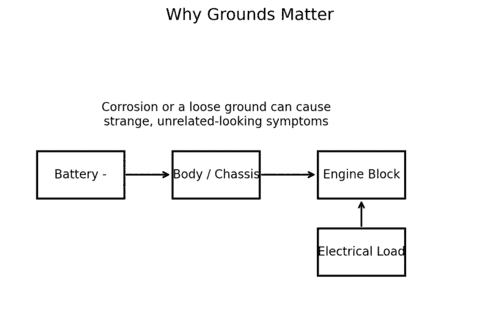
Ground faults can create symptoms that seem unrelated. A weak ground can cause lamps to glow dimly, multiple warning lights to appear, gauges to move strangely, modules to reset, motors to run slowly, or current to find an unintended return path through another component.
The battery negative terminal is connected to the body and usually to the engine. Individual components may ground through dedicated wires, ground studs, or their mounting points. Corrosion, loose fasteners, broken straps, paint under a repair point, or damaged connectors can increase resistance.
What to Look For
Do not confuse a reading with a conclusion. A meter showing 12 volts proves voltage is present at that moment; it does not automatically prove the circuit can deliver enough current under load.
Do not test a ground only with the ohms function and assume it is good. A ground path may show continuity with tiny meter current but fail when a motor draws real current. Voltage-drop testing under load is a better way to evaluate high-current grounds.
When several faults appear at once after body work, battery replacement, engine work, or water intrusion, shared grounds should be high on the suspect list.
Beginner Diagnostic Checklist
- Verify the exact symptom before touching anything.
- Check battery condition and obvious power/ground connections when relevant.
- Check the correct fuse and connector condition.
Stop and get help if: you cannot identify a safe test point or the vehicle may move unexpectedly.