Rotational position and speed can be measured several ways. Variable-reluctance sensors are passive: a magnetic core and coil create an AC voltage as teeth or slots move past the sensor. Signal amplitude generally rises with speed, which means a weak signal may be most noticeable during cranking or very low wheel speed.
Hall-effect sensors are active and require power. They switch an output electronically as a magnetic target changes. The result is a clean digital waveform that can remain usable at very low speed. Magnetoresistive sensors are also active and are common in modern wheel-speed and position applications.
The sensor technology matters when testing resistance. Some older passive sensors can be checked for coil continuity, although waveform and output testing are better. Active sensors may contain electronics that make simple resistance readings meaningless or potentially misleading. Do not assume a two-wire wheel-speed sensor is passive; some active designs use two wires for both supply and modulated signal.
When a speed sensor appears faulty, inspect the target as well. Broken reluctor teeth, magnetic debris, corrosion under the sensor, excessive bearing play and damaged magnetic encoder rings can all produce bad signals while the sensor itself remains electrically healthy.
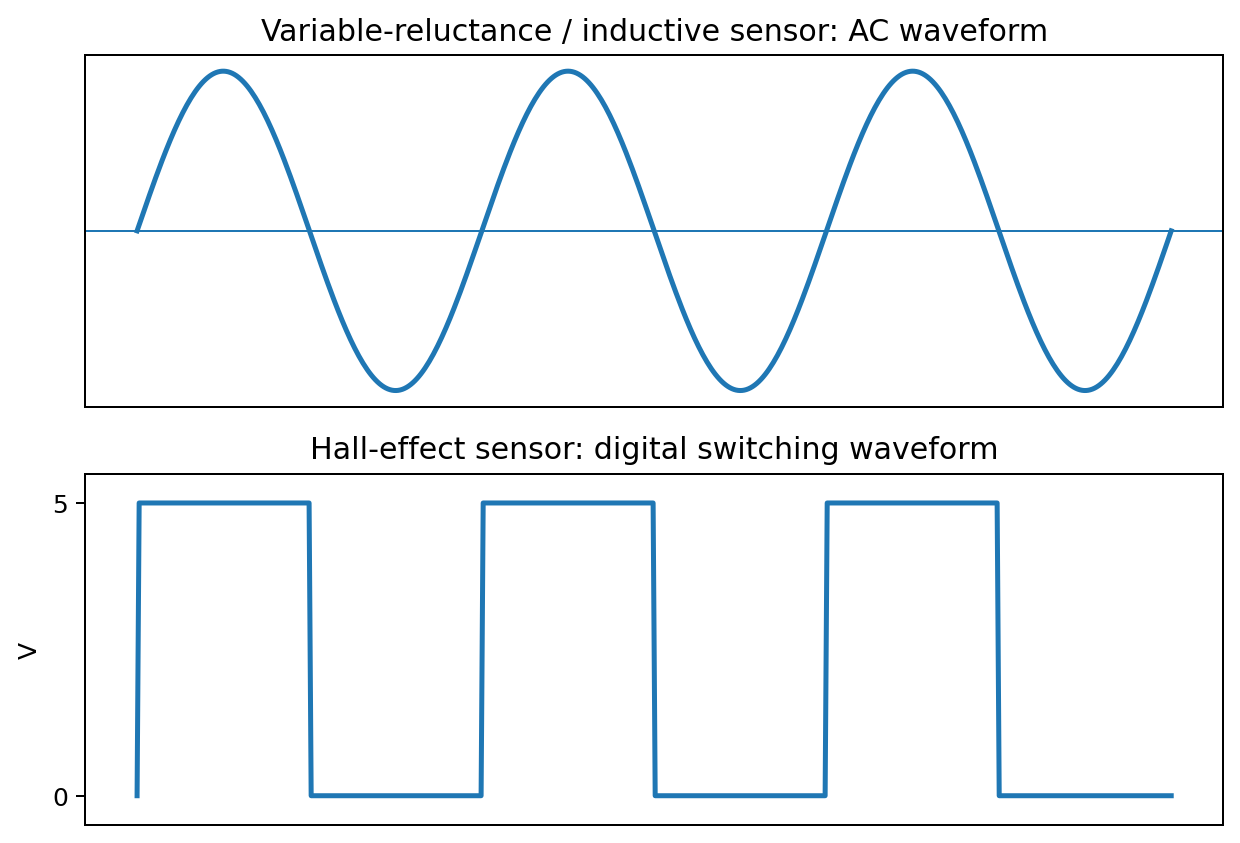
Figure: Hall-Effect, Magnetoresistive and Variable-Reluctance Sensors