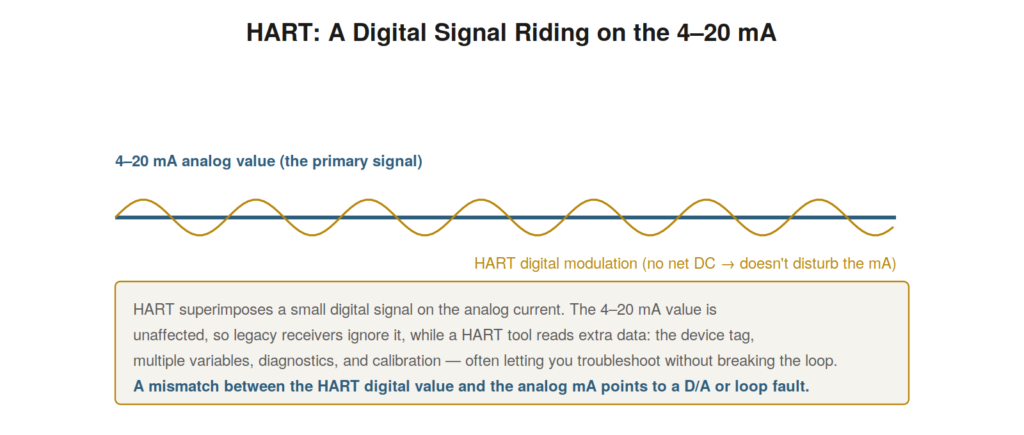
Many modern transmitters carry a digital signal superimposed on the 4–20 mA current — most commonly HART — that adds a wealth of information and diagnostic capability without disturbing the analog signal. Understanding what HART is and how it relates to the current loop is increasingly important, because it changes how loops can be configured and troubleshot.

A digital signal that does not disturb the analog
HART works by superimposing a small digital signal on the analog 4–20 mA current, using a modulation that averages to zero so it does not change the average current that the analog reading depends on. This means the analog 4–20 mA value continues to work exactly as before — legacy receivers read the current normally, unaware of the digital signal riding on it — while a HART-capable tool or system can read the superimposed digital data. The cleverness is that the two coexist on the same wires: the analog current carries the primary measurement as always, and the digital HART signal carries additional information without interfering. Understanding this coexistence explains how HART adds capability to an ordinary current loop without replacing it: the loop remains a 4–20 mA loop, fully compatible with everything that reads the analog current, with the digital signal as an optional extra layer for those equipped to read it.
What HART provides
The digital HART signal carries far more than the single analog value can. It can provide the device’s tag and identity, multiple process variables from one transmitter, diagnostic information about the device’s health, configuration and range settings, and calibration data — all readable with a HART communicator or a HART-capable control system. For troubleshooting, this is powerful: you can interrogate the transmitter digitally to read its status, its own view of the measurement, its configuration, and any faults it has detected, often without breaking the loop or even going to the field if the HART signal is accessible at the control system. Understanding what HART provides opens up troubleshooting approaches unavailable with a purely analog loop, because the transmitter can tell you about itself digitally. The extra data — identity, multiple variables, diagnostics, configuration — turns the transmitter from a device that only outputs a current into one you can query for a detailed picture of its state, which is a significant troubleshooting advantage.
HART in troubleshooting
HART changes loop troubleshooting by adding a digital window into the transmitter alongside the analog current. A particularly useful check is comparing the transmitter’s own digital reading of its measurement (via HART) with the analog current the loop is carrying: if they disagree, the fault is likely in the digital-to-analog conversion or the analog loop, whereas if they agree but the control-system value is wrong, the scaling is suspect. HART also lets you read the transmitter’s self-diagnostics, which may directly report a detected fault, and check its configuration and range without disturbing the loop. Using HART, much troubleshooting that would require field measurement and loop-breaking can be done by digital interrogation, faster and less invasively. Understanding HART as a complementary digital layer — the analog current still the primary signal, the digital HART data a rich diagnostic supplement — lets you use both in troubleshooting: the analog current for the fundamental signal and fault signatures, and the HART data for the transmitter’s own detailed report on itself, together giving a fuller picture than either alone.
Troubleshooting a loop with HART
HART transforms certain troubleshooting tasks by letting the transmitter tell you about itself digitally. A powerful technique is to compare the transmitter’s digital reading of its own measurement with the analog current the loop carries: since both come from the same transmitter, agreement confirms the transmitter and its analog output are consistent, while disagreement points to a problem in the digital-to-analog conversion or the analog loop between them. Reading the transmitter’s HART diagnostics may directly reveal a detected fault, and reading its configuration via HART lets you verify the range and settings without disturbing the loop. You can often do all this from where the HART signal is accessible, without breaking the loop or even going to the field. So HART adds a digital diagnostic channel that complements the analog troubleshooting: the analog current gives fault signatures and the fundamental signal, while HART gives the transmitter’s own detailed self-report. Using both — analog current for the signature and basic behavior, HART for the transmitter’s internal view — gives a fuller and faster diagnosis than the analog signal alone, which is why HART capability is so valued in modern instrument troubleshooting.
Scenario: diagnosing without leaving the control room
A scenario shows HART’s convenience. A loop was reading suspect, and traditionally a technician would go to the field, break into the loop, and measure — a trip and an intervention. But this transmitter was HART-capable and the HART signal was accessible from the control room. The technician interrogated the transmitter over HART from the control room, reading its digital view of the measurement, its diagnostics, and its configuration. The HART data showed the transmitter’s own reading and confirmed its health, and comparing the HART digital value to the analog current the system was receiving localized the issue — in this case revealing that the transmitter and its analog output agreed, so the fault was in the control-system scaling, found and corrected in the configuration. The whole diagnosis was done from the control room, without a field trip or breaking the loop, thanks to HART. This scenario shows how HART can streamline troubleshooting: the transmitter’s digital self-report, accessible remotely, allows much diagnosis to be done without field intervention, comparing the digital and analog views to localize faults quickly and non-invasively, which is a significant efficiency gain over purely analog, field-based troubleshooting.
HART does not replace understanding the loop
A caution is warranted: HART is a powerful aid, but it does not replace understanding the analog loop, and the best troubleshooting uses both together. HART tells you the transmitter’s digital view, but the analog current is still the signal the control system acts on, and faults can lie in the analog loop — the wiring, the sense resistor, the analog input — that HART does not directly diagnose. A loop can have a correct HART digital value but a faulty analog current, if the fault is in the analog path after the transmitter’s digital reading. So HART complements but does not supersede the analog understanding: you still need to know the loop as a circuit, read the analog current and its signatures, and reason about the analog path, using HART as an additional digital window rather than a complete replacement for analog troubleshooting. The technician who relies solely on HART and neglects the analog loop may miss analog-path faults; the one who understands the loop and also uses HART has the fullest toolkit. HART enriches loop troubleshooting, but the foundational understanding of the analog current loop — everything this book teaches — remains essential, with HART as a valuable complement to it rather than a substitute for it.
The analog loop in a digital age
HART represents a graceful bridge between the analog loop and the digital age, and understanding this positions the current loop in its modern context. Rather than replacing the analog loop with a purely digital system, HART adds digital capability while preserving the analog signal, so the loop gains digital data without losing analog compatibility. This lets the vast installed base of analog loops acquire digital diagnostics and data incrementally, and lets new installations enjoy digital features on a still-robust analog foundation. The current loop, far from being made obsolete by digital technology, has absorbed it via HART, remaining relevant by carrying both analog and digital. This graceful coexistence is a large part of why the loop endures in the digital age: it did not have to be replaced, because it could be augmented. Understanding HART as this bridge — digital capability preserving analog compatibility — positions the current loop correctly in the modern landscape: not a legacy technology awaiting replacement, but a living standard that has evolved to carry digital data while retaining its analog robustness. The loop technician of today works with this hybrid — analog current plus digital HART — and understanding both, and how HART bridges them, is understanding the current loop as it actually exists in the modern plant.
When to reach for HART
Knowing when to reach for HART in troubleshooting — and when the analog approach suffices — makes the most of the digital capability. Reach for HART when you want the transmitter’s own view: its digital reading, its self-diagnostics, its configuration, especially to compare against the analog current or to check settings without going to the field. HART is particularly valuable for interrogating a suspect transmitter, verifying configuration, and doing remote diagnosis. The analog approach — reading the current and its signature, measuring around the loop — suffices and is appropriate for the fundamental loop behavior, the fault signatures, and faults in the analog path that HART does not directly diagnose. Often the best approach uses both: the analog current for the signature and basic diagnosis, and HART for the transmitter’s self-report when that would help. Knowing when each is useful — analog for the loop’s fundamental behavior and analog-path faults, HART for the transmitter’s digital self-report and configuration — lets you apply the right tool to each part of a diagnosis. HART is a powerful addition, but reaching for it appropriately — when the transmitter’s digital view helps, alongside the analog reading for everything else — uses it to best effect, complementing rather than replacing the analog troubleshooting that remains the foundation for the loop’s fundamental behavior and its analog-path faults.
HART and the future of the loop
HART points to the likely future of the current loop — not replacement but continued evolution, carrying more digital capability on the enduring analog foundation — and understanding this positions your loop skills as durable. Rather than the loop being superseded, HART shows it absorbing digital features while retaining analog robustness and compatibility, suggesting a future where loops carry ever more digital data and diagnostics without abandoning the analog signal that makes them robust and universal. This evolutionary path means the current loop, and the skills to work with it, will remain relevant far into the future, augmented rather than replaced. Your investment in understanding loops — the analog fundamentals and the digital additions like HART — is therefore durable, applying to loops as they continue to evolve along this augmenting path. The loop is not a technology to be replaced but one that evolves, and skills for it remain valuable as it does. Understanding HART as pointing toward this future — continued evolution on an enduring analog foundation — positions your loop competence as a lasting skill, relevant to loops as they are and as they will be, augmented with digital capability but grounded in the analog fundamentals that this book teaches and that will remain the foundation of the current loop for the foreseeable future. The loop endures and evolves, and so does the value of understanding it.