Beginner question: What can I safely prove before buying any part?
A headlight fault can be as simple as a failed bulb or as complex as a body-control module command problem. First identify the pattern. Is one lamp out or both? High beam, low beam, daytime running lights, or all modes? Is the failure permanent or intermittent?
If only one conventional bulb is out, compare the left and right sides. Check the bulb, connector condition, power, and ground. If both sides fail simultaneously, a shared fuse, relay, switch input, module command, or power supply becomes more likely.
What to Look For
Work from the symptom outward. Note what still works, what fails at the same time, and whether the fault changes with heat, vibration, rain, or electrical load. These observations often tell you where to measure first.
Modern LED and adaptive headlamp systems can contain drivers, modules, leveling motors, and network communication. These systems may require scan-tool diagnostics and manufacturer procedures rather than simple bulb replacement.
Discolored or melted headlamp connectors deserve attention because heat damage increases resistance and can return even after a new bulb is installed.
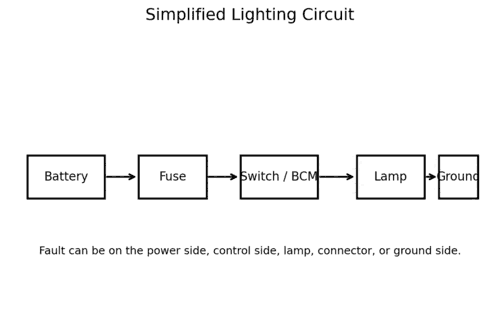
Beginner Diagnostic Checklist
- Verify the exact symptom before touching anything.
- Check battery condition and obvious power/ground connections when relevant.
- Check the correct fuse and connector condition.
Stop and get help if: airbag, high-voltage, or safety-critical circuitry is involved.