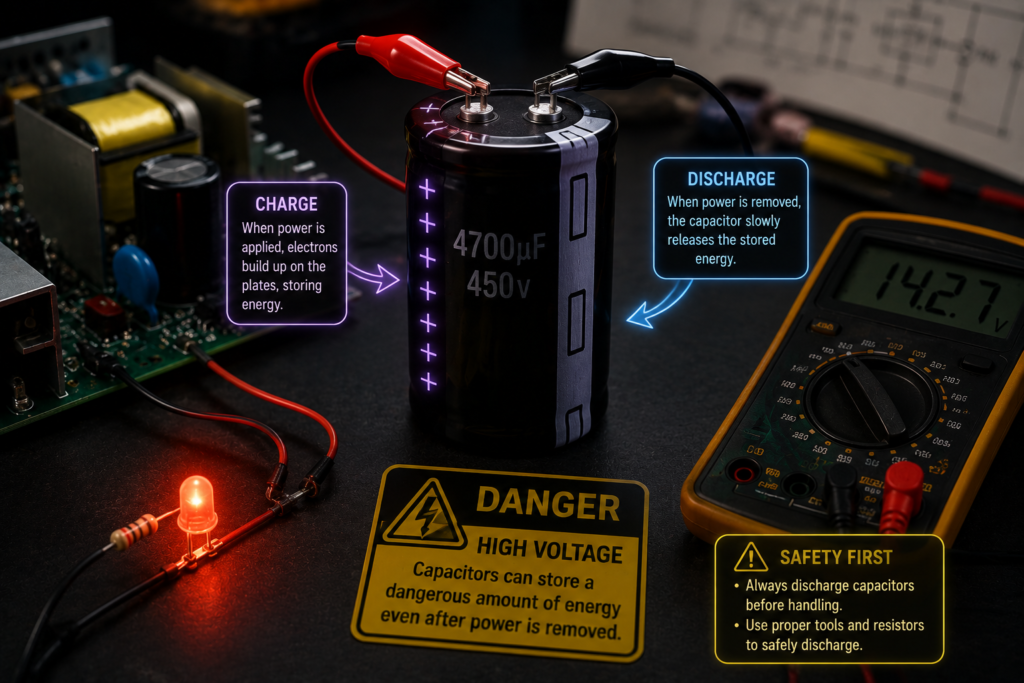
Switching off the power feels final.
The display goes dark, the fan stops spinning, and the equipment becomes silent. Naturally, you assume the electricity is gone.
Sometimes it isn’t.
Inside many electronic devices, capacitors can remain charged after the plug has been pulled or the main switch has been turned off. Small capacitors may hold only a harmless amount of energy for a brief moment. Large capacitors, however, can retain a dangerous voltage for minutes, hours or—in poorly designed equipment—even longer.
That is why warning labels inside power supplies often say something along the lines of “Danger: stored charge” or “Wait before servicing.”
The equipment may be disconnected from the wall, but a capacitor does not care about appearances. Until it has a path through which to discharge, the energy can remain sitting there, quietly waiting.
What Is a Capacitor?
A capacitor is a component designed to store separated electric charge.
At its simplest, it consists of two conductive plates placed close together, with an insulating material between them. That insulating layer is called the dielectric.
The two plates do not normally touch each other. Instead, one plate accumulates an excess of electrons while the other is left with a shortage of electrons.
In other words:
- one plate becomes negatively charged;
- the other becomes positively charged;
- an electric field develops between them.
That electric field is where the capacitor’s energy is stored.
It is common to say that a capacitor “stores electricity,” and for everyday explanations that wording is fine. More precisely, though, the capacitor stores energy in an electric field created by separated charge.
A battery stores energy chemically. A capacitor stores it electrically.
Similar outcome, different mechanism.
What Happens When a Capacitor Is Connected to Power?
Suppose a capacitor is connected across a DC power source.
At first, current flows into the capacitor. Electrons build up on one plate while electrons are pulled away from the other. As the charge separation increases, the voltage across the capacitor rises.
Eventually, the capacitor voltage becomes nearly equal to the supply voltage.
At that point, current largely stops flowing in an ideal DC circuit. The capacitor is considered charged.
The amount of charge it stores is described by:
[
Q = CV
]
Where:
- (Q) is the stored charge in coulombs;
- (C) is capacitance in farads;
- (V) is voltage across the capacitor.
A larger capacitance allows more charge to be stored at the same voltage. Raising the voltage also increases the stored charge.
Simple enough.
The stored energy, however, becomes especially important when discussing safety.
How Much Energy Does a Capacitor Store?
The energy stored in a capacitor is calculated using:
[
E = \frac{1}{2}CV^2
]
Where:
- (E) is energy in joules;
- (C) is capacitance in farads;
- (V) is voltage.
Notice that the voltage is squared.
That little number two matters quite a lot.
If the voltage doubles, the stored energy does not merely double—it becomes four times greater. This is one reason high-voltage capacitors deserve serious respect even when their capacitance does not look enormous.
For example, consider a 470-microfarad capacitor charged to 400 volts:
[
E = \frac{1}{2}\times0.00047\times400^2
]
That works out to approximately:
[
E = 37.6\text{ joules}
]
That is not a trivial amount of stored energy. Released quickly, it can create a fierce spark, damage tools, vaporise small pieces of metal and cause severe electric shock.
And that is just one capacitor.
Industrial drives, large power supplies, uninterruptible power systems and electric-vehicle electronics may contain entire capacitor banks.
Why Does the Charge Remain After Power Is Removed?
Removing the power source stops additional energy from entering the capacitor.
It does not automatically remove the charge already stored inside it.
For the capacitor voltage to fall, charge must flow from one plate to the other through some conductive path. That path might be:
- a resistor;
- an electronic circuit;
- a motor winding;
- a measurement instrument;
- leakage through the capacitor itself;
- a person touching the wrong points.
Without a discharge path, an ideal capacitor would remain charged forever.
Real capacitors are not ideal. They have internal leakage, so their voltage gradually decreases over time. However, the leakage may be extremely small. Depending on the capacitor, the circuit and environmental conditions, a dangerous voltage may remain for surprisingly long.
This is the key idea:
Turning off the supply stops charging, but discharging is a separate process.
People often mix those two events together. Electrically, they are not the same thing.
Capacitors Do Not Store Charge Perfectly Forever
A real capacitor slowly loses charge due to leakage current.
The dielectric material is an insulator, but no physical insulation is absolutely perfect. A tiny amount of current can pass through the dielectric, across the surface of the component or through connected circuitry.
Eventually, this leakage reduces the voltage.
How quickly that happens varies dramatically.
A small capacitor connected across a resistor may discharge almost instantly. A large capacitor disconnected from every load could remain charged much longer. Temperature, humidity, capacitor type, age and condition all influence leakage.
An old or damaged capacitor may leak more quickly, though that is hardly a safety strategy.
You should never assume a capacitor is safe simply because the equipment has been unplugged for a while.
“Surely it must be empty by now” is not a measurement.
What Determines the Discharge Time?
When a charged capacitor discharges through a resistor, the voltage does not normally fall at a constant rate.
It decreases exponentially.
The speed of this process depends on the circuit’s time constant, written using the Greek letter tau:
[
\tau = RC
]
Where:
- (R) is resistance in ohms;
- (C) is capacitance in farads;
- (\tau) is time in seconds.
After one time constant, the capacitor voltage has fallen to about 36.8% of its initial value.
After two time constants, about 13.5% remains.
After three, roughly 5%.
After five time constants, the voltage has fallen below 1% of its starting value. Engineers often treat five time constants as approximately fully discharged, although whether the remaining voltage is safe depends on the original voltage and the application.
A capacitor initially charged to 400 volts would still have approximately 4 volts after five time constants. That may be harmless in one situation, but the general principle remains: you calculate or measure rather than guess.
A Simple Discharge Example
Imagine a 1,000-microfarad capacitor discharging through a 10-kilohm resistor.
First, convert the values:
[
C = 1{,}000\ \mu F = 0.001\ F
]
[
R = 10{,}000\ \Omega
]
The time constant is:
[
\tau = RC
]
[
\tau = 10{,}000\times0.001
]
[
\tau = 10\text{ seconds}
]
After approximately 10 seconds, about 36.8% of the initial voltage remains.
After around 50 seconds—five time constants—the capacitor is close to fully discharged.
Change the resistance or capacitance, though, and the result changes. A larger resistor slows the discharge. A larger capacitor does too.
This is why different devices specify different waiting periods before servicing.
Why Not Let the Capacitor Discharge Instantly?
A capacitor can release energy extremely quickly if connected through a very low resistance.
That sounds useful until you see what it does.
Directly shorting a charged capacitor with a screwdriver, wire or metal tool can produce:
- a violent spark;
- molten metal;
- damage to the capacitor terminals;
- welded tools;
- burns;
- flying debris;
- damage to nearby electronics;
- capacitor rupture.
It may also create a current surge large enough to frighten even someone who was expecting it. Not exactly elegant troubleshooting.
A resistor allows the capacitor to discharge in a controlled manner. It limits current and converts the stored energy into heat over time.
However, the resistor must have an appropriate resistance, voltage rating and power capability. Using a random tiny resistor across a large, high-voltage capacitor can cause the resistor itself to overheat, fail or flash over.
Large capacitors should be discharged according to the equipment manufacturer’s procedure by someone qualified to work on that system.
The screwdriver trick belongs in the “things people used to do and somehow survived” category.
What Is a Bleeder Resistor?
Many circuits include a bleeder resistor permanently connected across a capacitor.
Its job is to provide a discharge path after power is removed.
During normal operation, a small current continuously flows through the resistor. Once the supply is switched off, the resistor gradually drains the capacitor’s stored charge.
Bleeder resistors are common in:
- power supplies;
- variable-frequency drives;
- amplifiers;
- high-voltage test equipment;
- industrial DC-link circuits;
- mains-powered electronics.
A properly selected bleeder resistor can reduce the voltage to a safer level within a predictable period.
There is a trade-off, of course.
A lower resistance discharges the capacitor faster but wastes more power and produces more heat during normal operation. A higher resistance wastes less power but takes longer to discharge.
Engineering is full of these little bargains.
Can a Bleeder Resistor Fail?
Yes.
Resistors can go open circuit because of age, overheating, manufacturing defects, mechanical damage or electrical stress. Connections can also break.
When that happens, a circuit that normally discharges within seconds may remain charged for much longer.
This is why trained technicians do not rely exclusively on the expected discharge time. They verify the voltage using a suitably rated measuring instrument.
The warning label may say “wait five minutes,” but waiting five minutes does not prove that the discharge circuit worked.
It only proves that five minutes passed.
Why Can Capacitor Voltage Seem to Return?
Here is one of the stranger capacitor behaviours.
A capacitor may be discharged, left disconnected and then show a small voltage again later. This effect is known as dielectric absorption, sometimes informally called capacitor soakage.
The dielectric material does not release all its stored polarisation immediately. After the capacitor is discharged, some charge can redistribute internally, causing voltage to reappear across the terminals.
Usually the returning voltage is much lower than the original value. Still, in high-voltage or high-capacitance equipment, it may be significant enough to matter.
This is another reason large capacitors may be left connected to a proper discharge device during service rather than discharged once and assumed permanently safe.
Capacitors can be stubborn little things.
Why Large Capacitors Are More Dangerous
Capacitor danger depends on more than voltage alone.
Several factors matter:
- stored energy;
- capacitance;
- voltage;
- internal resistance;
- discharge path;
- contact conditions;
- location of the current path through the body.
A tiny static-electricity spark may involve thousands of volts, but the stored energy is generally very low and the discharge lasts an extremely short time.
A large capacitor may have a lower voltage but far more stored energy. It can maintain current longer and release enough energy to cause burns, muscle contraction, heart disruption or serious physical injury.
Large capacitors also have very low internal resistance. This means they can deliver enormous current during a short circuit.
The result may be a loud bang and a brilliant flash. Dramatic, yes. Safe, absolutely not.
Where Are Dangerous Capacitors Found?
High-energy capacitors appear in more equipment than many people realise.
Microwave ovens
Microwave ovens commonly contain a high-voltage capacitor as part of the circuit powering the magnetron. The voltage involved can be lethal, and the capacitor may remain charged after the appliance is unplugged.
Opening a microwave oven is not ordinary DIY repair territory.
Power supplies
Computer power supplies, television power boards, chargers and industrial power converters often rectify mains AC into high-voltage DC. Their large electrolytic capacitors may operate at several hundred volts.
Even when the device stops working, the capacitor may still be perfectly capable of holding a charge.
A dead product is not necessarily an electrically dead product.
Variable-frequency drives
VFDs use large DC-link capacitors to smooth rectified voltage before producing a controlled output for a motor.
Many drives include a charge indicator and specify a waiting period after disconnection. The indicator must not be treated as the only proof that the DC bus is safe.
Camera flashes
A camera flash capacitor stores energy and then releases it rapidly through the flash tube. Even relatively small flash circuits can produce a painful shock.
Disposable-camera flash circuits became a popular source of questionable experiments for precisely this reason.
Electric vehicles and hybrid vehicles
Electric vehicles contain high-voltage DC systems with substantial capacitance. Service procedures include isolation, waiting periods and voltage verification.
Orange cables are not a decorative choice.
UPS systems and inverters
Uninterruptible power supplies and inverters contain batteries as well as large capacitors. Disconnecting the mains input may leave energy available from both sources.
Turning off one supply does not guarantee that every part of the circuit is de-energised.
Audio amplifiers
Large amplifiers use capacitors to smooth power-supply rails and provide energy during audio peaks. The voltage may be lower than in mains DC-link circuits, but the capacitance can be considerable.
Shorting one accidentally can still create a memorable afternoon.
Why Capacitors Are Useful Despite the Risk
The ability to retain and release energy is not an unfortunate side effect. It is exactly why capacitors are used.
They perform many useful jobs:
- smoothing rectified voltage;
- filtering electrical noise;
- stabilising power supplies;
- supplying brief bursts of current;
- creating timing delays;
- coupling AC signals;
- blocking DC;
- correcting power factor;
- starting electric motors;
- storing energy for flashes and pulses.
Without capacitors, modern electronics would be much larger, noisier and less reliable—or simply impossible in their current form.
The safety issue appears because a useful stored-energy component remains useful even after the incoming power disappears.
How Do You Know Whether a Capacitor Is Discharged?
You measure it.
A suitably rated multimeter can be used by a qualified person to verify the voltage across a capacitor or DC bus. The meter, probes and test method must all be appropriate for the expected voltage and energy level.
Before making contact with high-voltage equipment, technicians may also prove the meter on a known live source, perform the measurement and then prove the meter again. This helps confirm that the instrument did not fail during the test.
Looking at the circuit is not enough.
Waiting is not enough.
Seeing that the display is dark is definitely not enough.
Voltage verification is what matters.
Basic Capacitor Safety Rules
Capacitors deserve the same respect as any other electrical energy source.
Keep these principles in mind:
- Assume large capacitors are charged until proven otherwise.
- Follow the manufacturer’s specified shutdown and discharge time.
- Do not short capacitor terminals with a screwdriver or loose wire.
- Use properly rated test equipment.
- Verify voltage before touching conductors.
- Remember that dielectric absorption can make voltage reappear.
- Do not work inside microwave ovens, VFDs, high-voltage power supplies or electric vehicles without suitable training.
- Be aware that equipment may have multiple power sources.
- Replace damaged or bulging capacitors rather than experimenting with them.
- Do not assume an indicator light proves the circuit is safe.
For low-voltage hobby circuits, the risk is usually much smaller, but good habits are still worthwhile. They tend to follow you into larger projects later.
Bad habits do too.
Does a Capacitor Behave Like a Battery?
In some ways, yes.
Both components can store energy and provide voltage after the original power source is removed. Both can deliver current to a connected load.
But their behaviour is different.
A battery normally maintains a relatively steady voltage over much of its discharge period. A capacitor’s voltage falls continuously as charge leaves it.
A battery stores energy through chemical reactions. A capacitor stores energy in an electric field.
Capacitors can also charge and discharge far faster than most batteries. This makes them ideal for short bursts of power, filtering and rapid energy transfer.
A battery is more like a water tank that supplies pressure for an extended period. A capacitor is closer to a stretched spring—it can release energy very quickly, but the force falls as the stored energy disappears.
No analogy is perfect, but this one gets reasonably close.
Power Removed Does Not Mean Energy Removed
A capacitor can remain charged because disconnecting the supply does not automatically provide a route for the stored charge to escape.
The separated charge on its plates creates an electric field, and that field contains energy. Until a resistor, circuit or some other conductive path allows the charge to flow, the voltage remains.
Small capacitors usually discharge quickly and hold little energy. Large capacitors may retain dangerous voltages and deliver extremely high currents if accidentally shorted.
That is the part worth remembering.
The plug may be lying on the floor. The switch may say “off.” The screen may be completely black.
The capacitor can still be live.