Instrumentation and control technicians keep industrial processes measurable, stable, and safe.
Instead of working mainly with motors, conveyors, and machine sequences, an I&C technician often deals with pressure, temperature, flow, level, analytical measurements, control valves, transmitters, PLCs, distributed control systems, and industrial communication networks.
The role is common in chemical plants, oil and gas, power generation, water treatment, pharmaceuticals, food processing, paper mills, and other continuous-process industries.
There is no single route into the profession. Some people begin through an instrumentation apprenticeship or technical college programme. Others move across from electrical maintenance, industrial automation, or mechanical maintenance.
Understand What the Job Actually Involves
An I&C technician may install, calibrate, test, troubleshoot, and replace instruments that measure process variables.
Typical equipment includes:
- Pressure and differential-pressure transmitters
- Temperature sensors and transmitters
- Flowmeters
- Level instruments
- Control valves and positioners
- Gas and analytical instruments
- Signal isolators and converters
- PLC and remote I/O systems
- Distributed control systems
- Safety instrumented systems
The technician may investigate why a flow reading is unstable, calibrate a pressure transmitter, test a 4–20 mA loop, repair an air-operated control valve, or determine why a PLC input does not match the field measurement.
ISA describes control systems technicians as people who calibrate, document, troubleshoot, and repair instrumentation used to measure and control variables such as pressure, flow, temperature, and level.
Build the Electrical Foundation
You do not need to become a power-system specialist, but you must understand industrial electricity.
Important subjects include:
- DC and AC fundamentals
- Series and parallel circuits
- Voltage, current, resistance, and power
- Relays and control circuits
- Electrical drawings
- Earthing and shielding
- Multimeter use
- Electrical isolation
- 24 V DC control systems
Many instrument faults initially look like transmitter failures but are actually caused by missing loop power, damaged wiring, incorrect polarity, poor grounding, loose terminals, or failed input cards.
An electrician or industrial maintenance technician already has a strong starting point. The main transition is learning process measurement and analog control in greater depth.
Learn the Main Instrument Signals
Begin with 4–20 mA current loops. They remain one of the most important signal standards in industrial instrumentation.
You should understand:
- Two-wire and four-wire transmitters
- Loop-powered instruments
- Active and passive signals
- Analog input wiring
- Signal scaling
- Open-circuit and out-of-range behaviour
- HART communication
- Galvanic isolation
- Shielding and electrical noise
After that, learn 0–10 V signals, resistance temperature detectors, thermocouples, pulse signals, digital instruments, and common communication protocols.
Do not only memorise wire diagrams. Practise measuring loop current, injecting a test signal, identifying whether the PLC card or field device supplies power, and calculating the expected process value from the measured current.
Study Process Measurement
Instrumentation is not just electronics. You need to understand what is being measured.
Learn the operating principles, strengths, and limitations of common instruments.
For example, pressure can be used to infer tank level. Differential pressure can measure flow across a restriction. Temperature sensors respond differently depending on their construction and installation. Radar level measurement behaves differently from a float switch or hydrostatic transmitter.
A useful starting syllabus includes:
- Pressure measurement
- Temperature measurement
- Flow measurement
- Level measurement
- Control-valve operation
- Instrument installation
- Calibration and uncertainty
- Process safety fundamentals
Siemens’ current introductory process-instrumentation training covers pressure, temperature, level and flow measurement, together with electro-pneumatic valve positioners.
Learn Calibration Properly
Calibration is more than adjusting an instrument until its display looks correct.
You should be able to:
- Identify the required measurement range.
- Isolate the instrument safely.
- Apply a known reference input.
- Compare the instrument output with the expected value.
- Check several points across the range.
- Record as-found results.
- Adjust the instrument when permitted.
- Record as-left results.
- Restore the loop and perform a functional test.
Become familiar with pressure pumps, process calibrators, temperature simulators, resistance decade boxes, loop calibrators, and documenting instruments.
Good documentation matters in regulated industries because the company may need evidence that instruments were tested using appropriate procedures and traceable reference equipment.
Add PLC and Control-System Skills
An I&C technician is not always expected to write complete PLC programs, but they should understand how field instruments connect to the control system.
Learn how to:
- Monitor analog inputs online
- Scale raw signals into engineering units
- Identify bad-quality or out-of-range signals
- Follow interlocks and permissives
- Read control logic
- Interpret alarms
- Back up controller projects
- Diagnose communication faults
- Work with HMI and DCS displays
Also learn basic process-control concepts such as setpoint, process variable, controller output, automatic mode, manual mode, proportional control, integral action, and PID loops.
You should be able to determine whether a control problem comes from the transmitter, controller, valve, process, or incorrect tuning.
Get Practical Experience
Instrumentation cannot be learned completely from video courses.
Build a small low-voltage practice setup using:
- 24 V DC power supply
- 4–20 mA signal generator
- PLC analog input
- Pressure or temperature transmitter
- Loop calibrator or multimeter
- Small pneumatic control valve, where practical
- HMI or computer dashboard
Practise creating faults. Disconnect the loop, reverse the polarity, introduce an incorrect range, change the PLC scaling, and simulate a stuck valve.
For employment, search for positions such as:
- Junior instrument technician
- Electrical and instrumentation technician
- Calibration technician
- Process-control technician
- Automation maintenance technician
- Instrumentation apprentice
- Commissioning technician
Water plants, manufacturing sites, calibration companies, system integrators, and instrument suppliers can all provide entry routes.
Consider Recognised Certifications
Certifications are most useful when they confirm skills you have already begun developing.
ISA’s Certified Control Systems Technician certification has several levels and requires a combination of education, training, relevant work experience, and an examination. Level I requires seven years of combined education, training, and related work experience, including at least two years in instrumentation or measurement and control.
For people who do not yet meet those experience requirements, ISA’s CST Associate programme provides an earlier training route and counts as one year of work experience toward CCST eligibility.
Technicians working in explosive atmospheres may also need specialised hazardous-area competence. CompEx offers qualifications for electrical and instrumentation personnel working around explosive gases, vapours, and combustible dusts. Advanced practical qualifications generally expect the learner to already be a practising technician with relevant experience.
Certifications do not replace site experience, but they can demonstrate structured knowledge and safety awareness.
The Realistic Career Path
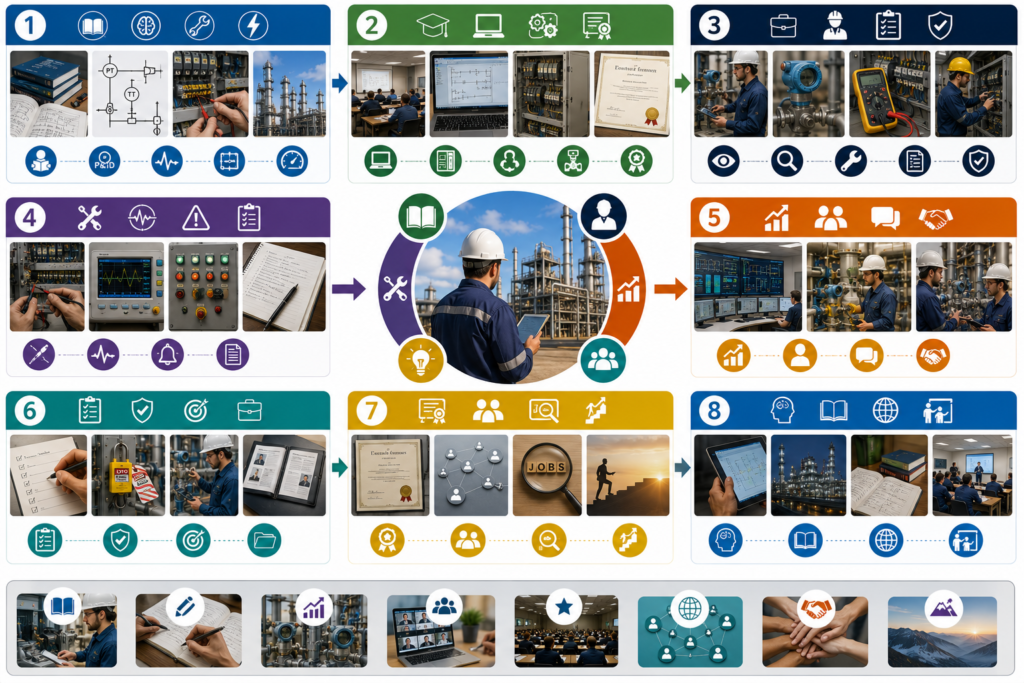
A practical progression might look like this:
Stage 1: Build electrical and measurement fundamentals.
Stage 2: Learn 4–20 mA loops, calibration, transmitters, valves, and process variables.
Stage 3: Gain hands-on experience through maintenance, calibration, commissioning, or an apprenticeship.
Stage 4: Add PLC, DCS, networking, and PID-control knowledge.
Stage 5: Specialise in areas such as hazardous locations, safety systems, analyzers, process control, or commissioning.
The strongest I&C technicians combine three abilities: they understand the field instrument, they can trace the signal through the control system, and they understand how the process should behave.
That combination takes time to develop, but it makes instrumentation and control one of the most technically varied and valuable maintenance careers in industry.