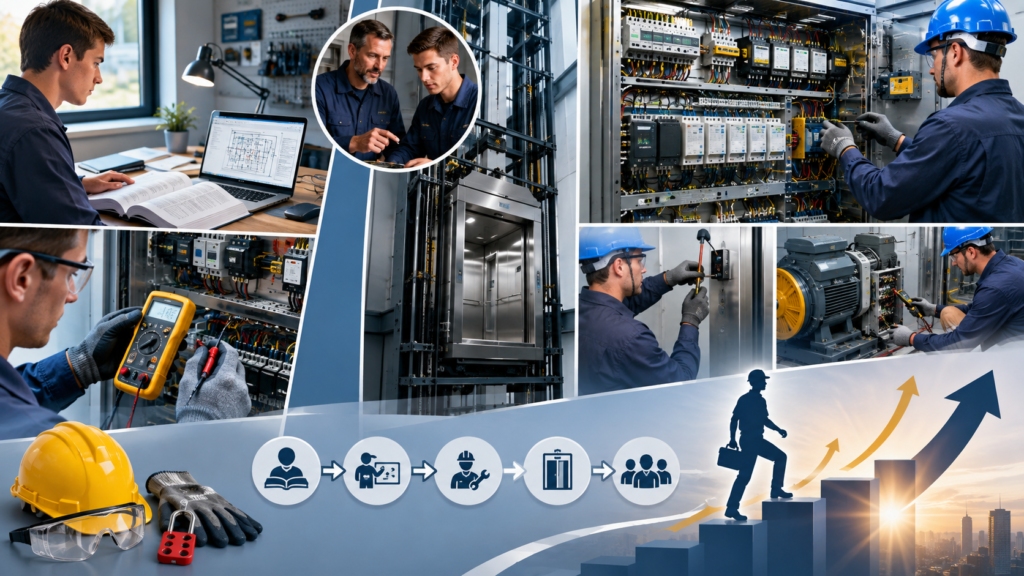
Elevator control work combines industrial electricity, automation, mechanical systems, safety engineering, and field service.
A lift technician may troubleshoot door circuits, position sensors, motor drives, brakes, encoders, safety chains, communication networks, and controller faults—sometimes during a passenger entrapment or in a building where one failed lift creates an immediate operational problem.
It can be an excellent career for an electrician, maintenance technician, or automation specialist. However, elevators are safety-critical systems. This is not a field where someone should learn by experimenting alone on operational equipment.
Understand the Different Career Routes
“Elevator technician” can describe several different jobs.
Installation technicians assemble new elevators, install rails and machinery, wire control equipment, fit landing devices, and prepare the system for testing.
Service technicians perform preventive maintenance, respond to breakdowns, release trapped passengers where authorised, and troubleshoot electrical and mechanical faults.
Modernisation technicians replace obsolete controllers, drives, door operators, wiring, indicators, safety devices, and sometimes complete traction systems.
Test and commissioning engineers verify that a newly installed or modernised lift operates correctly and meets applicable requirements.
Control engineers design or configure controller software, drive systems, group control, destination dispatch, remote monitoring, and building-system interfaces.
Most people enter through installation or maintenance and specialise later.
Build the Correct Technical Foundation
Elevators are electromechanical systems. PLC knowledge alone is not enough.
Useful foundational skills include:
- Industrial electrical troubleshooting
- Reading electrical schematics
- Three-phase motors and drives
- Relays, contactors, and safety circuits
- Encoders and position sensors
- Mechanical brakes and traction systems
- Door motors, locks, and detection devices
- Industrial communication networks
- Safe isolation and test procedures
You should understand how the lift controller receives a call, checks its safety conditions, releases the brake, controls the motor, determines car position, levels at the floor, and confirms that the doors are safely locked.
Many lift problems are not software faults. A damaged door contact, contaminated sensor, worn roller, slipping encoder coupling, weak brake, incorrect drive parameter, or intermittent travelling cable can create symptoms that appear to come from the controller.
Learn Through an Employer or Apprenticeship
The safest and most recognised entry route is employment with a lift company that provides structured training.
Look for apprenticeships, trainee technician positions, junior installers, or assistant service roles with:
- Major manufacturers
- Independent lift companies
- Modernisation contractors
- Building-service companies
- Specialist control-panel manufacturers
Lift-industry apprenticeships normally combine technical education with supervised field experience. The UK Lift and Escalator Industry Association, for example, recognises apprenticeship and vocational qualification routes for installation, servicing, and repair work. Its competency framework is intended to establish basic competence for people working on lift and escalator equipment.
Manufacturers also run their own programmes. Schindler describes vocational routes combining technical training with supervised work alongside experienced technicians, while Otis operates lift-engineering apprenticeship programmes in several markets.
Exact qualifications, licensing rules, and permitted work vary by country. Check local requirements before assuming that an electrical qualification alone authorises you to work independently on lifts.
Use Electrical or Maintenance Experience as an Entry Point
Industrial electricians and maintenance technicians already possess many transferable skills.
Experience with VFDs, control circuits, sensors, motor brakes, 24 V DC systems, fault-finding, and schematic reading is especially useful.
When applying, highlight examples such as:
- Diagnosing intermittent safety-circuit faults
- Replacing and commissioning drives
- Testing motors and brakes
- Tracing control wiring
- Troubleshooting encoders
- Working safely around moving machinery
- Maintaining accurate service records
Do not present yourself as an elevator specialist before receiving lift-specific training. Instead, show that you have a strong technical base and can learn under supervision.
Current KONE technician roles commonly seek electrical, electronics, automation, or vocational backgrounds combined with preventive-maintenance and troubleshooting ability.
Learn the Main Elevator Control Systems
Unlike general factory automation, many modern elevators use proprietary controllers rather than standard PLCs.
Depending on the employer, you may encounter controllers and diagnostic tools from KONE, Otis, Schindler, TK Elevator, Mitsubishi, Fujitec, or independent control manufacturers.
Important subjects include:
- Safety-chain operation
- Inspection and normal modes
- Floor-position systems
- Levelling and re-levelling
- Traction-drive control
- Brake monitoring
- Door sequencing
- Call allocation
- Group control
- Fault histories
- Parameter backups
- Remote monitoring
- Emergency and rescue operation
Older lifts may use relay logic or early electronic controllers. Modern systems may use distributed control boards, serial buses, remote diagnostics, variable-frequency drives, and cloud-connected monitoring.
KONE, for example, now combines on-site service with remote diagnostics, monitoring, testing, and certain software actions. This means future technicians will increasingly need networking and digital diagnostic skills alongside conventional mechanical and electrical knowledge.
Take Safety and Standards Seriously
Elevators transport people and contain several hazardous energy sources. Risks include electrical shock, unexpected car movement, moving counterweights, open shafts, stored mechanical energy, door movement, and work at height.
In the European Union, lifts and designated safety components fall under the Lifts Directive 2014/33/EU, which establishes essential safety and conformity requirements. European harmonised standards—including parts of the EN 81 family—provide recognised technical routes for demonstrating compliance.
Technicians do not necessarily perform the complete conformity-assessment process, but they need to understand how their work affects safety functions and regulatory compliance.
Never bypass door locks, brake monitoring, final limits, overspeed protection, or other safety devices merely to restore service. Temporary changes can expose passengers and technicians to serious danger.
Aim for Controls Specialisation Gradually
After gaining field experience, you can move toward control-focused work.
Possible specialisations include:
- Controller commissioning
- Drive setup and tuning
- Modernisation engineering
- Complex fault support
- Remote diagnostics
- Group-control systems
- Destination dispatch
- Building-management integration
- Technical training
- Control-panel design
Commissioning roles may require an electrical-engineering background, detailed knowledge of elevator systems, and the ability to test equipment against relevant standards and safety requirements.
Field experience remains extremely valuable. A controls engineer who understands how doors, brakes, ropes, guides, sensors, and passengers affect real operation will diagnose problems more effectively than someone who knows only the software.
The Realistic First Step
Search for trainee, apprentice, installer assistant, modernisation assistant, or junior service positions in your area. Contact both major manufacturers and smaller independent companies.
Present your electrical, automation, or mechanical experience honestly. Ask what formal qualifications the company provides, how long technicians work under supervision, and whether the role leads toward service, commissioning, or controls work.
You do not enter elevator controls by learning one programming language. You enter by understanding the complete lift, developing safe field habits, and gaining supervised experience on real equipment.
Once that foundation is established, your PLC, drive, networking, and troubleshooting skills can make you particularly valuable in modernisation and advanced control work.