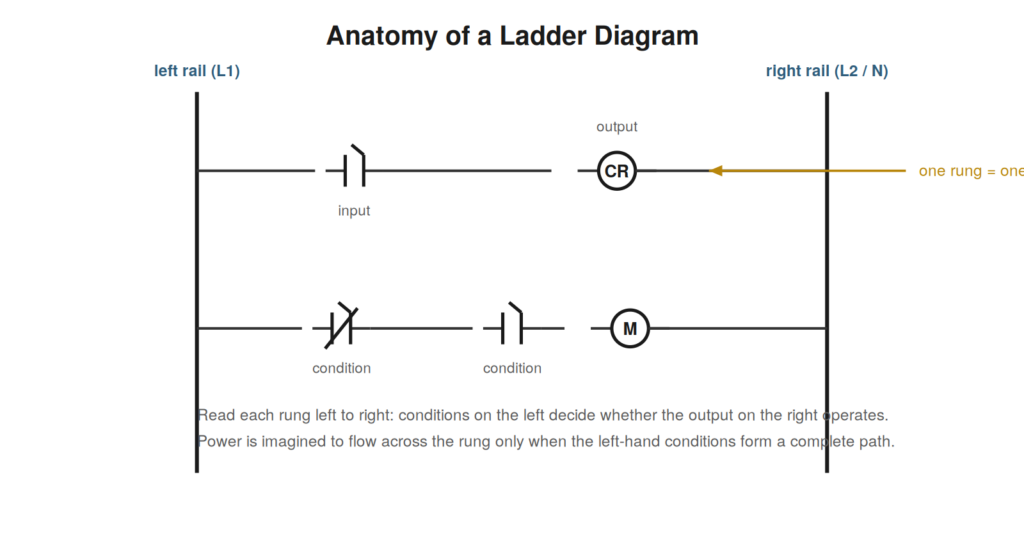
The ladder diagram is the dominant form for control logic in industrial systems, especially in North American practice, and reading it fluently is the central skill of this book. Its name comes from its appearance: two vertical rails like the sides of a ladder, with horizontal rungs between them, each rung a circuit. Once you can read a ladder, you can read the logic of most industrial machines.
Rails and rungs
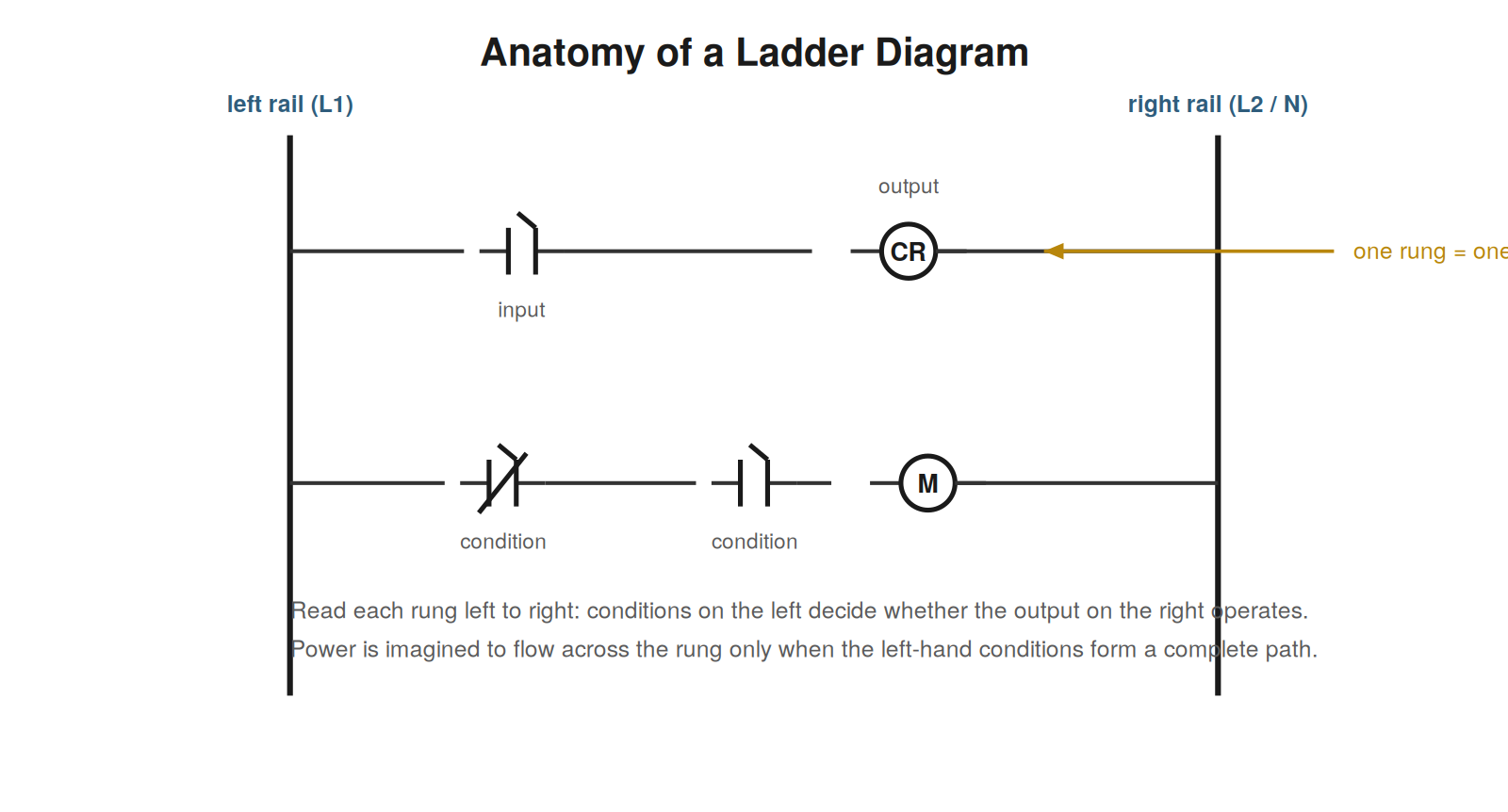
A ladder diagram has two vertical rails representing the two sides of the control power supply — one rail is the source, the other the return. Between them run horizontal rungs, and each rung is a complete circuit from one rail to the other. Power is imagined to flow across a rung from the left rail to the right rail when the rung forms a complete path. This structure organizes the entire control logic: each rung controls one thing, and the rungs are read one at a time, top to bottom, each an independent circuit sharing the same power rails. Recognizing the rails and seeing the logic as a series of independent rungs between them is the first step in reading any ladder.
Reading a rung left to right
Each rung is read from left to right, and its structure is consistent: the conditions are on the left, and the output they control is on the right. The conditions are contacts — inputs, or contacts operated by other coils — arranged in series and parallel to express the logic, and the output is a coil or load at the right end. To read a rung, you ask what must be true for the output to operate, which means asking what arrangement of the left-hand contacts forms a complete path from the left rail to the output. Contacts in series all must be closed; contacts in parallel offer alternative paths. Reading left to right, you accumulate the conditions and arrive at the output, understanding exactly what makes it operate. This left-to-right reading of conditions-then-output is the fundamental act of reading a ladder.
Series and parallel logic
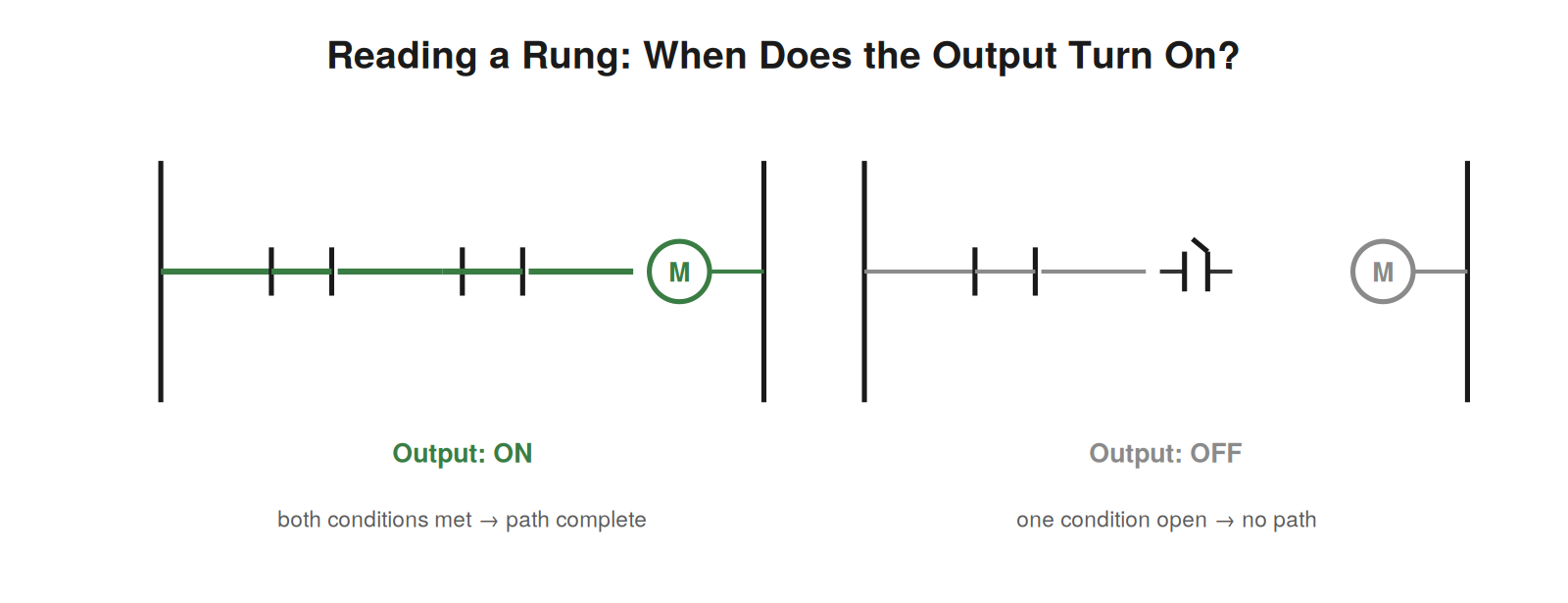
The arrangement of contacts expresses logic through series and parallel connections. Contacts in series — one after another along the rung — represent AND logic: all of them must be closed for the path to complete, so all their conditions must be satisfied. Contacts in parallel — branching so that either path can carry the circuit — represent OR logic: any one of them closing completes that portion of the path. Reading a rung means reading these arrangements as logic: this condition AND that condition (series), or this condition OR that condition (parallel). A rung with several series contacts is a set of requirements all of which must be met; a parallel branch offers alternatives. Seeing series as AND and parallel as OR turns the geometry of the rung into the logic it expresses, which is exactly what reading control logic means.
A worked reading of a multi-condition rung
Take a rung with several conditions and read it fully to practice the skill. The rung, left to right, has: a normally-closed Stop contact, then a normally-open Start contact paralleled with a seal-in contact, then a normally-closed contact from a high-temperature switch, then a normally-open contact from a guard-closed switch, driving a motor coil. Reading it as logic: the motor runs if Stop is not pressed AND (Start is pressed OR the seal-in holds) AND the temperature is not too high (the high-temp NC contact still closed) AND the guard is closed (its NO contact closed). Every series condition must be satisfied. Now the rung’s full behavior is clear: it is a start/stop/seal-in circuit with two added permissives — temperature and guard. This reading, accumulating each condition left to right and combining them with AND and OR logic, is exactly how any rung is read, however many conditions it contains, and practicing it on multi-condition rungs builds the fluency to read complex logic as readily as simple logic.
Reading exercise: translating a rung to plain language
The best test of whether you have read a rung correctly is to translate it into plain language — a sentence stating what makes the output operate. Take a rung and write or say its meaning: ‘The pump runs when the level is low AND the system is enabled AND no fault is present.’ If you can state the rung’s logic in a clear sentence, you have read it; if you cannot, you have not fully understood it, and the attempt reveals where the gap is. This translation exercise forces you to read the contact types (which conditions are ‘is’ versus ‘is not’), the series and parallel arrangement (AND versus OR), and the output, assembling them into meaning. Practicing it on many rungs builds the fluency to read a rung’s logic directly into plain-language meaning, which is the goal — a rung should read as clearly as a sentence. Start with simple rungs and work up to multi-condition ones, always ending with a plain-language statement of what operates the output, and your rung-reading will become both accurate and fast.
Reading complex rungs by decomposition
When a rung is complex — many contacts in intricate series-parallel arrangements — reading it becomes manageable by decomposition: breaking the rung into sub-groups and reading each before combining. A branch of parallel contacts can be read as a single OR condition (‘any of these’); a series string can be read as a single AND condition (‘all of these’); and these sub-results combine into the rung’s overall logic. Rather than trying to grasp the whole complex rung at once, you read it in pieces — this parallel branch means ‘A or B,’ that series string means ‘C and D and E,’ and the rung overall means ‘(A or B) and C and D and E drives the output.’ This decomposition turns an intimidating rung into a combination of simple sub-readings, each easy on its own. Practicing it on complex rungs builds the ability to read arbitrarily intricate logic by breaking it down, which is essential because real control rungs can be quite complex, and reading them whole is overwhelming while reading them by decomposition is straightforward. The skill is to see the sub-structures — the parallel branches and series strings — and read each before assembling the whole.
The order of rungs and why it matters
The order of rungs in a ladder — top to bottom — carries meaning, particularly in PLC ladder logic where rungs execute in sequence, and reading with attention to order deepens your understanding. In a physical relay ladder, all rungs are effectively active together, but their logical relationships still create an implicit order of cause and effect. In PLC ladder logic, rungs execute top to bottom in each scan, so a coil set in an early rung affects contacts in later rungs within the same scan, making rung order significant to the logic’s behavior. Reading a ladder with attention to order means noticing how earlier rungs affect later ones — a coil energized early operating contacts used later — and understanding the flow of logic down the ladder. While simple ladders may not depend heavily on order, complex logic can, and reading it correctly requires following the order of rungs and how each affects those after it. This attention to rung order, especially in PLC logic, is part of reading a ladder fully — not just each rung in isolation but the sequence of rungs and how they interact, which is how the ladder expresses logic that unfolds through the order of its rungs.
Case: reading a rung to explain odd behavior
Sometimes a machine behaves oddly — not failing outright but acting unexpectedly — and reading the relevant rung explains the behavior as the logic correctly doing something you did not anticipate. A machine did something surprising under certain conditions, and rather than a fault, reading the rung revealed the logic was correctly producing that behavior given those conditions — behavior that was designed in but not obvious until read. Reading the rung’s full logic, including a condition that was easy to overlook, showed why the machine acted as it did: the conditions combined, through the rung’s logic, to produce exactly that result. What seemed like odd behavior was the circuit correctly following its logic, and reading the rung carefully revealed the logic that produced it. This case shows that reading explains behavior, not just faults: a machine acting unexpectedly may be following logic you have not fully read, and careful reading of the relevant rung reveals the logic behind the behavior. Understanding a machine’s behavior — expected or surprising — comes from reading its logic, and behavior that seems odd often makes complete sense once the rung is read fully, including the conditions that are easy to miss but that the logic accounts for. Reading the rung turns surprising behavior into understood behavior.
Building ladder-reading speed
Speed in reading ladders comes from practice and pattern recognition, developing from laborious rung-by-rung analysis to fluent reading where familiar structures are grasped at a glance. The beginner reads each rung carefully, working out the logic contact by contact; the experienced reader recognizes patterns — start/stop/seal-in, interlocks, common structures — and reads them instantly, focusing careful analysis only on the unfamiliar parts. This speed develops naturally with exposure but faster with deliberate practice: reading many ladders, recognizing recurring patterns, translating rungs to plain language until it is quick. The pattern recognition is key — much of reading speed comes from recognizing familiar structures rather than analyzing everything from scratch, and building a repertoire of recognized patterns accelerates reading enormously. Practicing ladder reading, especially recognizing and internalizing common patterns, builds the speed that makes reading practical for real work, where you often need to read a ladder quickly under time pressure. The progression from careful rung-by-rung reading to fluent pattern-based reading is the development of ladder-reading skill, and it comes from practice: read many ladders, internalize the patterns, and speed follows, until you read familiar ladder structures as quickly as you read familiar words, reserving careful analysis for the genuinely new.