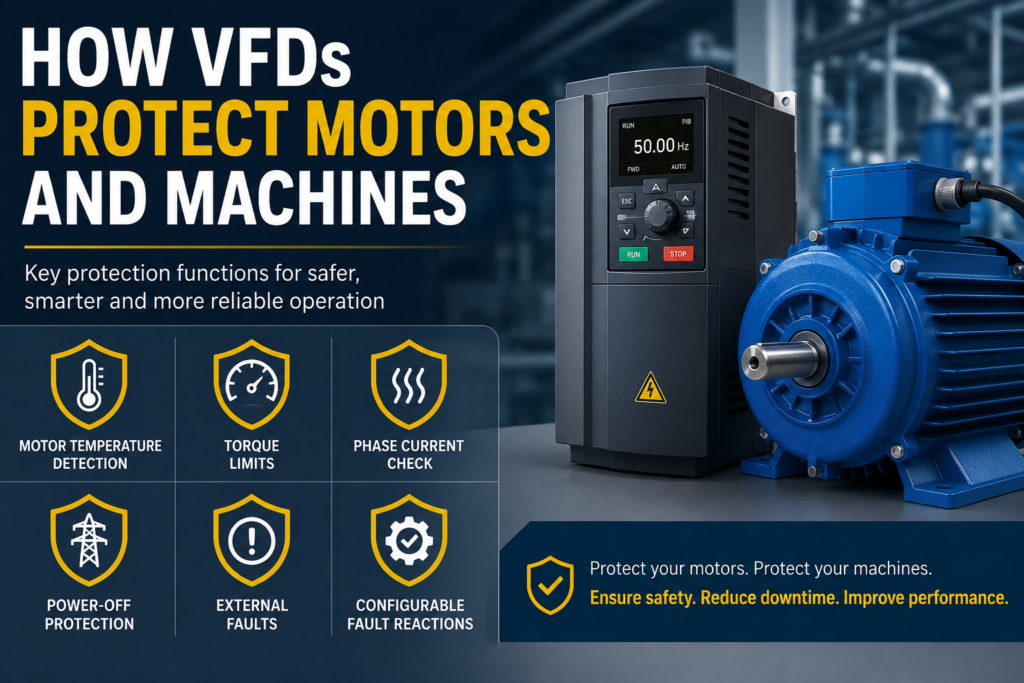
Three-phase motors are everywhere in industry.
They run conveyors, pumps, fans, mixers, saws, compressors, and many other machines that keep production moving. In simple terms, they take electrical power and turn it into mechanical movement.
But there is one important thing to remember:
A motor does not really know when something is wrong.
It will keep trying to run even if it is overloaded, overheating, wired incorrectly, or driving a machine that is close to being damaged. That is why motor control and motor protection are so important.
This is where a Variable Frequency Drive, or VFD, becomes very useful.
A VFD is not only used to control motor speed. It can also help protect the motor, protect the machine, and make the whole system safer and easier to control.
In this post, we will look at some common VFD protection functions and how they help prevent problems in industrial machines.
Why Motor Protection Matters
In many machines, the motor is connected to expensive mechanical parts. Gearboxes, belts, shafts, bearings, pumps, fans, and other components can all be damaged if the motor is not controlled properly.
For example, too much current can overheat the motor. Too much torque can damage the machine. A missing motor phase can create unsafe movement. A power failure can allow a heavy load to coast out of control.
Small electrical problems can quickly become big mechanical problems.
That is why many modern VFDs include built-in protection functions. These functions allow the drive to monitor what is happening and react before serious damage occurs.
1. Motor Temperature Detection
One of the most basic and important protections is motor temperature monitoring.
When a motor works under load, current flows through the windings. This creates heat. Some heat is normal, but too much heat can damage the insulation inside the motor and eventually cause motor failure.
To prevent this, many motors have temperature sensors installed in the windings.
Common motor temperature sensors include:
PTC sensors
KTY sensors
PT1000 sensors
These sensors send temperature information to the VFD. The drive can then monitor the motor and react if the temperature rises too high.
Depending on the setup, the VFD can give a warning, reduce operation, or stop the motor completely.
This is useful because overheating does not always happen instantly. Sometimes the temperature rises slowly. Without monitoring, the operator may not notice anything until the motor is already damaged.
With temperature detection, the drive can catch the problem earlier.
2. Torque Limits
A motor is designed to produce torque. Torque is the force that turns the shaft and moves the machine.
But too much torque can be dangerous.
In some applications, the motor is stronger than the mechanical parts connected to it. If the motor applies too much force, it can damage a gearbox, belt, screw, chain, coupling, or other machine component.
A VFD can help by limiting the amount of torque the motor is allowed to produce.
This is called a torque limit.
For example, if the machine only needs part of the motor’s available torque, the drive can be set so the motor does not go above that value. This protects the machine from unnecessary stress.
Some applications also need different torque limits depending on the direction of rotation.
For example, reverse torque may be dangerous in a machine where backdriving could cause damage or unsafe movement. In that case, the VFD can be configured to limit or block torque in that direction.
This gives better control over how the motor behaves in real machine conditions.
3. Phase Current Check
Many motor and drive faults are caused by wiring problems.
A loose connection, broken cable, missing phase, or short circuit can create serious issues. The difficult part is that these problems are not always easy to see. Motor cables may be hidden inside the machine, inside cable chains, or inside electrical cabinets.
Some VFDs include a phase current check function.
This function checks the motor phase connections before the drive starts the motor.
The drive sends a test signal to the motor output and checks if the three motor phases are connected correctly. It can detect problems with continuity and phase balance before the motor receives real running torque.
This is especially important in applications where the motor controls a load, brake, or vertical movement.
If the drive finds a wiring problem, it can prevent the brake from releasing or stop the motor from producing torque. Instead of starting a dangerous movement, the drive creates a fault and warns the operator that there is a wiring issue.
That is much better than discovering the problem after the machine has already moved.
4. Power-Off Function
Power failures can happen at any time.
Sometimes it is a complete power outage. Sometimes it is only a voltage drop. Either way, losing power while a machine is running can be a big problem.
This is especially true for high-inertia loads.
A high-inertia load is something that keeps spinning for a long time after power is removed. Examples include large fans, saw blades, rollers, centrifuges, or heavy rotating machines.
If the VFD simply shuts off, the motor may coast freely until it stops by itself. In some machines, this is acceptable. In others, it can be unsafe or cause a difficult restart.
Some VFDs include a power-off or controlled power-loss function for these situations.
During a mains failure, the drive can use energy from the decelerating motor and load to support its own DC bus. This gives the drive enough energy for a short time to keep applying controlled deceleration torque.
In simple terms, the drive uses the spinning load to help bring the machine to a safer stop.
This function is useful when a machine should not be allowed to coast freely after a power failure.
5. External Faults
Standard VFD protection functions are useful, but they cannot cover every possible machine problem.
Every application has its own risks.
A hydraulic pump may need pressure protection.
A conveyor may need jam detection.
A fan may need airflow monitoring.
A lifting system may need brake feedback.
For this reason, many VFDs allow external fault inputs or programmable fault logic.
This means the drive can react to external signals from sensors, switches, or other machine devices.
For example, in a hydraulic system, a pressure sensor can be connected to the control system or drive. If the pressure becomes too high, the VFD can stop the motor or trigger a fault.
This allows the machine builder to create protection that fits the real application, not just general motor faults.
It can also improve reaction time, especially when the signal is processed directly by the drive or local control system.
What Happens When a Fault Occurs?
Detecting a fault is only one part of protection.
The next question is:
What should the VFD do when something goes wrong?
In many drives, the standard reaction is to immediately stop modulation. Modulation is the fast switching of the output voltage that controls the motor.
When modulation stops, the motor is no longer actively controlled by the drive. The load then coasts to a stop.
This is similar to turning off a car engine and putting the car in neutral.
Sometimes this is fine. But not always.
If the machine has a heavy rotating load, it may take a long time to stop. If the application is sensitive, uncontrolled coasting may cause product damage, machine damage, or a difficult reset.
Also, when a VFD enters a fault state, it usually cannot run again until the fault is reset.
That is safe, but it can also stop production.
Controlled Fault Reactions
In some applications, a controlled stop is better than an instant fault shutdown.
For example, imagine a saw blade running at high speed. If the drive suddenly stops controlling the motor, the blade may continue spinning for a long time.
A better option may be to ramp the motor down in a controlled way before the drive enters a fault state.
Many modern VFDs allow configurable fault reactions. This means the user can decide how the drive should respond to different fault conditions.
Depending on the drive and application, the response may include:
A normal stop ramp
A special fault ramp
A controlled deceleration
A warning before a full fault
A safe torque off function, where required
This gives the machine builder more flexibility.
Not every machine should react to faults in the same way. A conveyor, pump, fan, saw, and hoist all have different safety and process requirements.
A configurable fault reaction allows the VFD response to match the application.
Warnings Before Faults
Some problems do not happen instantly.
Motor temperature may rise slowly.
Current may increase over time.
A load may gradually become heavier.
Cooling may become weaker.
In these cases, it is often better to give a warning before the drive reaches a full fault condition.
Many VFDs can be programmed with warning levels before a fault occurs. This allows the machine to react earlier.
For example, the drive can warn the operator that the motor is getting hot before it reaches the trip point. The operator or control system can then slow down, stop the process, or check the machine.
This can prevent unnecessary downtime.
Instead of suddenly stopping with a fault, the machine can make a controlled response.
Most drive programming software allows these warning levels to be adjusted in the parameters. Some systems also display the warning limits graphically, making setup easier for the technician or engineer.
Final Thoughts
A VFD is much more than a motor speed controller.
It can protect the motor from overheating, limit torque to protect mechanical parts, check motor phase connections, react during power loss, and process external machine faults.
These protection functions help reduce downtime, prevent equipment damage, and improve machine safety.
The biggest benefit comes when the drive response can be adjusted to the application. Sometimes the safest reaction is an immediate fault. Sometimes it is a controlled stop. Sometimes it is better to show a warning before stopping the machine.
With proper VFD protection settings, machine builders and maintenance teams get more control over what happens when something goes wrong.
And in industrial machinery, that control matters.
Because when a machine stops, you do not want surprises. You want a safe, predictable, and controlled response.