Affiliate disclosure: This post contains an affiliate link. If you buy through my link, I may earn a small commission at no extra cost to you.
Check the book here:
[Fluid Power: Hydraulics and Pneumatics]
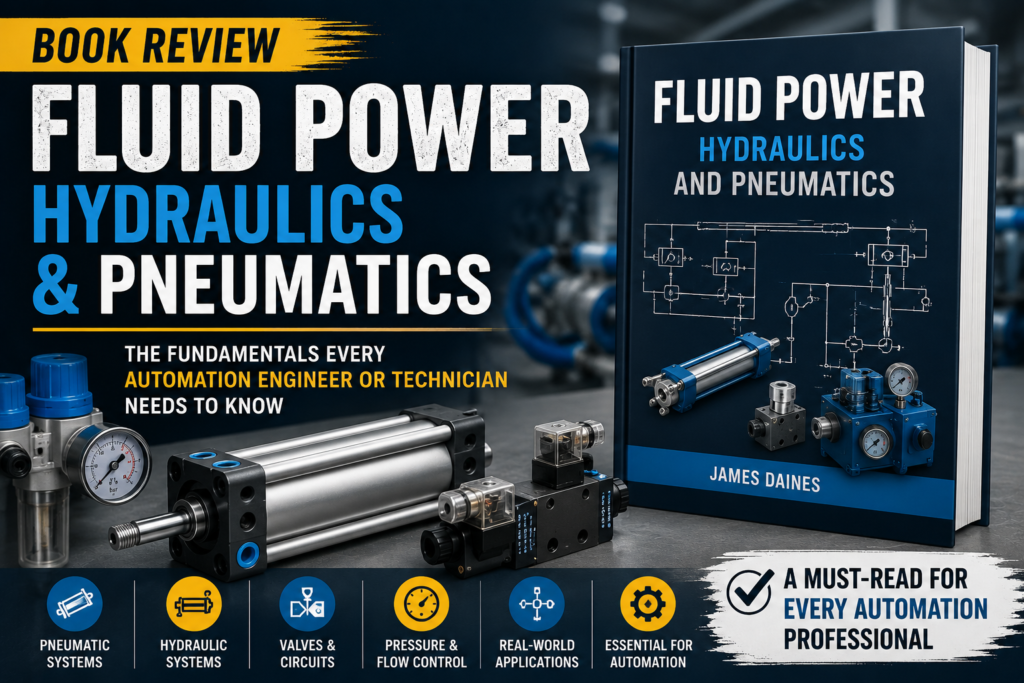
I recently read Fluid Power: Hydraulics and Pneumatics, and I really enjoyed the information it provided.
If you are learning industrial automation, maintenance, machine control, pneumatics, or hydraulics, I think this is the kind of book that gives very useful foundational knowledge. The book is described as covering the fundamentals of fluid power, including hydraulic and pneumatic components, circuits, and systems.
For me, this topic is important because automation is not only PLCs and electrical wiring. A lot of real machines use compressed air and hydraulic power to move, clamp, lift, press, push, stop, and position parts.
If you want to understand industrial machines properly, you need to understand pneumatics and hydraulics too.
Why I Liked This Book
The biggest thing I liked is that the book explains fluid power in a structured way.
Fluid power means using pressurized fluid to transmit and control power. Pneumatics usually use compressed air, while hydraulics usually use pressurized oil or another liquid.
In factories, both systems are very common.
Pneumatics are often used for simple and fast movements, such as pushing products, clamping parts, opening gates, and moving small mechanisms.
Hydraulics are usually used when much higher force is needed, such as pressing, lifting, forming, or moving heavy loads.
This book helped me understand these systems better.
Important Knowledge for Automation Engineers and Technicians
I think every automation engineer or maintenance technician should know the information covered in this type of book.
Why?
Because many machines are not purely electrical.
A PLC may control the sequence, but the real physical movement often comes from pneumatic cylinders, hydraulic cylinders, valves, pumps, compressors, regulators, filters, actuators, and hoses.
If you only understand the PLC program but do not understand what the pneumatic or hydraulic system is doing, troubleshooting becomes much harder.
For example, a machine may fail because of:
Low air pressure
A leaking cylinder
A blocked filter
A faulty solenoid valve
Wrong valve timing
Hydraulic oil contamination
A pressure problem
A damaged hose
A sticking actuator
Incorrect flow control adjustment
These problems may look like automation problems, but the real issue can be in the fluid power system.
That is why this knowledge matters.
Good for Students and Beginners
I also think this book is useful for students and beginners.
When you first start learning automation, it is easy to focus only on sensors, PLCs, motors, and VFDs. Those are important, of course, but pneumatics and hydraulics are just as important in many machines.
This book can help beginners understand:
What fluid power means
How pneumatic systems work
How hydraulic systems work
What actuators do
How valves control movement
Why pressure and flow matter
How cylinders create linear motion
How fluid power systems are used in real machines
For someone building a foundation in automation, this is very useful information.
Useful for Maintenance Work
For maintenance technicians, fluid power knowledge is extremely practical.
In real factory work, pneumatic and hydraulic problems are common. A cylinder may not extend. A valve may not switch. A machine may move slowly. A hydraulic system may lose pressure. A pneumatic actuator may leak. A clamp may not hold properly.
If you understand the basic principles, you can troubleshoot these problems more logically.
Instead of guessing, you can ask better questions:
Is there enough pressure?
Is the valve receiving a signal?
Is air or oil flowing correctly?
Is the actuator mechanically jammed?
Is the filter blocked?
Is there a leak?
Is the flow control adjusted correctly?
That is the kind of practical thinking that helps in real maintenance work.
Good Foundation Before Advanced Automation
I see this book as a good foundation before going deeper into machine control and automation.
If you want to learn PLC programming, pneumatics and hydraulics are still very relevant.
A PLC often controls solenoid valves.
Solenoid valves control air or oil flow.
The air or oil moves the actuator.
The actuator moves the machine.
Sensors confirm the movement.
The PLC then continues the sequence.
That is a very common automation process.
So, understanding fluid power helps you understand the complete machine, not just the electrical side.
Who I Think This Book Is For
I would recommend this book for:
Automation students
Maintenance technicians
Electricians
Beginner automation engineers
PLC learners
Machine builders
Industrial technicians
People learning pneumatics
People learning hydraulics
Anyone who works around production machines
If you are working with automated machinery, this knowledge is useful.
Even if you do not design hydraulic or pneumatic systems yourself, you still need to understand how they work.
What This Book Will Not Replace
This book is useful, but it does not replace hands-on practice.
Pneumatics and hydraulics are very practical subjects. You learn them best when you also work with real components.
So I would use this book together with:
Real pneumatic circuits
Hydraulic circuit diagrams
PLC examples
Solenoid valve wiring
Cylinder sensors
Pressure gauges
Flow controls
Machine troubleshooting practice
Safety procedures
Reading gives you the theory. Practice makes it real.
Final Verdict
After reading Fluid Power: Hydraulics and Pneumatics, I think it is a very useful book for anyone learning industrial automation.
I enjoyed the information it provided, and I think the knowledge inside is important for automation engineers, maintenance technicians, electricians, and students.
Pneumatics and hydraulics are everywhere in real industrial machines. If you want to understand machines properly, you need to understand fluid power.
My opinion is simple:
If you are learning automation or working in maintenance, this book is worth checking out.
Check the book here:
[Fluid Power: Hydraulics and Pneumatics]