Affiliate disclosure: This post contains an affiliate link. If you buy through my link, I may earn a small commission at no extra cost to you.
Check the book here:
[Industrial Motor Control]
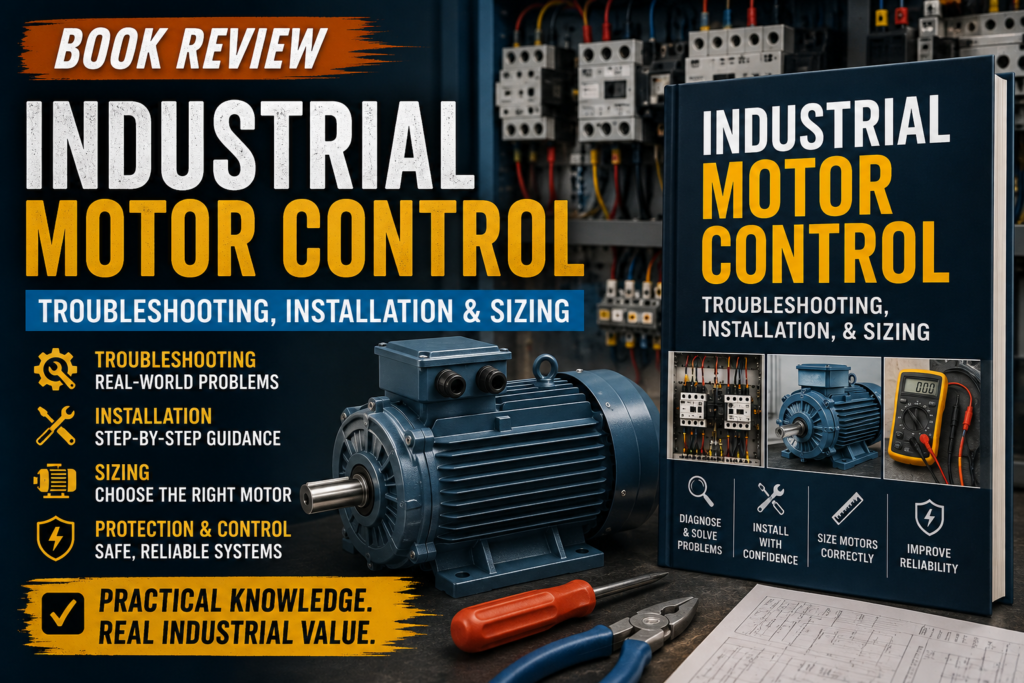
I recently read Industrial Motor Control: Troubleshooting, Installation, & Sizing, and I really enjoyed the information it provided.
The Amazon listing describes it as a practical guide for electricians and technicians working with industrial motor control systems, including troubleshooting, installation, and sizing topics.
For me, this book fits very well for anyone who wants to understand industrial motors and motor control in a more practical way.
It is not just theory for the sake of theory. It feels more focused on real work: how motors are connected, controlled, protected, installed, and diagnosed when something goes wrong.
Why I Liked This Book
The biggest thing I liked is that the book focuses on industrial motor control, which is one of the most important topics in electrical maintenance and automation.
Motors are everywhere in factories.
You see them on:
Conveyors
Pumps
Fans
Compressors
Mixers
Machine tools
Production lines
Industrial equipment
But understanding motors is not only about knowing that they spin. You also need to understand how they are started, stopped, protected, wired, sized, and troubleshot.
That is where this book becomes useful.
It helped me connect the basic theory of motors with the practical side of industrial work.
Good for Beginners and Students
I think this book is a very good option for students and beginners who are learning about industrial electrical systems.
When you are new to motor control, many things can feel confusing:
Motor starters
Overload relays
Contactors
Control circuits
Motor protection
Three-phase wiring
Motor sizing
Troubleshooting faults
Start and stop circuits
This book can help make those topics easier to understand.
It gives a better foundation before moving into more advanced automation topics like PLC control, VFDs, servo systems, and industrial panels.
Useful for Maintenance Technicians
I also think this book is useful for maintenance technicians.
In real maintenance work, motor problems are common. A motor may not start, may trip overloads, may run in the wrong direction, may overheat, or may stop randomly during production.
Sometimes the motor is bad.
But many times, the issue is somewhere else:
Wrong wiring
Bad contactor
Loose terminal
Incorrect overload setting
Mechanical overload
Wrong motor size
Control circuit problem
Power supply problem
A book like this is useful because it helps you think through motor control problems in a more organized way.
Instead of guessing, you start checking the system step by step.
Good Foundation Before PLC and Automation Learning
If you want to learn PLC programming, I think motor control knowledge is very important.
A PLC often controls motors, but the PLC is only one part of the system.
The full system may include:
PLC outputs
Contactors
Relays
Overload protection
Motor starters
VFDs
Sensors
Push buttons
Emergency stops
Wiring and protection devices
If you understand motor control first, PLC programming becomes much easier to understand later.
You are not just writing ladder logic. You understand what the PLC is actually controlling in the real machine.
That is why I think this book can be a good step for people starting their journey into industrial automation.
Who I Think This Book Is For
I would recommend this book for:
Electrical students
Beginner electricians
Maintenance technicians
Automation beginners
PLC learners
People learning industrial motors
Technicians working with production machines
Anyone who wants to understand motor control better
If you already have many years of motor control experience, some parts may feel basic. But for beginners, students, and technicians who want a practical foundation, I think it is very useful.
What This Book Will Not Replace
This book is useful, but it does not replace real hands-on practice.
Motor control is something you understand much better when you also work with real wiring, real panels, real contactors, real overload relays, and real motors.
So I would use this book together with:
Wiring diagrams
Motor nameplate examples
Real control panels
PLC practice
VFD manuals
Troubleshooting practice
Electrical safety rules
Reading gives you the foundation. Practice makes it real.
Final Verdict
After reading Industrial Motor Control: Troubleshooting, Installation, & Sizing, I think it is a good book for anyone learning industrial motor control.
I enjoyed the information it provided, and I think it is especially useful for students, beginners, electricians, and maintenance technicians.
It gives a practical foundation for understanding how industrial motors are installed, controlled, sized, and troubleshot.
My opinion is simple:
If you want to understand industrial motors and motor control better, this book is worth checking out.
Check the book here:
[Industrial Motor Control]