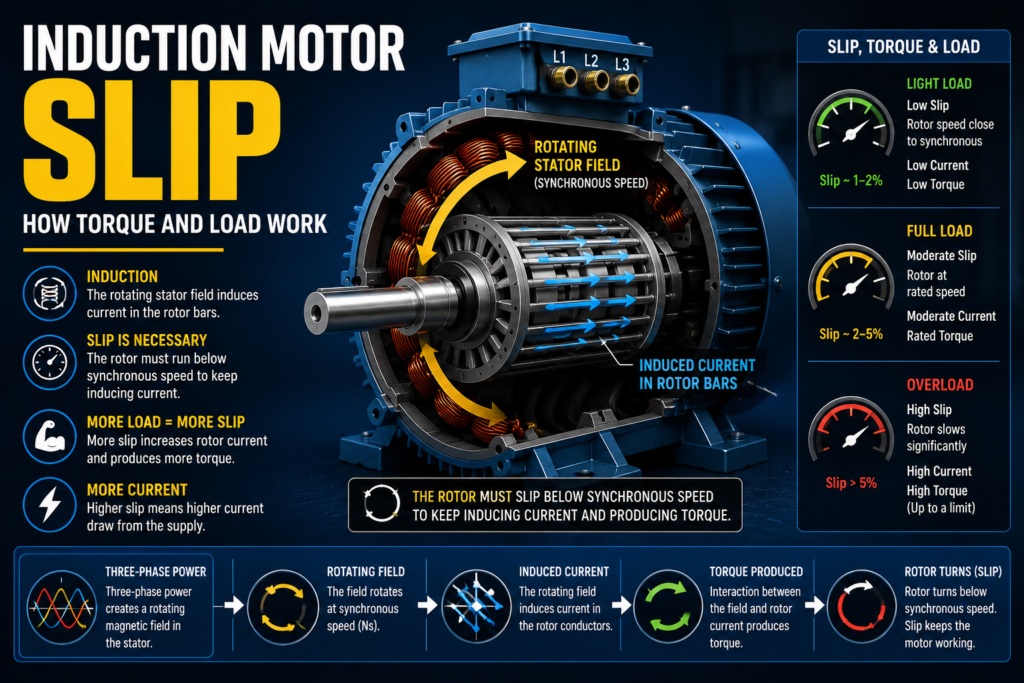
The rotating field explains how the motor creates a moving magnetic field, but not yet how that field turns the rotor. The answer is induction — the same principle by which a transformer works — and it leads to the concept of slip, which is essential to how the induction motor produces torque. Understanding induction and slip completes the picture of how the motor turns and explains key aspects of its behavior under load.
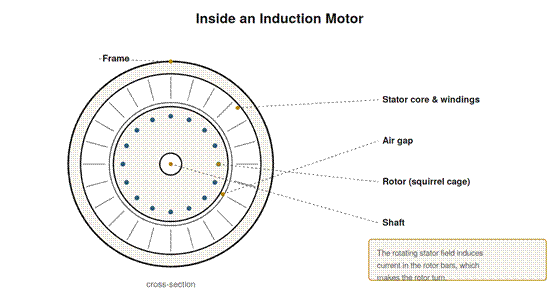
Figure 3.1 — Inside an induction motor. The rotating stator field induces current in the rotor’s conductor bars (the squirrel cage), and the interaction of that induced current with the field makes the rotor turn.
How the rotor turns: induction
The induction motor’s rotor is not connected to any electrical supply; instead, the rotating stator field induces current in it. The rotor contains conductors — in the common squirrel-cage design, a set of conducting bars connected at their ends — and as the stator’s magnetic field sweeps past these conductors, it induces a current in them, just as a changing magnetic field induces current in any conductor. This induced current, flowing in the rotor conductors within the stator’s magnetic field, experiences a force, and this force turns the rotor. So the rotor turns not because it is connected to power but because the rotating field induces current in it, and that current interacts with the field to produce turning force. This is the induction principle that gives the motor its name: the rotor current is induced by the stator field, requiring no electrical connection to the rotor, which is a large part of the induction motor’s simplicity and robustness — the rotor is just conductors, with no brushes, windings to connect, or external supply, powered entirely by induction from the stator field.
Why the rotor must slip
A crucial subtlety is that the rotor can never quite reach the synchronous speed of the rotating field, and in fact must run slightly slower — this difference is called slip. The reason is fundamental: the field induces current in the rotor only because it is moving relative to the rotor, sweeping past the rotor conductors. If the rotor turned at exactly synchronous speed, keeping pace with the field, there would be no relative motion, no changing field at the rotor conductors, no induced current, and thus no force to turn the rotor. So the rotor must lag the field — slip — to maintain the relative motion that induces the rotor current. The rotor settles at a speed slightly below synchronous, where the slip is just enough to induce the current needed to produce the torque the load demands. Understanding slip as necessary — the rotor must run slower than the field to be driven by it — explains why an induction motor’s actual speed is always a little below synchronous, and it is why the nameplate speed (like 1460 rpm) is below the synchronous speed (1500 rpm for that motor): the difference is the slip at full load.
Slip, torque, and load
Slip is not fixed but varies with load, and this relationship explains much of the motor’s behavior. When the load on the motor increases, the rotor tends to slow slightly, increasing the slip — the relative motion between field and rotor — which induces more rotor current and produces more torque to meet the increased load. So the motor automatically produces more torque as slip increases with load, up to a limit. At light load, slip is small and the rotor runs close to synchronous speed; at full load, slip is larger and the rotor runs at its nameplate speed; and if overloaded beyond its capability, the slip becomes excessive, the current rises sharply, and the motor may stall or overheat. Understanding this slip-torque-load relationship explains why the motor draws more current under more load (more slip, more rotor current), why it slows slightly as load increases, and why an overloaded motor draws high current and overheats (excessive slip and current). It connects the motor’s electrical behavior (current draw) to its mechanical situation (load), which is central to troubleshooting: a motor drawing high current is working hard against a large load or fault, because load, slip, and current are directly linked through the induction principle.
| THE INDUCTION MOTOR IN ONE PICTURE Three-phase power feeds three stator windings, creating a magnetic field that rotates at synchronous speed. This field induces current in the rotor, and the induced current interacts with the field to turn the rotor — which must slip slightly below synchronous speed to keep inducing that current. More load means more slip, more rotor current, more torque, and more current drawn from the supply. Almost everything about the motor follows from this picture. |
The transformer analogy
Induction in the motor is closely analogous to a transformer, and the analogy illuminates how the rotor gets its current. In a transformer, an alternating current in one winding creates a changing magnetic field that induces a current in a second winding, with no electrical connection between them. In the induction motor, the stator’s rotating field plays the role of the transformer’s primary, and the rotor plays the role of the secondary: the changing field (changing because it moves relative to the rotor) induces current in the rotor conductors, with no electrical connection to the rotor. So the induction motor is, in a sense, a rotating transformer, where the induced ‘secondary’ current in the rotor produces the force that turns it. This analogy explains why the rotor needs no electrical connection — like a transformer secondary, it is powered by induction alone — and why the motor is so robust: the rotor is simply conductors with induced current, no brushes or connections to wear or fail. Understanding induction through the transformer analogy — the rotor as an induced secondary — makes the induction principle intuitive and explains the induction motor’s characteristic simplicity and reliability, which come from powering the rotor by induction rather than by any connection.
Scenario: the motor that slowed under load
A scenario shows slip in action. An operator notices a motor running slightly slower when the machine it drives is working hard, and wonders if something is wrong. Understanding slip explains that this is normal: as the load increases, the rotor slows slightly, increasing the slip, which induces more rotor current and produces more torque to meet the higher load. The slight slowing under load is the motor automatically responding to the increased demand, not a fault. At light load, the motor runs close to synchronous speed with little slip; under heavier load, it runs a bit slower with more slip and draws more current. This is exactly how an induction motor is supposed to behave, and the small speed drop under load is the visible sign of the slip increasing to produce more torque. This scenario reassures that a motor slowing slightly under load is normal slip behavior, not a problem — unless the slowing is excessive, indicating overload beyond the motor’s capability. Understanding slip lets you distinguish normal load-related speed variation (small, expected) from excessive slowing (a sign of overload), and it explains the everyday observation that a working motor slows a little and draws more current under load, which is the induction principle operating exactly as designed rather than any fault.
Starting current and why it is high
The induction principle also explains why a motor draws a high current when starting, which is important for understanding motor circuits and protection. At the instant of starting, the rotor is stationary while the field is already rotating at full speed, so the slip is at its maximum — the full difference between the stationary rotor and the rotating field. This maximum slip induces a large rotor current, and correspondingly the motor draws a large current from the supply — the starting or inrush current, typically several times the running current. As the rotor accelerates and catches up toward synchronous speed, the slip decreases, the induced current decreases, and the current falls to its normal running value. So the high starting current is a direct consequence of the maximum slip at standstill: the stationary rotor, with the field sweeping past at full speed, has maximum relative motion, inducing maximum current. Understanding this explains why motors draw a brief high inrush current when starting, which matters for sizing the supply and protection (the protection must tolerate the brief inrush without tripping) and for understanding starting methods (which reduce this inrush). Understanding that the high starting current comes from the maximum slip at standstill — falling as the rotor accelerates and slip decreases — connects the induction principle to the practical starting behavior of motors and to why their protection and starters are designed to accommodate or reduce the inrush current.
The whole motor in the induction principle
The induction principle, with slip, contains the essence of the whole motor, and seeing this ties the fundamentals together. The rotating field induces current in the rotor; the induced current interacts with the field to produce torque; the rotor must slip below synchronous speed to maintain the induction; more load means more slip, more induced current, more torque, and more current drawn. From this single principle flow the motor’s key behaviors: it is self-driving (the field drives the induced rotor), it runs below synchronous speed (slip), it responds to load (slip and current increasing with load), it draws high starting current (maximum slip at standstill), and its current reflects its load (more load, more current). So the induction principle with slip is not just one aspect of the motor but the core from which its behavior follows. Understanding it deeply — the field inducing rotor current, the necessary slip, the load-slip-current relationship — is understanding the motor’s essential operation, from which its behaviors and many of its faults are consequences. Recognizing that the whole motor is, in a sense, contained in the induction principle reinforces its central importance: master this principle and its consequences, and you understand how the motor turns, why it runs as it does, how it responds to load, and why its current behaves as it does — the essential operation on which all motor understanding and troubleshooting rest, unified in the single elegant principle of induction with slip.
Current as a window into the motor’s work
A practical insight from the induction principle: the motor’s current is a window into how hard it is working, and reading current with this understanding turns a simple measurement into a rich diagnostic. Because current rises with load (more load, more slip, more rotor current, more line current), the running current tells you the motor’s loading: near full-load current means near full load, above means overloaded, well below means lightly loaded. So measuring current, understood through the induction principle, reveals the motor’s mechanical situation — how hard it is working — from an electrical measurement. This makes current one of the most informative measurements: compared to the nameplate full-load current, it indicates the loading, and its changes indicate changing load or developing problems. Understanding current as this window — into the motor’s work, via the load-slip-current relationship — enriches its interpretation. It reinforces that current is not just an electrical quantity but an indicator of the motor’s mechanical loading, so that reading current (against the nameplate) tells you how hard the motor is working, which is central to diagnosing overload and monitoring the motor. The induction principle makes current this window into the motor’s work, and understanding the connection — load determines current — lets you read the motor’s mechanical state from its current, which is a powerful, practical application of the fundamental principle to everyday motor diagnosis and monitoring.