
Real machines rarely just start and stop; they enforce conditions, prevent unsafe combinations, and move through sequences of steps. These behaviors appear in the control logic as interlocks, permissives, and sequential circuits, and reading them is essential to understanding why a machine does — or refuses to do — what it does.
Permissives: conditions that must be met
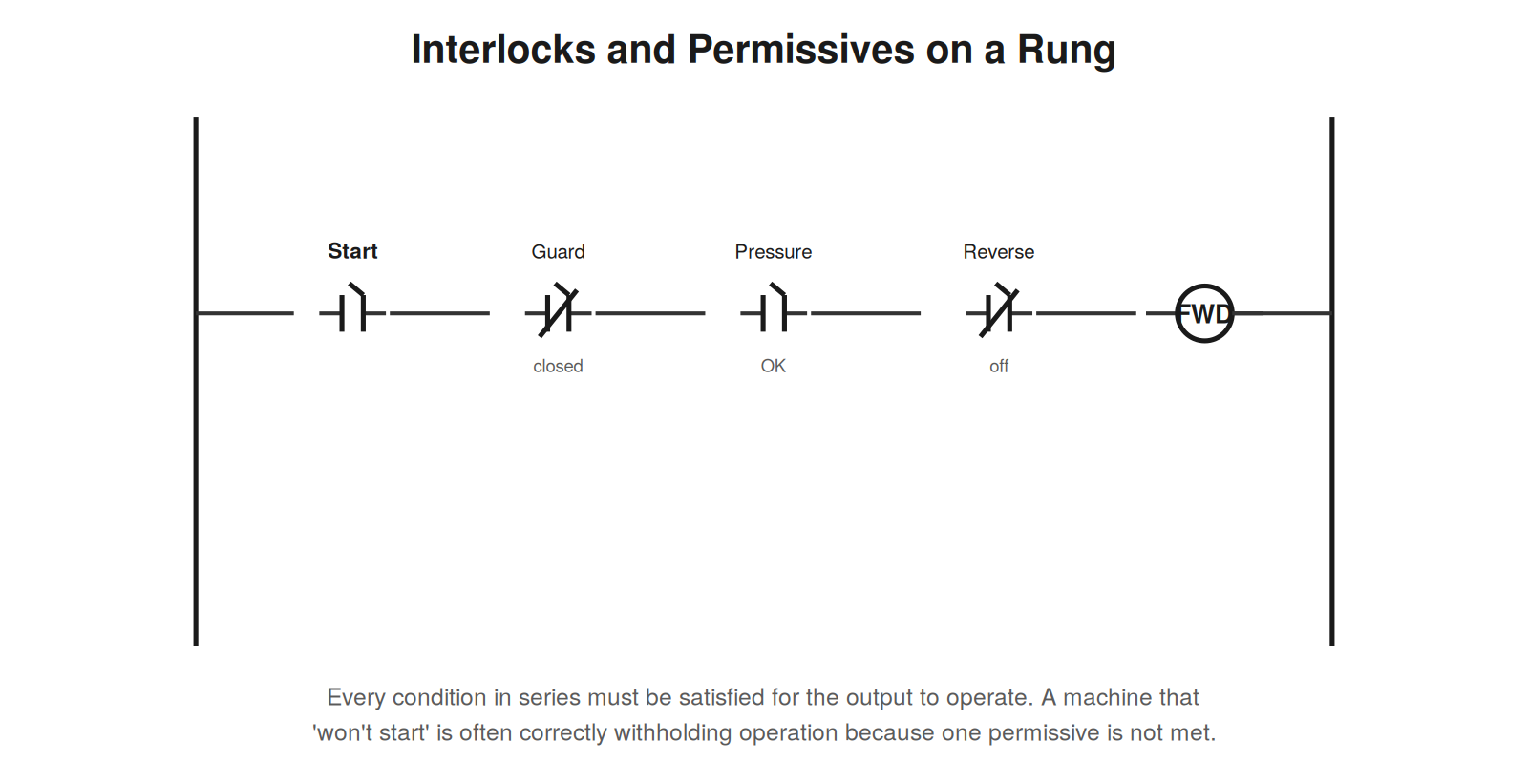
A permissive is a condition that must be satisfied before an action is allowed, appearing in a rung as a contact in series that must be closed for the output to operate. A guard must be closed, a pressure must be adequate, a previous step must be complete, a level must be sufficient — each such requirement is a permissive contact in the rung, and all of them, being in series, must be satisfied together. Reading permissives is crucial to troubleshooting, because a machine that ‘won’t start’ is very often not broken but correctly withholding operation because a permissive is not met. Reading the rung reveals which conditions are required, and checking them reveals which is missing — and the missing permissive frequently points straight at the real fault, such as a failed sensor reporting a guard open or a pressure not made.
Interlocks: preventing conflicts
An interlock prevents unsafe or conflicting operations, and it appears in the logic as a contact that blocks one action while another incompatible one is active. The classic example is a reversing motor circuit, where an interlock prevents the forward and reverse contactors from both energizing at once, which would short the supply — each direction’s rung contains a normally-closed contact of the opposite direction’s contactor, so energizing one direction opens the other’s permitting contact. Reading an interlock means recognizing that this contact exists to prevent a conflict, and understanding what it blocks and why. Interlocks are safety and protection built into the logic, and reading them tells you not just what the machine does but what it deliberately prevents, which is essential to understanding its behavior and to troubleshooting cases where an interlock is correctly blocking an action.
Sequences: steps in order
Many machines operate as sequences — a series of steps performed in order, each waiting for its conditions before the next begins. In the control logic, this appears as rungs where each step’s initiation depends on the previous step’s completion, often through contacts that advance only when a condition confirms a step is done. Reading a sequential circuit means following the chain of steps: this step completes and confirms, which permits the next step, and so on. This is especially valuable when a machine stops partway through its cycle, because a machine stuck mid-sequence is waiting for a specific step’s advance condition, and reading the logic reveals which condition is not met. A machine that halts reliably at the same point is not usually broken randomly; it is waiting on a condition the sequence requires, and reading the sequence logic identifies exactly what it is waiting for.
A worked example: reading a reversing interlock
The reversing motor circuit is the classic interlock to read closely, because it shows exactly how logic prevents a dangerous combination. Two contactors control the motor: FWD for forward, REV for reverse. Energizing both at once would connect the supply to itself through the two contactors and cause a short circuit, so the logic must prevent it. The interlock does this with cross-wired normally-closed contacts: the FWD rung contains a normally-closed REV contact, and the REV rung contains a normally-closed FWD contact. Reading it: when FWD is energized, its normally-closed contact in the REV rung opens, so REV cannot energize; and vice versa. Whichever direction runs first blocks the other. Reading this interlock means recognizing the cross-wired NC contacts and understanding that each direction’s coil, when energized, opens a contact that prevents the opposite direction. This is the interlock reading skill: seeing a contact placed specifically to block a conflicting action, and understanding what conflict it prevents and how.
Reading a machine stuck mid-sequence
A sequential machine that stops partway through its cycle is one of the most satisfying things to diagnose by reading, because the logic points directly at what the machine is waiting for. Suppose a machine completes steps one and two of its cycle and halts before step three. Reading the sequence logic, step three’s initiation depends on some advance condition — a position confirmed, a sensor made, a previous action completed. Because the machine reliably stops at the same point, it is not failing randomly; it is waiting for step three’s condition, which is not being satisfied. Reading the logic identifies exactly which condition step three requires, and checking that condition — the sensor, the position, whatever it is — finds why the sequence will not advance. This is reading-based diagnosis at its best: the drawing converts ‘the machine stops at step three’ into ‘step three needs this specific condition, which must be checked,’ and the fault is localized to one condition rather than searched for across the whole machine.
Case scenario: the machine that refuses to start
A machine that refuses to start, with no obvious fault, is the archetypal permissive problem, and reading the permissives solves it. The operator presses Start and nothing happens — no motor, no motion. Reading the start rung, the output depends on Start plus a series of permissives: perhaps a guard-closed switch, a reset condition, a pressure-adequate switch, an emergency-stop-not-pressed contact. Any one of these permissives not satisfied prevents the start, so the machine is likely not broken but withholding operation because a permissive is unmet. Reading the rung lists the permissives; checking each finds the unsatisfied one — a guard not fully closed, an e-stop still latched, a pressure not yet built, a reset not performed. Very often the ‘fault’ is an unmet permissive that, once satisfied, lets the machine start normally, and no repair is needed at all. Reading the permissives is what distinguishes a genuine fault from an unmet condition, and it prevents the wasted effort of hunting for a broken component when the machine is simply, correctly, waiting for a condition to be met.
Reading safety interlocks with care
Safety interlocks — guard switches, emergency stops, safety mats, light curtains — deserve especially careful reading, because they are the logic that protects people, and misunderstanding them is dangerous. A safety interlock typically appears as a contact (often normally-closed, failing safe) in series in the circuits it protects, so that when the guard opens, the e-stop is pressed, or the light curtain is broken, the contact opens and disables the protected motion. Reading these means recognizing which contacts are safety interlocks and understanding that they are meant to stop or prevent motion when a safety condition is violated — and that they are working correctly when they do so. A machine disabled by a safety interlock is not faulty; it is correctly protecting someone, and the correct response is to address the safety condition (close the guard, reset the e-stop, clear the light curtain), not to bypass the interlock. Reading safety interlocks with care — understanding what each protects and never treating a correctly-operating safety interlock as a fault to defeat — is a matter of both correct reading and responsibility, because these particular contacts exist to keep people safe.
Reading a step sequence in detail
To read a sequential circuit thoroughly, follow its steps in detail, tracing how each step is initiated, what it does, how its completion is confirmed, and how that confirmation permits the next step. A sequence might go: step one initiates on a start command, performs an action, and confirms completion via a sensor; that confirmation permits step two, which performs its action and confirms; and so on to the sequence’s end. Reading it means following this chain — initiation, action, confirmation, permission of the next step — through each step, understanding the whole sequence as a series of confirmed steps each enabling the next. This detailed reading is what lets you understand exactly where a sequence is in its progression and, when it halts, which step’s confirmation is missing. The confirmation sensors are key: each step typically confirms its completion before the next begins, so a missing confirmation halts the sequence at that step. Reading the sequence in detail, step by step with its confirmations, gives you the complete picture of the machine’s cyclic operation and the diagnostic ability to pinpoint where and why it stops, which is the practical payoff of reading sequential logic thoroughly rather than just recognizing it is a sequence.
Case: the interlock that was doing its job
A case that teaches respect for interlocks is when an interlock correctly prevents an action and is mistaken for a fault. An operator could not get a machine to perform an action, and it seemed broken. Reading the drawing revealed an interlock preventing the action because a conflicting condition was present — the interlock was correctly blocking the action for a good reason. The machine was not faulty; the interlock was doing exactly its job, preventing an operation that should not occur under the current conditions. Reading the interlock revealed both that it was blocking the action and why — the conflicting condition it guards against. The resolution was not to fix or bypass the interlock but to address the conflicting condition, after which the interlock allowed the action normally. This case is a lesson in reading interlocks with respect: an action prevented by an interlock is often not a fault but the interlock correctly protecting against a conflict or unsafe condition, and the correct response is to address the condition the interlock guards against, not to defeat the interlock. Reading the drawing to understand what an interlock prevents and why is what distinguishes a genuine fault from an interlock correctly doing its protective job, and it prevents the dangerous mistake of bypassing an interlock that is functioning exactly as intended.
The mindset of reading conditions
Reading interlocks, permissives, and sequences well requires a particular mindset: seeing a machine’s refusals and pauses not as faults but as the machine correctly enforcing its conditions, and reading to understand what condition is being enforced. This mindset shift is valuable because so many apparent faults are actually the machine correctly withholding operation because a condition — a permissive, an interlock, a sequence step — is not met. The reader with this mindset, faced with a machine that will not do something, first asks what condition the machine is enforcing, reading the relevant logic to find the unmet condition, rather than assuming a fault. Often the resolution is to satisfy the condition, not to repair anything. This mindset — that machines enforce conditions, and unmet conditions look like faults but are the machine working correctly — reframes troubleshooting productively, directing you to read the conditions and find the unmet one rather than hunting for broken components. It is especially valuable for the many cases where the machine is not broken but is correctly waiting for a permissive, blocked by an interlock, or paused in a sequence. Reading conditions with this mindset — the machine enforces conditions, read to find the unmet one — resolves these cases efficiently and prevents the wasted effort of seeking faults where the machine is simply, correctly, enforcing its designed conditions.