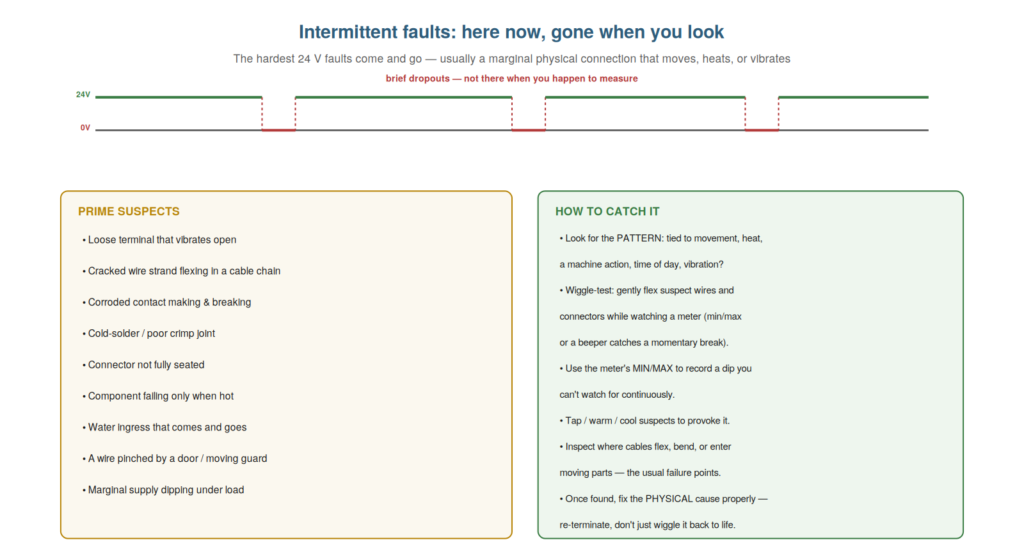
The intermittent fault — a fault that comes and goes, often absent exactly when you look for it — is the most challenging and frustrating control-circuit problem, and diagnosing it requires patience and a different, pattern-and-physical approach. Because the fault is not present when you measure, you cannot simply trace it; instead you look for patterns and provoke the physical cause. Understanding this approach equips you for the hardest faults. This chapter covers intermittent faults and how to catch them.
Why intermittents are hard, and where they live
Understanding why intermittent faults are so hard, and where they typically live, orients you to the right approach for them. Intermittent faults are hard because they are not present when you look: the fault comes and goes, so at the moment you measure, the circuit may be fine, giving you nothing to trace. This defeats the normal measure-and-trace approach, which needs the fault to be present. As for where they live: intermittent faults are overwhelmingly physical and marginal — a terminal that vibrates loose and tight, a wire with a cracked strand that flexes open and closed, a corroded contact making and breaking, a connector not quite seated, a component failing only when hot, water ingress that comes and goes. The common thread is a marginal physical condition that changes with movement, vibration, temperature, or time. So intermittents are hard because they are absent when you look, and they live in marginal physical connections. Understanding this — the difficulty and the physical, marginal nature — orients you to an approach based on patterns and physical provocation rather than straightforward tracing. Understanding why intermittents are hard and where they live — hard because absent when you look, living in marginal physical connections that change with movement, heat, vibration, or time — orients you to the right approach, so that you accept the normal trace-it approach will not work on a fault that is not present, and you focus instead on the marginal physical conditions where intermittents overwhelmingly live (loose terminals, cracked wires, corroded contacts, poor connectors, heat-sensitive components), which directs you to the pattern-finding and physical-provocation methods that catch intermittent faults rather than the futile attempt to trace a fault that keeps vanishing.
Finding the pattern
The first key technique for an intermittent fault is finding its pattern, and understanding how to look for patterns turns an elusive fault into one you can localize. Since the fault comes and goes, when and how it does so is a clue: look for a pattern in its occurrence. Is it tied to machine movement (a fault that appears when a particular axis moves, suggesting a wire flexing there)? To vibration (appearing when the machine runs, suggesting a loose connection shaken)? To temperature (appearing when hot, after running a while, suggesting a heat-sensitive connection or component)? To a machine action or time of day (suggesting a related trigger)? By noting the conditions under which the fault appears, you find the pattern, and the pattern points to the cause and location: a fault tied to a specific movement points to the wiring at that movement. So finding the pattern — correlating the fault’s occurrence with movement, vibration, heat, or actions — turns the intermittent fault into a localizable one. Understanding how to find the pattern — looking for what the fault correlates with — is the first key technique for intermittents. It reinforces that intermittents are localized by finding the pattern in their occurrence (movement, vibration, heat, time), which points to the cause. Understanding how to find the pattern — correlating an intermittent fault’s occurrence with machine movement, vibration, temperature, or actions to see what triggers it — turns an elusive fault into one you can localize, so that instead of being helpless before a fault that comes and goes, you note the conditions under which it appears and let the pattern point to the cause and location (a fault tied to a movement pointing to the wiring that flexes there), which is the first and often decisive technique for cracking intermittent faults by using their very coming-and-going as the clue to where they live.
Provoking and fixing the physical cause
The second key technique is provoking the fault to catch it, and understanding how to do this safely — and then fix the physical cause properly — completes your approach to intermittents. Once a pattern suggests a location or trigger, you can provoke the fault to confirm and pinpoint it: gently wiggle or flex suspect wires and connectors while watching the meter (a beeper or the MIN/MAX function catches a momentary break), tap components, or warm or cool a suspect to trigger a heat-related fault. When provoking reproduces the fault — wiggling a connector drops the signal — you have caught and localized it. The MIN/MAX function helps catch a dip you cannot watch for continuously. This must be done safely, with the machine in a safe state. Then, crucially, fix the physical cause properly: re-terminate the loose connection, replace the cracked wire, clean and remake the corroded contact — do not merely wiggle it back to life, which leaves the marginal fault to return. So provoking catches the fault, and a proper physical fix resolves it. Understanding provoking and proper fixing — reproducing the fault to pinpoint it, then repairing the physical cause properly — completes your approach to intermittents. It reinforces that intermittents are caught by provoking (wiggling, MIN/MAX, heat) and resolved by a proper physical fix, not a temporary wiggle. Understanding how to provoke and fix the physical cause of an intermittent fault — reproducing it by wiggling, flexing, tapping, or heating suspects while watching the meter or using MIN/MAX to catch a momentary break, then fixing the physical cause properly by re-terminating, replacing, or remaking the connection rather than merely wiggling it back to life — completes your approach to the hardest faults, so that once a pattern has pointed you to a location, you provoke the fault to confirm and pinpoint it and then make a proper, lasting physical repair, which is how the patient, pattern-and-physical approach cracks and permanently resolves the intermittent faults that most frustrate straightforward troubleshooting.
Using the meter’s MIN/MAX and recording
A specific meter feature invaluable for intermittents is MIN/MAX (and, where available, recording), because it catches a momentary event you cannot watch for continuously. An intermittent dropout may last only a fraction of a second and occur unpredictably, so watching the meter display live may miss it. The MIN/MAX function helps: it captures and holds the minimum and maximum values the meter sees over a period, so if the voltage dips momentarily (an intermittent open), the MIN value records the dip even if you did not see it happen. You set the meter measuring the suspect point in MIN/MAX, leave it (perhaps while running or provoking the machine), and check whether the MIN captured a dropout. Some meters can record over time, logging the value for later review. So MIN/MAX and recording catch the momentary intermittent event that live watching misses. Understanding these features lets you catch dropouts too brief or unpredictable to observe directly. So understanding the meter’s MIN/MAX and recording — capturing momentary dips — lets you catch intermittent events you cannot watch for continuously. Understanding how to use the meter’s MIN/MAX and recording — capturing and holding the minimum and maximum values so a momentary voltage dip is recorded even if you did not see it, and logging over time where available — lets you catch the brief, unpredictable events of an intermittent fault, so that instead of trying to watch the display at the exact instant of a fraction-of-a-second dropout, you set the meter to MIN/MAX at the suspect point and check whether it captured a dip, which catches the momentary intermittent events that live observation misses and is one of the most valuable meter techniques for the hardest, come-and-go faults.
Scenario: the fault that came with the movement
A scenario shows the pattern-and-provoke approach cracking an intermittent. A device dropped out intermittently, never faulty when the technician measured it, defeating a straightforward trace. He looked for the pattern: noting when it happened, he saw the dropouts coincided with a particular machine movement — the fault appeared when a certain axis extended. This pattern pointed to a physical cause tied to that movement, likely a wire flexing. He went to the cabling at that axis and, with the machine safely positioned, gently flexed the suspect cable while watching his meter in MIN/MAX — and provoked the dropout: flexing the cable broke the signal. He had caught and localized it. Inspecting, he found a cracked wire strand inside the cable at the flex point. He replaced the cable section properly (not merely repositioning it), and the intermittent was gone. The pattern found the location, provoking confirmed it, and a proper fix resolved it. This scenario shows the pattern-and-provoke approach cracking an intermittent tied to movement. Understanding to find the pattern and provoke the fault let the technician tie the dropout to a movement and confirm the cracked wire. It reinforces that intermittents are cracked by finding the pattern, provoking the fault, and fixing the physical cause properly. The scenario reinforces the intermittent method: the technician cracked an elusive fault by finding its pattern (tied to an axis movement), provoking it (flexing the cable while watching MIN/MAX), and making a proper physical repair (replacing the cracked wire), illustrating how the patient pattern-and-provoke approach — rather than futile live tracing — catches and permanently resolves intermittent faults by using their pattern to locate them and a proper fix to end them.
Temperature-related intermittents
A specific class worth understanding is the temperature-related intermittent, because heat and cold cause a distinct pattern of come-and-go faults that you diagnose by their thermal correlation. Some intermittent faults correlate with temperature: a connection or component that works when cool but fails when hot (thermal expansion opening a marginal joint, or a component whose failure appears at temperature), or occasionally the reverse (working only when warmed up). The pattern is a fault that appears after the machine has run a while (heating up), or in a hot part of the day or the plant, and clears when things cool. Recognizing this thermal pattern points to a heat-affected cause, and you can provoke it by warming the suspect (carefully) to trigger the fault, or cooling it to clear it, confirming the thermal relationship. So understanding temperature-related intermittents — faults tied to heat or cold — lets you recognize and provoke this distinct class by its thermal correlation. This adds temperature to the patterns (movement, vibration, time) you look for in an intermittent. Understanding temperature-related intermittents — faults that correlate with heat or cold, appearing when the machine warms up or in a hot environment and clearing when cool — lets you recognize and diagnose this distinct class by its thermal pattern, so that when an intermittent correlates with temperature, you suspect a heat-affected connection or component (thermal expansion opening a marginal joint) and can provoke it by carefully warming or cooling the suspect to confirm the relationship, which adds temperature to the movement, vibration, and time patterns you look for and catches the thermal intermittents that a purely mechanical view would miss.
Patience and method with the hardest faults
To close, it helps to recognize that intermittent faults reward patience and method above all, because embracing this attitude is what carries you through the hardest control-circuit faults. Intermittents are frustrating precisely because they resist the quick look — not there when you check — and the temptation is to give up or guess. But they yield to patience and method: finding the pattern, provoking the fault, and fixing the physical cause properly. The technician who approaches an intermittent with patience (accepting it takes time) and method (the systematic pattern-and-provoke approach) cracks faults that defeat the impatient. So the right attitude to the hardest faults is patient method, and embracing it carries you through. Understanding that intermittents reward patience and method — the disciplined pattern-and-provoke approach — carries you through the hardest faults. Understanding that intermittent faults reward patience and method above all — the disciplined finding of the pattern, provoking of the fault, and proper physical fix that cracks faults resisting the quick look — is the attitude that carries you through the hardest control-circuit faults, so that instead of giving up or guessing when a fault is not there as you check, you embrace the patient, methodical pattern-and-provoke approach that uses the fault’s own coming-and-going to find it, which distinguishes the technician who resolves intermittents from the one they defeat and is the right mindset for the sternest test of control-circuit troubleshooting.