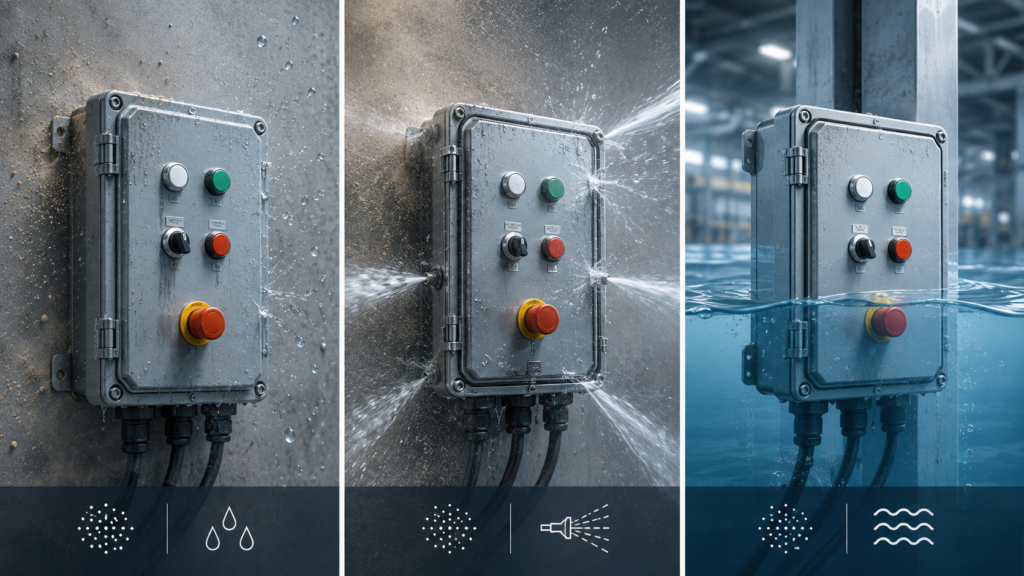
An IP65 control panel is not automatically the correct choice simply because 65 is higher than 54.
A clean indoor electrical room may need nothing more than IP54. A dusty production area exposed to cleaning water may require IP65. IP67 is intended for temporary immersion—but that does not necessarily mean it is better at surviving powerful water jets.
The correct rating depends on how dust and water will actually reach the enclosure.
IEC 60529 defines the international IP Code used to classify how electrical enclosures protect against access to hazardous parts and the ingress of solid objects and water. The current consolidated publication is IEC 60529:1989 with Amendments 1 and 2.
Important: The IP rating applies to the complete, correctly assembled panel—not just the empty metal box. Poor cable entries, incorrectly installed pushbuttons or an unsuitable ventilation opening can reduce the protection of the entire assembly.
Quick Comparison: IP54 vs IP65 vs IP67
| Rating | Dust protection | Water protection | Typical control-panel use |
|---|---|---|---|
| IP54 | Dust protected, but not completely dust-tight | Protected against splashing water from any direction | Indoor factories, workshops and relatively clean industrial areas |
| IP65 | Completely dust-tight | Protected against water jets from any direction | Dusty areas, outdoor locations and moderate washdown environments |
| IP67 | Completely dust-tight | Protected against temporary immersion, commonly up to 1 m for 30 minutes | Equipment exposed to flooding, temporary submersion or direct field installation |
IP65 protects against water jets, while IP67 addresses temporary immersion. Those are separate tests, so an enclosure marked only IP67 is not automatically certified against the jet tests represented by IP65 or IP66. Equipment intended to meet several conditions is often marked with multiple ratings, such as IP65/IP66/IP67.
How to Read an IP Rating
An IP code normally contains two digits:
IP 6 5
   │ │
   │ └── Water protection
   └──── Solid-object and dust protection
The first digit describes protection against access to hazardous parts and the entry of solid objects.
The second digit describes resistance to water ingress.
Therefore:
IP54 = dust-protected enclosure + splash protection
IP65 = dust-tight enclosure + water-jet protection
IP67 = dust-tight enclosure + temporary immersion protection
The numbers should be read separately. They are not one general environmental-quality score.
First Digit: Protection Against Solids and Dust
| First digit | General meaning |
|---|---|
| 0 | No specified protection |
| 1 | Protected against objects larger than 50 mm |
| 2 | Protected against objects larger than 12.5 mm, such as fingers |
| 3 | Protected against objects larger than 2.5 mm |
| 4 | Protected against objects larger than 1 mm |
| 5 | Dust protected; some dust may enter, but not enough to interfere with operation |
| 6 | Dust-tight |
The important distinction for control panels is between 5 and 6.
An IP54 enclosure is not completely sealed against dust. Limited dust ingress is permitted as long as it does not interfere with safe operation.
An IP65 or IP67 enclosure has the first digit 6, meaning it is dust-tight under the applicable test conditions.
Second Digit: Protection Against Water
| Second digit | General meaning |
|---|---|
| 0 | No specified water protection |
| 1 | Vertically falling water drops |
| 2 | Falling drops when tilted up to 15° |
| 3 | Spraying water |
| 4 | Splashing water from any direction |
| 5 | Water jets from any direction |
| 6 | Powerful water jets |
| 7 | Temporary immersion |
| 8 | Continuous or prolonged immersion under manufacturer-specified conditions |
IP65, IP66 and IP67 are not simply three progressively stronger versions of the same water test.
They address different exposure:
IP65 → water jets
IP66 → powerful water jets
IP67 → temporary immersion
Phoenix Contact describes IP67 as dust-tight and able to withstand freshwater immersion up to 1 m deep for up to 30 minutes. For IP68, the permitted depth and duration are specified by the equipment manufacturer.
What Does IP54 Mean?
IP54 provides:
- Protection against contact with hazardous internal parts
- Protection against harmful quantities of dust
- Protection against water splashing from any direction
Some dust can enter an IP54 enclosure. The test requirement is that the amount must not interfere with satisfactory operation or safety. The second digit 4 covers splashing water, not directed hose jets or immersion.
Typical IP54 applications
IP54 is commonly suitable for control panels installed in:
- Indoor production areas
- Relatively clean workshops
- Warehouses
- Mechanical rooms
- Indoor conveyor systems
- Utility rooms
- Areas exposed to occasional splashes
- Locations where dust exists but is not severe
A typical IP54 panel might contain:
- PLC and remote I/O
- Motor starters
- Contactors and overload relays
- Circuit breakers
- 24 V DC power supplies
- Ethernet switches
- HMI or operator controls
Where IP54 may not be enough
IP54 is usually a poor choice where the enclosure is exposed to:
- Regular hose cleaning
- Heavy airborne dust
- Conductive metal dust
- Outdoor driving rain
- Water sprayed directly at panel doors
- Food-processing washdown
- Flooding or temporary immersion
Do not read “splash protected” as “safe to pressure-wash.”
A cleaner standing two metres away with a hose can expose a panel to a considerably harsher condition than occasional splashing.
What Does IP65 Mean?
IP65 provides:
- Complete protection against dust ingress
- Protection against contact with hazardous parts
- Protection against water jets from any direction
The first digit 6 makes IP65 dust-tight. The second digit 5 covers directed water jets, making IP65 a common choice for dusty factories and moderately wet industrial environments.
Typical IP65 applications
IP65 is often selected for:
- Dusty manufacturing areas
- Sawmills and woodworking plants
- Cement and mineral-processing equipment
- Outdoor machine panels
- Agricultural installations
- Conveyor systems exposed to rain
- Packaging areas with routine cleaning
- Machine-mounted junction and control boxes
- Panels near water or coolant spray
Does IP65 mean the panel can be pressure-washed?
Not necessarily.
IP65 covers a defined water-jet test. It does not automatically cover powerful jets, steam cleaning or close-range high-pressure washdown.
For more aggressive cleaning, designers may need to consider:
- IP66 for powerful water jets
- IP69 or IP69K-rated equipment for high-pressure, high-temperature cleaning
- Hygienic enclosure construction
- Sloped roofs and surfaces
- Stainless-steel materials
- Washdown-rated cable glands and operators
Phoenix Contact distinguishes IP65 water jets from IP66 strong water jets and IP69K high-pressure, high-temperature jets used in intensive cleaning applications.
A panel can survive normal rain and still fail after someone points a high-pressure cleaner directly at the door seal from 20 cm away.
What Does IP67 Mean?
IP67 provides:
- Complete dust-tight protection
- Protection against temporary immersion in water
The commonly stated IP67 test condition is immersion in freshwater at a depth of up to 1 m for up to 30 minutes.
Typical IP67 applications
IP67 is more common for smaller field devices than for large floor-standing control panels.
Examples include:
- Machine-mounted I/O blocks
- Industrial Ethernet switches
- Sensors
- Junction boxes
- Valve islands
- M12 connectors
- Field power supplies
- Underground or low-mounted boxes exposed to flooding
- Equipment temporarily submerged during cleaning or process operation
Large control panels rarely need immersion protection unless the risk assessment identifies flooding or similar exposure.
IP67 does not mean permanent underwater use
IP67 is intended for temporary immersion under defined test conditions.
Equipment intended for prolonged or continuous immersion is normally marked IP68, with the manufacturer specifying the permitted depth and duration.
It would therefore be incorrect to assume:
IP67 = suitable for permanent underwater installationIt would also be unwise to place a standard IP67 control cabinet at the bottom of a tank and regard the specification as complete.
Is IP67 Better Than IP65?
Not in every situation.
The first digit is the same:
IP65 → dust-tight
IP67 → dust-tight
The difference is in water exposure:
IP65 → tested against water jets
IP67 → tested against temporary immersion
An immersion test does not automatically prove resistance to concentrated water jets.
Rittal specifically notes that an IP67 enclosure may withstand temporary immersion without necessarily meeting the water-jet tests represented by the lower second digits.
For equipment exposed to both washdown and temporary immersion, look for combined marking such as:
IP65/IP67or:
IP66/IP67This indicates that the equipment has been evaluated for more than one water-exposure condition.
Which Rating Should You Choose?
Choose IP54 when:
- The panel is indoors
- The area is reasonably clean
- Only occasional splashes are expected
- No direct hose cleaning occurs
- Cooling through filtered ventilation is needed
- The specification does not require dust-tight construction
IP54 is often a sensible balance for ordinary industrial control panels.
There is little value in creating a perfectly sealed enclosure if the environment does not require it and the equipment then struggles to lose heat.
Choose IP65 when:
- Significant dust is present
- The panel is outdoors
- Water may be directed toward it
- Routine cleaning occurs nearby
- Dust-sensitive electronics are installed
- The enclosure is mounted directly on a machine
- Rain, coolant or process spray is expected
IP65 is the practical default for many harsher industrial environments.
Choose IP67 when:
- Temporary flooding is credible
- The enclosure may be submerged
- The device is installed low to the floor in a wet area
- Field-mounted equipment must survive temporary immersion
- The process itself exposes equipment to submersion
For a conventional wall-mounted control panel, IP67 is often unnecessary. For a field I/O box mounted beside a drainage channel, it may be entirely reasonable.
Application Selection Chart
| Environment | Likely starting point | Important notes |
|---|---|---|
| Clean indoor electrical room | IP31–IP54 | Final requirement depends on access and local standards |
| General factory floor | IP54 | Suitable where water jets are not expected |
| Dusty workshop | IP65 | Dust-tight construction is usually preferable |
| Outdoor sheltered position | IP54 or IP55 | Check rain direction, condensation, UV and corrosion |
| Fully exposed outdoors | IP65 or IP66 | IP rating alone does not prove outdoor durability |
| Moderate hose cleaning | IP65 | Confirm cleaning pressure and distance |
| Strong washdown | IP66 | Check the exact jet conditions |
| High-pressure hot cleaning | IP69/IP69K system | Common in hygienic food and pharmaceutical areas |
| Temporary flooding | IP67 | Confirm immersion depth and duration |
| Continuous immersion | IP68 | Conditions must be defined by the manufacturer |
This table is a starting point, not a substitute for the project specification or environmental assessment.
The Empty Enclosure Rating Is Not the Finished Panel Rating
A supplier may deliver an empty steel enclosure rated IP65.
That does not automatically mean the completed control panel is IP65.
Once the panel builder adds:
- Cable-entry holes
- Pushbuttons
- Selector switches
- HMI screens
- Indicator lamps
- Door handles
- Viewing windows
- Fans
- Filters
- Air-conditioning units
- Ethernet service ports
- Gland plates
the complete assembly must still maintain the required protection.
ABB guidance notes that the stated degree of protection applies to the complete switchboard as assembled and installed for normal use, normally with the door closed. Empty enclosures and completed switchgear or controlgear assemblies are also evaluated under different standards frameworks.
The lowest-rated component usually determines the result
Suppose the panel contains:
Enclosure:       IP65
HMI:             IP65 front
Pushbuttons:     IP66
Cable glands:    IP68
Filter fan:      IP54
The completed panel cannot simply be declared IP65 because most components meet or exceed it.
The IP54 ventilation opening may limit the complete assembly to IP54 unless a tested arrangement establishes otherwise. NEMA guidance similarly explains that the complete installation is limited by its lowest-rated part.
Cable Glands Are a Common Failure Point
A correctly selected enclosure can still leak because of poor cable entry.
Typical problems include:
- Gland too large for the cable
- Cable diameter outside the gland’s sealing range
- Missing sealing washer
- Gland fitted to an uneven surface
- Loose locknut
- Unused entry left open
- Several cables pushed through one ordinary gland
- Cable entering from the top without suitable protection
- Cable pulling sideways against the seal
- Incorrect conduit fitting
Schneider Electric warns that incorrect cable-gland selection or installation can degrade the IP rating of the entire panel.
Use glands and entry systems rated for at least the required panel protection, and follow their permitted cable-diameter range.
An IP68 gland does not remain IP68 when someone fits a 6 mm cable into a seal designed for 10–14 mm.
Door-Mounted Equipment Must Preserve the Rating
Pushbuttons, HMIs and service interfaces normally have different ratings for their front and rear surfaces.
An HMI may be:
Front face: IP65 when correctly mounted
Rear body:  IP20
This can be acceptable because the rear is protected by the control-panel enclosure.
However, the front rating generally depends on:
- Correct panel cut-out
- Clean and flat mounting surface
- Undamaged gasket
- Correct clamp torque
- Approved mounting orientation
- Closed protective covers
Phoenix Contact, for example, states that some cabinet service interfaces reach IP65/IP67 only while their protective covers are closed.
Leaving the USB service flap open during production rather ruins the point of specifying IP65.
Ventilation Can Reduce the Panel Rating
Control equipment produces heat.
Inside a panel, that may include losses from:
- VFDs
- Servo drives
- Power supplies
- Transformers
- Contactors
- PLCs
- Network switches
- Braking resistors
- Soft starters
A highly sealed enclosure restricts natural air exchange. The thermal design therefore becomes more important as the required environmental protection increases.
Possible solutions include:
- Larger enclosure surface area
- Internal circulation fans
- Air-to-air heat exchangers
- Enclosure air conditioners
- Water-to-air heat exchangers
- Appropriately rated filtered fans
- Lower-loss equipment
- Locating heat-producing devices elsewhere
Do not cut two ventilation holes after commissioning because the drive is overheating and continue calling the panel IP65.
The cooling equipment and installation method must preserve the required overall rating.
IP65 Does Not Automatically Mean Suitable for Outdoor Use
An outdoor panel may need protection against more than dust and water:
- Ultraviolet radiation
- Corrosion
- Salt atmosphere
- Condensation
- Ice
- Snow
- Solar heating
- Extreme temperature
- Mechanical impact
- Insects and vermin
- Vandalism
Schneider Electric explicitly notes that a high IP rating alone is not sufficient for harsh outdoor applications; outdoor enclosure selection may also require UV resistance, corrosion protection, suitable cable-entry design, canopies and condensation management.
A painted mild-steel IP65 enclosure may resist water entry while still corroding rapidly in a coastal or chemical environment.
For outdoor use, also evaluate:
- Enclosure material
- Coating system
- Corrosion category
- UV resistance
- Maximum solar load
- Heating and cooling
- Drainage
- Anti-condensation heaters
- Hygrostats or thermostats
- Roof and canopy design
IP Rating Does Not Prevent Condensation
A sealed panel can still contain moisture.
Warm humid air may enter while the door is open during maintenance. When the temperature falls, that moisture can condense on cold surfaces inside the enclosure.
IP protection tests concern ingress from outside. Humidity and condensation are addressed through separate environmental considerations and test methods. IEC publishes separate standards for high humidity and cyclic conditions that produce condensation.
Common condensation controls include:
- Anti-condensation heater
- Hygrostat
- Thermostat
- Breather or pressure-equalisation device
- Drain arrangement
- Insulated enclosure
- Controlled ventilation
- Maintaining the internal temperature above the dew point
A perfectly sealed panel containing a small indoor rain cloud is still a wet panel.
IP Rating Does Not Describe Impact Resistance
IP65 tells you about dust and water.
It does not tell you how well the enclosure survives being hit by a forklift, dropped tool or piece of moving machinery.
Mechanical impact resistance is classified separately using the IK code under IEC 62262.
A project may therefore specify:
IP65
IK10
The first code addresses ingress. The second addresses mechanical impact.
Do not assume a stainless-steel enclosure is impact-resistant merely because its product sheet contains a high IP number.
IP and NEMA Ratings Are Not Directly Interchangeable
IP ratings are widely used internationally. NEMA enclosure types are primarily used in North America.
The systems are not identical.
IP focuses on access protection and the ingress of solids and water. NEMA enclosure types can include additional environmental factors such as:
- Corrosion
- External icing
- Oil
- Coolant
- Indoor or outdoor use
Because the tests and covered hazards differ, there is no exact two-way conversion between IP and NEMA ratings. A NEMA enclosure type may meet or exceed certain IP requirements, but an IP rating alone cannot automatically be converted into a NEMA type.
For a North American project, follow the specified NEMA or UL enclosure type instead of replacing it with what looks like a similar IP number.
Common IP-Rating Mistakes
Selecting the highest number without assessing the environment
Higher protection may increase cost and complicate cooling without providing a practical benefit.
Assuming IP67 includes IP65
Immersion and water-jet tests are separate.
Using an IP65 box with IP54 accessories
The finished panel may no longer meet IP65.
Drilling cable entries after the panel has been tested
New holes, glands and conduit fittings can alter the verified design.
Forgetting the door seal
A damaged, painted-over, twisted or missing gasket can destroy the enclosure’s water protection.
Installing an enclosure incorrectly
A horizontally tested box may not retain the same protection when mounted flat with the door facing upward.
Leaving unused openings unsealed
A plastic bag and cable tie are not an IP-rated blanking plug.
Treating IP65 as a corrosion rating
Dust-tight and water-resistant does not mean salt-resistant or chemically resistant.
Ignoring condensation
Water does not always need to enter through the door to appear inside the panel.
Cleaning with more pressure than the rating covers
IP65 is not permission to use any hose, pressure washer or steam cleaner available on site.
Control-Panel IP Selection Checklist
Before specifying the enclosure, confirm:
[ ] Indoor or outdoor location identified
[ ] Type and concentration of dust assessed
[ ] Conductive dust considered
[ ] Direction of water exposure identified
[ ] Cleaning pressure and temperature confirmed
[ ] Temporary immersion risk considered
[ ] Corrosion and chemical exposure assessed
[ ] UV and solar heating considered
[ ] Ambient temperature range confirmed
[ ] Condensation risk evaluated
[ ] Heat dissipation calculated
[ ] Cooling equipment preserves the rating
[ ] Cable glands meet the required rating
[ ] Unused entries use approved blanking plugs
[ ] Door-mounted equipment is correctly rated
[ ] HMI and operator gaskets installed correctly
[ ] Door seals and latches remain accessible
[ ] Mechanical impact requirement checked
[ ] Complete finished assembly is verified
[ ] Applicable IEC, EN, UL or NEMA requirements followed
Final Thoughts
The practical difference is straightforward:
IP54
Dust protected
+
Splashing water
IP65
Dust-tight
+
Water jetsIP67
Dust-tight
+
Temporary immersionFor an ordinary indoor control panel, IP54 is often sufficient.
For dusty, wet or exposed industrial locations, IP65 is usually the more appropriate starting point.
IP67 should be selected when temporary immersion is a genuine risk—not merely because it has the largest number.
Most importantly, specify the rating for the completed panel.
An IP65 enclosure with an IP54 fan, an incorrectly fitted cable gland and a damaged door gasket is not an IP65 control panel.
It is an expensive box with three places for water to enter.