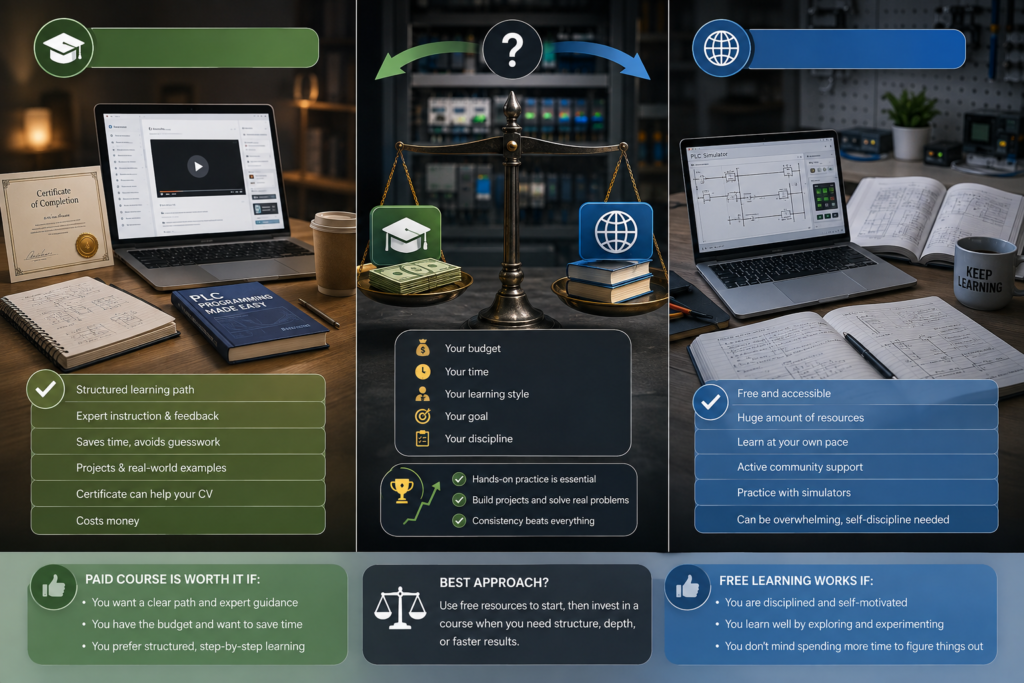
You can learn PLC programming without paying for a course. Free software, manufacturer documentation, YouTube tutorials, forums, and simulation projects provide enough material to develop solid beginner skills.
The harder question is whether you will learn efficiently, practise the right subjects, and recognise gaps in your knowledge without a structured course.
A paid PLC course does not contain secret information unavailable elsewhere. What you are normally paying for is organisation, instructor support, exercises, hardware access, and a clearer route from beginner concepts to complete projects.
Whether that is worth the money depends on your experience, goals, budget, and learning habits.
What Can You Learn for Free?
A beginner can learn most fundamental PLC concepts without spending anything.
These include:
- Basic ladder logic
- Inputs and outputs
- Start-stop circuits
- Timers and counters
- Interlocks
- Comparisons and arithmetic
- Manual and automatic modes
- Basic sequences
- Alarm logic
- Structured Text fundamentals
- Analog scaling
- Basic HMI design
Free programming environments make practical learning possible even without a physical PLC.
The CODESYS Development System can be downloaded and used without a licence fee. Its installation also includes a demonstration version of the CODESYS Control Win SL SoftPLC, allowing learners to create and test IEC 61131-3 applications on a computer.
Schneider Electric also provides EcoStruxure Machine Expert Basic as free programming software for Modicon M221 controllers.
Students interested in Siemens can access its Automation Cooperates with Education resources. Siemens currently lists more than 100 learning documents, over 40 digital modules, and more than 160 web-based training resources covering subjects including TIA Portal, LOGO!, industrial security, robotics, digital twins, and process control. Access to downloadable modules requires the appropriate Siemens account permissions.
The information is available. The real challenge is turning that information into skill.
The Weakness of Free Learning
Free learning is usually unstructured.
You may watch one video about timers, another about motor control, and a third about analog inputs without understanding how those subjects fit into a complete machine program.
Tutorials also tend to show successful examples. Real automation work involves unclear faults, incorrect wiring, missing sensor signals, communication failures, invalid operator settings, and machines that stop halfway through a sequence.
Another problem is passive learning. Watching someone build ladder logic feels productive, but recognising instructions on a screen is not the same as creating a working program from an empty project.
Free learning works best when you create your own structure.
For example:
- Learn basic contacts, coils, timers, and counters.
- Build a start-stop motor circuit.
- Add operating permissions and interlocks.
- Create manual and automatic modes.
- Build a complete machine sequence.
- Add alarms and timeouts.
- Simulate failed sensors.
- Document and test the finished project.
Without projects and deliberate fault-finding, it is possible to consume hundreds of tutorials while remaining unable to program independently.
What Does a Paid Course Actually Add?
A good paid course gives you a defined learning path.
Instead of deciding what to study next, you follow lessons that gradually introduce new concepts. Exercises reinforce the material, and the instructor may explain why one programming method is preferable to another.
Instructor-led vendor courses can also include practical workstations and hands-on laboratory exercises. Rockwell Automation, for example, describes its instructor-led courses as combining lectures with practical labs using real training workstations.
A paid course may provide:
- Structured lessons
- Practical assignments
- Instructor feedback
- Access to real PLC hardware
- Troubleshooting exercises
- Downloadable project files
- A learner community
- Deadlines and accountability
- A completion certificate
These features can shorten the learning process, but only when the course is well designed.
Paying does not guarantee quality. Some paid courses consist mainly of basic videos that repeat information available freely. Others teach learners to copy completed programs without making independent decisions.
The certificate itself is rarely the most valuable part. Employers are generally more interested in whether you can explain a program, diagnose a fault, read an electrical schematic, and demonstrate a completed project.
When a Paid Course Is Worth It
A paid course is more likely to be worthwhile when you:
- Need a structured path
- Keep abandoning self-paced learning
- Want access to expensive hardware or software
- Need feedback from an experienced instructor
- Are changing careers and do not know where to begin
- Need training on a specific employer-used platform
- Can apply the material immediately at work
Vendor training can be especially valuable when your employer pays and you already work with that manufacturer’s equipment.
For example, a maintenance technician who regularly troubleshoots Siemens S7-1500 systems can apply TIA Portal training immediately. The same course may offer much poorer value to a beginner who has no software access, no PLC, and no opportunity to practise afterward.
When You Should Start Free
Start with free resources when you are still deciding whether industrial automation interests you.
There is little reason to spend hundreds or thousands of euros before you understand basic ladder logic or complete your first simulated project.
Use a free environment such as CODESYS, work through official learning material, and build several small systems. A good starting sequence might include:
- Motor start-stop control
- Traffic-light sequence
- Tank filling system
- Conveyor with product counting
- Pump alternation
- Bottle-filling simulation
After completing these, attempt one project without following a tutorial. This will reveal whether you genuinely understand the concepts.
You can then identify a specific weakness worth paying to correct, such as Siemens TIA Portal, Allen-Bradley Studio 5000, industrial networking, HMI development, motion control, or functional safety.
How to Judge a Paid PLC Course
Before purchasing, examine what you will build rather than how many hours of video are included.
A strong course should cover more than individual instructions. Look for:
- Complete machine projects
- Manual and automatic modes
- Interlocks and permissions
- Alarm handling
- Sensor and actuator timeouts
- Program organisation
- Troubleshooting exercises
- HMI integration
- Industrial communication
- Documentation and testing
Check which PLC platform and software version the instructor uses. Confirm whether the software is included, free, available as a trial, or must be purchased separately.
Also ask whether the course teaches transferable control principles or only tells you where to click.
The Honest Verdict
You do not need a paid course to begin learning PLC programming.
A motivated learner can build strong foundations using free software, official documentation, tutorials, and simulation projects. Free learning is especially effective for ladder logic, sequencing, alarms, basic HMI development, and general PLC concepts.
A paid course becomes valuable when it solves a specific problem: lack of structure, lack of feedback, lack of hardware access, or the need to learn a particular industrial platform quickly.
The best approach for most beginners is simple:
Start free. Build projects. Discover where you struggle. Then pay only for training that closes a clearly identified skill gap.
Do not buy a course because its certificate promises to make you a PLC programmer. Buy it when the exercises, support, and structure will help you do something you cannot yet do independently.