Buying electrical test equipment one tool at a time can become expensive and confusing, especially when you are just getting started.
You need a meter for current and voltage, a non-contact voltage detector for quick checks, a receptacle tester for outlet wiring and a compact tester for basic AC and DC voltage measurements. Before long, four separate products are rolling around inside the toolbox.
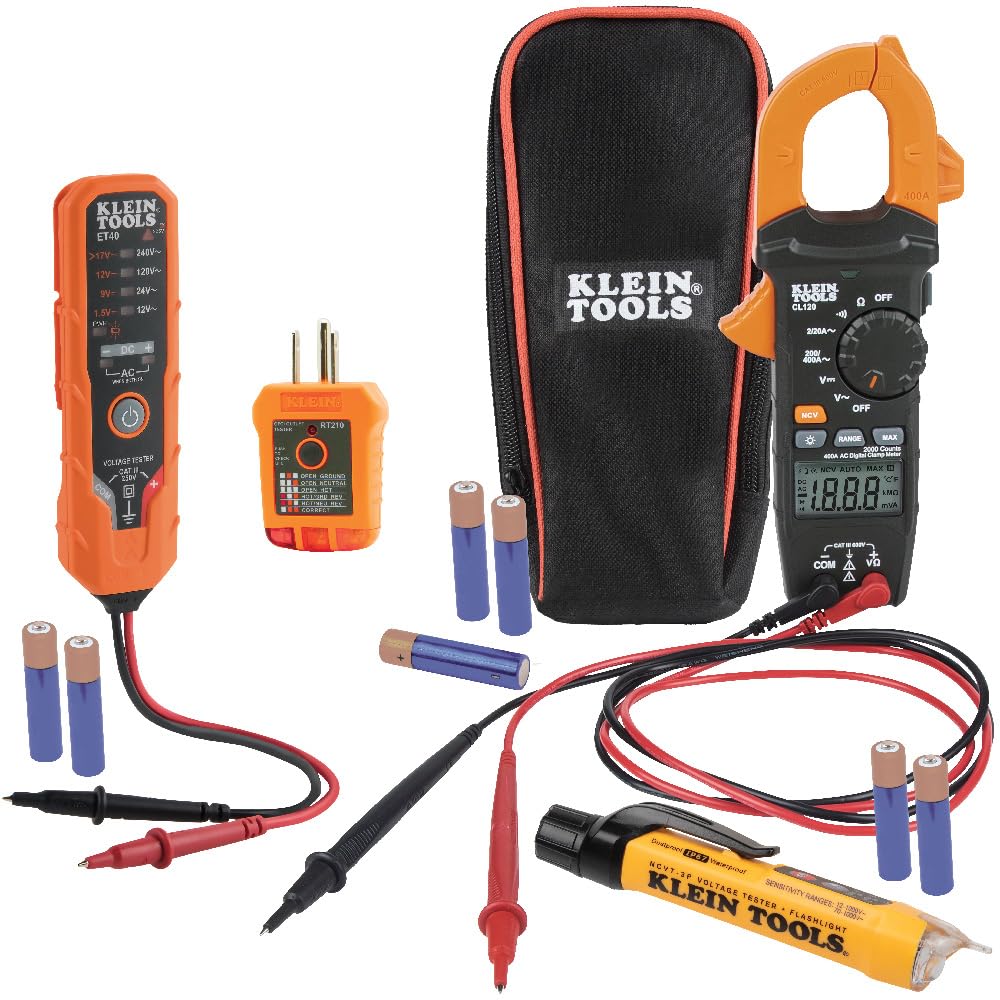
The Klein Tools CL120VP Electrical Test Kit combines all of those tools in one package.
I recommend it as a very good all-in-one electrical testing kit for beginners and handy homeowners who want reliable tools for basic troubleshooting, maintenance and learning. It also provides a practical backup set for electricians who want several commonly used testers in one carrying pouch.
Affiliate disclosure: This post contains affiliate links. I may earn a commission when you purchase through one of these links, at no additional cost to you. As an Amazon Associate, I earn from qualifying purchases.
Klein packages one measuring instrument and three smaller testers together, giving users several ways to investigate common electrical problems without immediately purchasing additional equipment.
CL120 Digital Clamp Meter
The CL120 is the main instrument in the kit.
It can measure:
AC current through the clamp
AC and DC voltage through the test leads
Resistance
Continuity
The clamp measures AC current up to 400 A without requiring the circuit conductor to be disconnected. The meter also has a backlit 2,000-count display, a 1.6-inch jaw opening and a CAT III 600V safety rating.
For beginners, the auto-ranging function is useful because the meter selects the measurement range automatically. You still need to choose the correct function, but you do not have to estimate whether a voltage belongs in a 20V, 200V or 600V range before testing it.
A clamp meter is useful for checking the current drawn by:
Motors
Appliances
Heating equipment
Lighting circuits
Pumps
Air-conditioning equipment
Remember that the clamp must normally surround only one current-carrying conductor. Clamping around both line and neutral together usually causes their magnetic fields to cancel, producing an incorrect or near-zero reading.
NCVT3P Non-Contact Voltage Tester
The NCVT3P helps detect the presence of AC voltage without exposing a conductive test probe.
It has two detection ranges:
12–1,000V AC
70–1,000V AC
The lower range can be useful for some low-voltage AC systems, while the higher range is intended for normal electrical wiring. It also includes a flashlight that can be used independently of the voltage-detection function.
This tester is useful for quick preliminary checks around:
Electrical outlets
Switches
Cables
Light fixtures
Circuit breakers
A non-contact tester should not be the only instrument used to prove that a circuit is safe. It may react to induced voltage, and certain wiring arrangements can reduce detection sensitivity.
Always verify isolation using an appropriate contact tester and safe procedure before touching conductors.
ET40 AC/DC Voltage Tester
The compact ET40 provides a quick indication of common voltage levels.
It detects AC voltage from 12V to 240V and DC voltage from approximately 1.5V to 24V across several indicated levels.
This can be handy when checking:
Household wiring
Doorbell transformers
Batteries
Low-voltage controls
Thermostat circuits
Automotive-style DC supplies
It does not provide the same detailed numerical reading as the clamp meter, but it is small, quick to use and useful for basic checks.
RT210 GFCI Receptacle Tester
The RT210 plugs into a standard North American three-wire receptacle.
Its indicator pattern can help identify common problems such as:
Open ground
Open neutral
Open hot
Reversed polarity
Hot and ground reversed
It also includes a button for testing compatible GFCI receptacles.
This is particularly helpful for homeowners checking outlets after replacement or investigating why equipment does not operate correctly.
However, the RT210 is designed for compatible North American receptacles. It is not suitable for ordinary European 230V outlets.
Why I Recommend This Kit
The strongest feature is its versatility.
A beginner receives several tools covering different types of electrical testing rather than one multimeter and no clear idea which accessories to buy next.
The kit is useful for:
Learning basic electrical measurements
Checking household outlets
Testing batteries and low-voltage supplies
Identifying the presence of AC voltage
Measuring appliance or motor current
Troubleshooting simple continuity problems
Building a first electrical tool collection
The padded pouch keeps everything together, and the required batteries are included. Klein also gives the main meter a two-metre drop-protection rating, which is useful for a tool likely to spend time in garages, workshops and tool bags.
Important Limitations
The CL120VP is a beginner-friendly kit, but electrical testing still requires knowledge and caution.
It does not replace:
Professional electrical training
Safe isolation procedures
Lockout and tagout
Appropriate personal protective equipment
A dedicated two-pole tester where required
An electrician for complex or dangerous faults
The CL120 measures AC current through its clamp, but it does not measure DC current through the clamp. It also lacks some advanced features found on more expensive meters, such as temperature measurement and higher-resolution displays.
Klein warns users not to measure resistance or continuity on energized circuits and recommends verifying the meter on a known voltage source before each use. Damaged test leads or meters should not be used.
Final Verdict
The Klein Tools CL120VP is a very good all-in-one electrical testing kit for beginners and handy homeowners.
You receive a capable clamp meter, a non-contact voltage tester, a compact AC/DC voltage tester and a GFCI receptacle tester in one organized package.
It covers many of the basic measurements someone is likely to perform around a workshop or North American home, while still being useful enough to remain in the tool bag as their experience grows.
I recommend it for anyone building a first electrical test kit and wanting several trusted tools without purchasing each one separately.