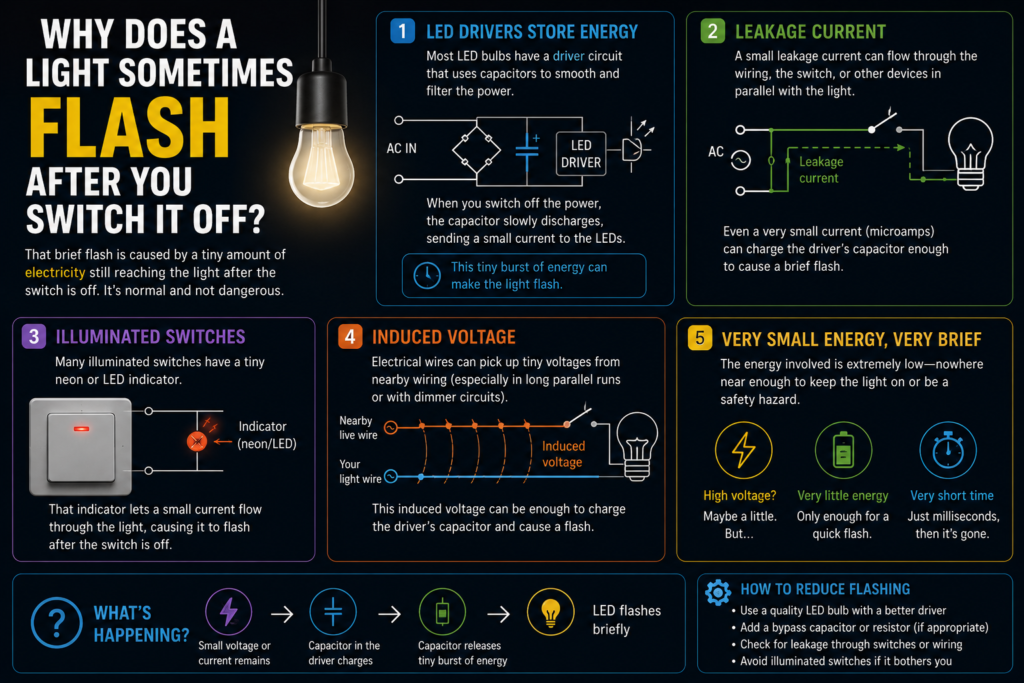
You flip the switch, the room goes dark, and then—half a second later—the lamp flashes once.
Or perhaps it does something even stranger. It gives a faint blink every few seconds, glows weakly in the dark, or produces one final pulse long after it was supposedly switched off.
With an old incandescent bulb, switching off was rather final. The circuit opened, the filament cooled, end of story.
LED lighting is more complicated.
An LED lamp contains electronic components that can respond to extremely small currents. Even when the wall switch is open, a tiny amount of electricity may still reach the lamp through an illuminated switch, a dimmer, cable capacitance, a smart-switch circuit, or ordinary leakage inside connected equipment.
That current may be far too small to keep the light on continuously. It can still charge a capacitor inside the LED driver.
Once the capacitor reaches a certain voltage, the driver attempts to start. The LEDs flash, the stored energy is used up, and the process begins again.
Tiny current. Slow charging. Brief flash.
That is the usual explanation, although not the only one.
LED Bulbs Are Electronic Devices
An incandescent lamp is essentially a resistive heating element.
Current passes through a thin filament, the filament becomes extremely hot, and some of that heat appears as visible light. If only a tiny leakage current reaches the lamp, the filament does not become hot enough to glow.
An LED lamp works differently.
The LEDs themselves operate on low-voltage direct current, while the building supplies higher-voltage alternating current. Electronics inside the lamp must therefore convert and regulate the incoming power.
This electronic circuit is called an LED driver.
A typical driver may contain:
- A bridge rectifier
- Resistors
- Diodes
- One or more capacitors
- A switching controller
- An inductor or small transformer
- Current-regulating components
- Protection components
The exact design depends on the lamp’s price, power, size, and manufacturer.
Because the driver includes energy-storage components and sensitive electronics, an LED lamp can behave in ways that an incandescent bulb never would.
The Capacitor Inside the LED Driver
Capacitors temporarily store electric charge.
Inside an LED driver, a capacitor helps smooth the rectified supply and maintain a more stable voltage for the LEDs. While the lamp is switched on, this is useful and completely normal.
When the lamp is switched off, that capacitor does not always become empty instantly.
A remaining charge may power the LEDs for a fraction of a second, producing:
- A brief flash
- A fading glow
- A short delay before complete darkness
This is particularly noticeable with low-power LED lamps because they require relatively little energy to produce visible light.
A single flash immediately after switching off may therefore come from energy already stored in the driver.
However, if the lamp continues flashing every few seconds, another source is probably recharging the capacitor.
How Repeated Flashing Happens
Imagine that a tiny leakage current continues flowing toward the lamp after the switch has opened.
The current is not large enough to operate the LED driver normally. Instead, it slowly charges the driver’s input capacitor.
The sequence then looks like this:
- The light switch opens.
- A very small current still reaches the LED driver.
- The driver capacitor begins charging.
- Its voltage gradually rises.
- The driver reaches its starting threshold.
- The circuit briefly powers the LEDs.
- The LEDs flash.
- The capacitor discharges and its voltage collapses.
- Charging begins again.
Depending on the leakage current and lamp design, this cycle may repeat every second, every few seconds, or only occasionally.
It is basically a very disappointing strobe light—one nobody asked for.
What Is Leakage Current?
Leakage current is a small unintended or deliberately limited current that flows where an ideal open circuit would allow none.
Real electrical devices and wiring are not perfect.
Small currents can pass through:
- Electronic switches
- Dimmers
- Surge-protection components
- Indicator lamps
- Cable capacitance
- Insulation
- Filters inside connected equipment
- Moisture or contamination
- Faulty wiring
In many cases, the leakage is normal and extremely small.
A few microamps or a fraction of a milliamp would have had no visible effect on an incandescent lamp. An LED driver, though, may slowly collect that energy until it has enough for a brief start-up attempt.
This is why the problem often appears after replacing an old incandescent or halogen bulb with an LED.
The wiring did not necessarily change. The new lamp is simply much more responsive to tiny currents.
Illuminated Light Switches
Some wall switches contain a small indicator lamp.
The indicator may help you find the switch in a dark room or show whether a circuit is energised. Older illuminated switches often use a neon lamp, while newer designs may contain a small LED circuit.
In a common two-wire arrangement, the indicator is connected across the switch contacts.
When the switch is open, a tiny current flows through:
- The switch indicator
- The lighting circuit
- The connected lamp
With an incandescent bulb, this current is too small to heat the filament visibly.
With an LED bulb, it may charge the driver capacitor.
Once enough charge accumulates, the LED flashes. The indicator circuit then starts charging it again.
The illuminated switch is not necessarily defective. It may simply be incompatible with the particular LED lamp.
Some lamp manufacturers design their drivers to tolerate this current. Others do not. Two bulbs with the same wattage may therefore behave completely differently on the same circuit.
Smart Switches Without a Neutral Connection
Many traditional wall-switch boxes contain only the incoming live conductor and the switched live conductor. The neutral remains at the ceiling fitting or junction box.
A mechanical switch does not need a neutral because it merely opens or closes the live conductor.
A smart switch is different. Its electronics need continuous power for:
- Wireless communication
- Touch sensing
- Indicator lights
- Timers
- Internal control circuits
- Relays or semiconductor switching
A smart switch without a neutral often powers itself by allowing a tiny current to pass through the connected lamp, even while the light is off.
Once again, an incandescent filament barely notices.
An LED driver might.
The result can be:
- Faint glowing
- Intermittent flashes
- Buzzing
- Failure to switch fully off
- Unstable smart-switch operation
Some manufacturers supply a bypass or load-correction device that is installed across the lamp. It gives the tiny current another path instead of allowing it to charge the LED driver.
Such devices must be selected and installed correctly. This is mains-voltage work, not a place for improvised resistor experiments behind a ceiling rose.
Electronic Dimmers and Sensors
Even when their controls appear to be off, electronic devices may allow a small current through the lighting circuit.
Common examples include:
- Triac dimmers
- Motion sensors
- Photocell switches
- Timers
- Remote-control receivers
- Touch switches
- Electronic relays
- Home-automation modules
Some devices need a small holding or sensing current. Others contain suppression networks that allow limited AC current to pass.
Older dimmers were often designed for incandescent loads of 40 watts, 60 watts, or more. A modern LED lamp may consume only 5 to 10 watts and behave poorly below the dimmer’s minimum load.
The light may flicker while on, flash while off, or refuse to extinguish completely.
Using an LED-compatible dimmer usually helps, but “LED compatible” does not guarantee compatibility with every bulb. The driver and dimmer still need to work together.
Induced Voltage and Capacitive Coupling
Sometimes the switch and lamp are both perfectly normal, yet a small voltage appears on the switched conductor when it should be disconnected.
People often call this induced voltage or ghost voltage.
In many building cables, the switched wire runs alongside permanently energised conductors for several metres. The insulated conductors behave like the plates of a very small capacitor.
An alternating electric field from the live conductor can couple a tiny current into the disconnected wire.
This is known as capacitive coupling.
The available current is usually extremely limited, but a high-impedance digital multimeter may still display a surprisingly high voltage—sometimes dozens or even more than 100 volts.
That does not mean the disconnected conductor can necessarily deliver the same power as a properly connected live wire. When a low-resistance load is applied, the ghost voltage often collapses.
An LED driver is a light load with capacitors and sensitive electronics, so even this weakly coupled current may be enough to produce an occasional flash.
Long cable runs, bundled conductors, and certain wiring arrangements make the effect more noticeable.
Is It Really Electromagnetic Induction?
The phrase “induced voltage” is often used loosely.
Two related effects may be involved:
Capacitive coupling
An electric field between nearby conductors allows a tiny alternating current to pass through their mutual capacitance.
This is often the dominant cause in ordinary lighting cables.
Inductive coupling
Current in one conductor produces a changing magnetic field. That magnetic field can induce voltage in a nearby conductor.
Inductive coupling becomes more important where conductors form larger loops, carry substantial current, or run near transformers, motors, contactors, and other magnetic equipment.
In typical household lighting wiring, capacitive coupling is usually the more likely explanation for a small ghost voltage.
Either way, the source has limited energy. It may still be enough to annoy an LED lamp all night.
Why Some LED Bulbs Flash and Others Do Not
Not all LED drivers are designed the same way.
A better-quality lamp may include:
- A discharge resistor across the input capacitor
- Improved filtering
- A higher start-up threshold
- Better leakage-current tolerance
- Proper dimmer compatibility
- More stable current regulation
A cheaper design may omit some of these components to save space and cost.
The lamp may then be more prone to afterglow or periodic flashing.
Differences in capacitor size also matter. A small capacitor may charge quickly and produce frequent flashes. A larger one may take longer but create a brighter pulse.
The number and arrangement of LEDs affect the behaviour too.
This is why replacing the bulb with another brand sometimes solves the problem immediately—even though nothing else in the installation has changed.
Not a particularly satisfying engineering diagnosis, perhaps, but a useful test.
Why the Light May Flash Only Once
A single flash immediately after switch-off usually has a simpler explanation than repeated blinking.
Possible causes include:
- The driver capacitor discharging through the LEDs
- The electronic switch briefly changing state
- A dimmer’s internal circuit releasing stored energy
- Contact bounce inside the switch
- A transient voltage created as current is interrupted
When an inductive load is switched, collapsing magnetic fields can create voltage transients. Ordinary lighting circuits are not always strongly inductive, but connected drivers, transformers, relays, and long wiring runs can produce switching effects.
One brief flash is often just the electronics settling after the supply disappears.
Repeated flashes mean energy is probably continuing to enter the driver somehow.
Why an LED May Glow Faintly Instead of Flashing
Sometimes the leakage current is sufficient to pass through part of the LED driver continuously.
Instead of charging to a start-up threshold and discharging in a pulse, the circuit allows a weak steady current through the LEDs.
The result is a faint glow.
You may only notice it at night after your eyes adjust to the darkness.
Whether the lamp glows or flashes depends on the driver design:
- Some drivers block current until a threshold is reached.
- Some allow a weak continuous current.
- Some repeatedly attempt to start.
- Some remain completely dark.
The leakage source may be identical in all four cases. The lamp determines how visibly it responds.
Switching the Neutral Instead of the Live Conductor
A more serious possibility is that the switch has been installed in the neutral conductor rather than the live conductor.
The lamp may turn off because the circuit is interrupted, but the lamp holder and internal electronics can remain connected to live voltage.
This does not automatically cause flashing, but it can contribute to leakage and capacitive effects.
More importantly, it creates a safety hazard.
Someone changing the lamp may assume the fitting is isolated because the wall switch is off. In reality, parts of it may still be live relative to earth.
Lighting switches should normally interrupt the live conductor, following the applicable wiring rules and equipment design.
A persistent afterglow does not prove that the neutral has been switched. Still, incorrect polarity should be considered if the installation is old, recently modified, or behaving unusually.
Shared Neutrals and Wiring Faults
Occasional flashing can also result from actual wiring problems.
Possible faults include:
- A loose neutral connection
- A shared or incorrectly connected neutral
- Damaged insulation
- Moisture inside a fitting
- Incorrect two-way switch wiring
- Faulty smart-switch installation
- Current returning through another circuit
- Poor connections in junction boxes
- A defective lamp holder
- Voltage appearing from another switched circuit
A loose neutral can create unstable voltages and should be taken seriously, particularly if several lights change brightness, appliances behave strangely, or the problem affects more than one circuit.
Other warning signs include:
- Crackling sounds
- A burning smell
- Warm switches
- Discoloured fittings
- Frequent breaker trips
- Visible arcing
- Lights becoming brighter and dimmer unexpectedly
Those symptoms are not normal LED quirks. The circuit should be inspected by a qualified electrician.
Can the Flash Damage the LED?
Occasional flashing does not always destroy the lamp immediately.
However, repeated start-up cycles can stress the LED driver.
Every flash charges and discharges capacitors, activates semiconductor components, and may send a brief current pulse through the LEDs.
Over time, this can contribute to:
- Capacitor wear
- Driver failure
- Reduced lamp life
- Unstable operation
- Premature LED degradation
The energy involved is small, but thousands of unnecessary flashes add up.
Even if the lamp survives, a bedroom light blinking every 20 seconds is hardly a premium lighting experience.
Can It Waste Electricity?
Yes, but usually not much.
The leakage current charging the lamp uses some electrical energy. In a single residential circuit, the consumption is often tiny.
A smart switch or illuminated switch may consume more energy running its own electronics than the lamp’s occasional flash consumes.
Still, the more important concerns are compatibility, lamp life, annoyance, and whether the behaviour indicates a wiring fault.
A small energy cost does not automatically make the problem harmless.
How the Problem Is Diagnosed
A sensible diagnosis starts with the simplest possibilities.
Try a different LED lamp
Replace the lamp with a known good bulb from another manufacturer.
If the flashing stops, the original LED driver was probably unusually sensitive to leakage current.
Check for an illuminated switch
Look for a switch that glows when the light is off.
Its indicator current may be charging the LED driver.
Identify dimmers, sensors, or smart controls
Electronic switching devices often allow small off-state currents.
Confirm that the device is rated for the type and wattage of LED load being used.
Observe the pattern
A single flash directly after switch-off suggests stored energy.
Regular flashes every few seconds suggest a capacitor repeatedly charging from leakage current.
A steady faint glow suggests continuous low-level current.
Random flashes may point toward switching transients, another connected circuit, or a wiring issue.
Measure the circuit correctly
A high-impedance multimeter may show ghost voltage that disappears under load.
Electricians may use an appropriate low-impedance tester to distinguish a weak coupled voltage from a conductor connected to a real power source.
Measurement on mains wiring should be performed only by someone trained and equipped to do it safely.
Common Solutions
The correct remedy depends on the cause.
Possible solutions include:
- Replacing the LED bulb with a better-compatible model
- Replacing an illuminated switch
- Using an LED-compatible indicator switch
- Installing the manufacturer’s approved bypass device
- Replacing an incompatible dimmer
- Using a smart switch with a neutral connection
- Correcting switched-neutral wiring
- Separating or rerouting problematic conductors
- Repairing loose or damaged connections
- Installing a properly selected suppression or bleed component
A bypass device typically provides a controlled path for leakage current, preventing the LED driver capacitor from charging.
In some circuits, a resistor-capacitor network or approved load compensator may be used. Component selection must account for mains voltage, heat, power rating, insulation, enclosure, and applicable electrical standards.
A random resistor found in a drawer is not an acceptable ceiling-fitting accessory.
Is a Flashing LED Dangerous?
Often, no.
A brief flash after switch-off is commonly caused by stored charge inside the LED driver. Repeated blinking may come from a tiny leakage current through an illuminated switch, dimmer, smart control, or cable capacitance.
These effects can occur in an otherwise functioning installation.
However, flashing should not be automatically dismissed when it is accompanied by:
- Burning smells
- Heat or discolouration
- Crackling
- Unstable brightness
- Protective-device operation
- Recent electrical modifications
- Multiple affected circuits
- Exposed or damaged wiring
Incorrect switching, loose neutrals, and insulation faults can produce confusing lighting symptoms too.
The lamp may be telling you nothing more than “my capacitor is slowly charging.”
Or it may be the first visible sign that the circuit deserves a proper inspection.
Context matters.
The Main Point
An LED light can flash after being switched off because “off” does not always mean absolutely zero electrical current.
The LED driver contains capacitors that store charge. Residual energy may produce one final flash immediately after switch-off.
If a tiny current continues reaching the lamp, the capacitor may slowly recharge. Once the driver reaches its start-up voltage, the LEDs flash briefly, the capacitor empties, and the cycle repeats.
That tiny current may come from:
- An illuminated wall switch
- A smart switch without a neutral
- An electronic dimmer or sensor
- Leakage through connected equipment
- Capacitive coupling between nearby wires
- Induced or ghost voltage
- Incorrect or faulty wiring
Older incandescent bulbs ignored these tiny currents because their filaments needed far more power to produce visible light.
LEDs are efficient.
Occasionally, almost too efficient for their own good.