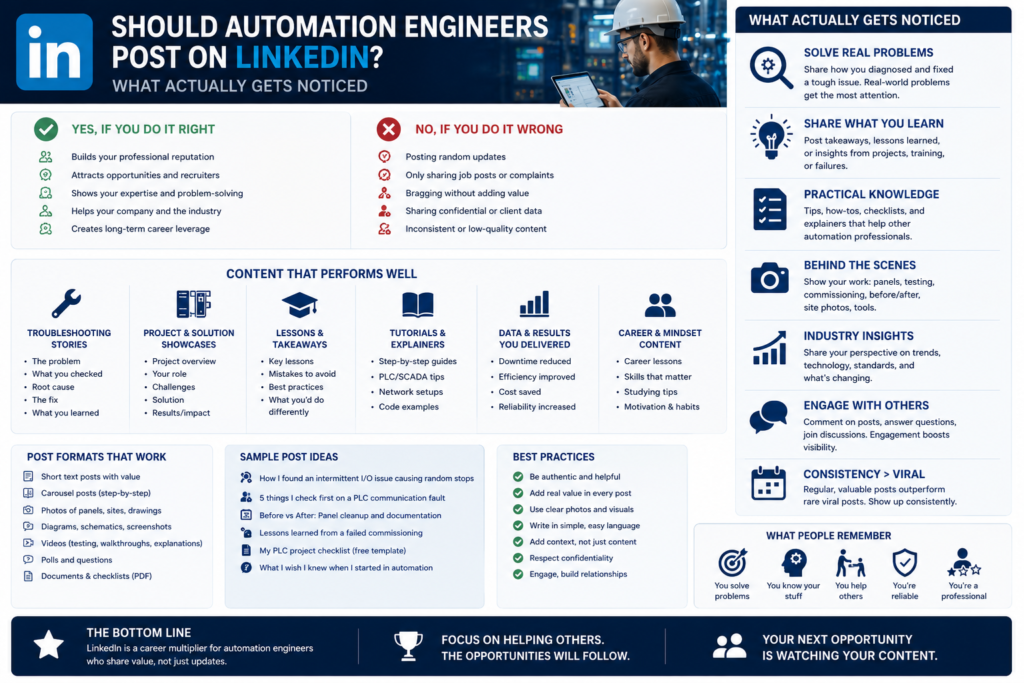
Most automation engineers do not need to become content creators.
They do not need to publish motivational stories every morning, photograph their coffee beside a laptop or describe every ordinary workday as a “powerful journey.”
However, posting useful technical content can help an automation engineer become more visible to recruiters, system integrators, manufacturers, contractors and other engineers.
The important word is useful.
A hiring manager is unlikely to be impressed by a generic post saying that industrial automation is the future. They may remember someone who clearly explains how they diagnosed an intermittent PROFINET fault, structured a machine sequence or improved an unhelpful HMI alarm.
LinkedIn increasingly supports skills-based recruiting, where employers search for specific capabilities rather than relying only on degrees or job titles. LinkedIn reports that companies using the most skills-based searches are more likely to make successful hires. Technical posts can support that process by showing evidence behind the skills listed on your profile.
What Posting Can Realistically Do
Posting will not automatically produce job offers.
It can help you:
- Demonstrate technical knowledge
- Become visible outside your immediate workplace
- Build relationships with engineers and recruiters
- Document your professional development
- Attract freelance or subcontracting enquiries
- Create evidence for a future job search
- Improve how confidently you explain technical work
Think of LinkedIn content as a public technical notebook with selected pages visible.
Your CV may say:
Experienced in PLC and industrial-network troubleshooting.
A post can show how you approach that work:
A machine repeatedly lost communication with one remote-I/O station. The fault looked like a PLC problem, but switch diagnostics showed port errors increasing during machine vibration. The actual cause was a damaged cable near a moving assembly.
That is more convincing because it demonstrates a diagnostic process.
What Actually Gets Noticed
1. Real Troubleshooting Lessons
Practical fault stories are among the strongest topics for maintenance and controls professionals.
Good examples include:
- A sensor LED was on, but the PLC input remained off
- A drive received a frequency command, but the motor did not accelerate
- A machine stopped because of an unexpected downstream permissive
- A communication fault was traced to duplicate IP addressing
- A motor overload was caused by mechanical binding rather than an electrical fault
The post does not need to reveal the customer, factory or machine.
Use a simple structure:
Symptom → tests performed → confirmed cause → lesson
For example:
A contactor had the correct coil voltage but would not pull in. Before replacing it, we measured the voltage while the coil was connected. It collapsed under load because of a high-resistance connection upstream. An unloaded voltage reading had hidden the fault.
That type of post shows practical judgement, not merely textbook knowledge.
2. Project Breakdowns
Show how you approached a project rather than only announcing that it was completed.
Useful subjects include:
- Migrating an old PLC
- Replacing an obsolete HMI
- Adding SCADA data collection
- Standardising motor-control blocks
- Building a machine alarm structure
- Commissioning remote I/O
- Connecting production data to SQL
- Improving backup management
Explain your responsibility clearly.
Do not write:
Completed another successful automation project for a major customer.
Write:
My part of the project was rebuilding the PLC alarm structure and creating HMI diagnostics for missing start conditions. The most useful improvement was showing operators which permissive prevented each motor from starting.
Specific responsibility is more credible than vague project language.
3. Simple Technical Explanations
Engineers frequently underestimate the value of explaining basic concepts clearly.
A useful post might explain:
- Permissive versus interlock
- PNP versus NPN sensors
- PROFINET device name versus IP address
- PLC output command versus physical output state
- Standard stop versus emergency stop
- Analogue raw value versus engineering value
- Why a VFD can show “ready” but still refuse to run
You do not need to demonstrate that you know everything.
You need to make one concept easier for someone else to understand.
LinkedIn’s own current content guidance emphasises providing value, understanding the intended audience, experimenting with formats and maintaining quality rather than publishing large volumes of low-value material.
4. Honest Career Lessons
Career content works when it contains practical detail.
Examples include:
- What surprised you during your first commissioning project
- Skills that helped you move from electrician to automation technician
- What night-shift maintenance taught you
- Why you learned industrial networking
- A mistake you made during testing and how your process changed
- What you would study first if starting again
Avoid turning every minor event into an inspirational speech.
A grounded post such as this is enough:
Early in maintenance, I assumed every machine fault visible in the PLC originated in the PLC. Experience taught me that the program often only shows where the real field problem becomes visible.
That sounds like an engineer reflecting on experience rather than someone auditioning to become a business influencer.
5. Useful Visual Evidence
Relevant images can make technical content easier to understand:
- An anonymised network diagram
- A simplified control sequence
- A training-panel project
- A simulated HMI screen
- A handwritten diagnostic flow
- A safe photograph of a test setup
- A before-and-after alarm design
Visuals should support the technical lesson.
A random photograph of an electrical cabinet with the caption “another exciting day” provides little evidence of what you actually know.
What Hiring Managers Are Likely to Notice
A manager looking for automation staff is more interested in professional evidence than popularity.
The strongest signals are:
| Signal | What it suggests |
|---|---|
| Clear technical reasoning | You troubleshoot systematically |
| Specific platform knowledge | You may match the installed equipment |
| Honest scope of responsibility | You do not exaggerate your experience |
| Good documentation | You can communicate with a team |
| Safety awareness | You understand industrial consequences |
| Useful interaction with others | You can collaborate professionally |
| Consistent technical focus | Your interest is genuine rather than temporary |
Ten thoughtful comments from relevant engineers may be more valuable than 10,000 impressions from an unrelated audience.
LinkedIn allows members to review post impressions, engagement, follower development and audience demographics through its analytics tools. These numbers can help you identify whether your content is reaching engineers, recruiters and companies in your intended field rather than simply accumulating views.
Your Profile Must Support Your Posts
A good post may cause someone to visit your profile.
The profile should immediately explain:
- Your current role
- Main PLC platforms
- HMI and SCADA experience
- Industries supported
- Troubleshooting or programming scope
- Location
- Travel availability
- Type of opportunity you would consider
Use a clear headline such as:
Automation Technician | Siemens TIA Portal | VFD and PROFINET Troubleshooting
Your skills section should also contain relevant, accurate platform names. LinkedIn allows members to list a substantial number of profile skills, while recruiters can use specific skills as part of candidate searches. Select the ones that genuinely represent your work instead of filling the section with every automation term you have encountered.
What Not to Post
Confidential customer information
Do not reveal:
- Customer names without permission
- Production data
- PLC source code
- Network addresses
- Passwords
- Electrical drawings
- Machine vulnerabilities
- Proprietary processes
- Photographs showing sensitive equipment
Even when no formal non-disclosure agreement exists, publishing internal details can make future employers question your judgement.
Unsafe work
Do not post photographs showing open energised panels, defeated guarding or unsafe meter use.
A post intended to demonstrate confidence may instead demonstrate that you treat safety rules as optional.
Exaggerated expertise
Do not call yourself a functional-safety expert because you completed one introductory course.
LinkedIn’s professional policies require truthful representation of qualifications, experience and achievements. More importantly, experienced engineers can recognise inflated claims quickly.
Constant complaints
An occasional honest discussion about poor commissioning schedules or maintenance pressure can be useful.
Repeatedly attacking operators, managers, previous employers or customers makes you appear difficult to work with—even when some complaints are justified.
Empty engagement bait
Avoid posts built around:
Agree?
Thoughts?
Comment “PLC” and I will send you the secret.
LinkedIn explicitly treats certain misleading attempts to manufacture engagement as spam. Ask a question when it genuinely adds to the technical discussion.
A Realistic Posting Routine
One useful post every week or two is enough for most automation professionals.
A simple monthly plan could be:
- Troubleshooting lesson
- Technical explanation
- Project or simulation example
- Career observation
Comment thoughtfully on posts from:
- Automation manufacturers
- Local system integrators
- Controls engineers
- Technical recruiters
- Training providers
- Companies where you may eventually work
LinkedIn states that posts, comments, likes and other professional activity help shape content distribution and recommendations. Participating in relevant discussions can therefore matter alongside publishing your own posts.
Final Verdict
Yes, automation engineers should consider posting on LinkedIn—but only when they have something useful to share.
The posts most likely to create professional value are not motivational speeches or photographs of expensive control panels.
They are posts that show:
A real problem → a logical approach → a useful technical lesson
You do not need thousands of followers.
You need the right maintenance manager, engineering lead, recruiter or system integrator to see enough evidence to think:
This person understands industrial systems and can explain their work clearly.
That is what gets noticed.