A motor shaft begins turning, but nothing inside the machine is physically pushing it in the way a gear pushes another gear.
No little mechanical arm. No hidden spring. Just magnetic force.
That invisible force is what makes AC motors possible. Without magnetism, the stator would simply be a collection of copper windings and steel laminations sitting inside a metal housing—expensive, heavy, and not particularly useful.
To understand how an AC motor produces rotation, it helps to first understand a few basic ideas about magnets, magnetic poles, and magnetic fields.
What Is Magnetism?
Magnetism is a force that can attract or repel certain materials and other magnets.
Iron and steel are common examples of materials affected strongly by magnetic fields. Bring a magnet close to a steel object and the attraction is easy to feel, even though there is no visible connection between them.
Magnets also naturally align themselves in a roughly north-to-south direction when they are free to move.
A compass is the familiar example. Its needle is a small magnet that responds to Earth’s magnetic field. One end points approximately toward magnetic north while the other points toward magnetic south.
This behaviour reveals two important features found in every ordinary magnet:
- A north pole
- A south pole
You cannot normally have one without the other. Cut a bar magnet in half and you do not get a separate north pole and south pole. Instead, you get two smaller magnets, each with its own north and south poles. Magnetism is stubborn like that.
What Is a Magnetic Field?
A magnetic field is the invisible region around a magnet where magnetic forces can act.
You cannot see the field directly. Still, its effects are very real.
Move a piece of iron toward a strong magnet and it may suddenly jump toward it. Bring two magnets together and they may pull toward one another—or push apart, depending on which poles are facing.
The field exists around the magnet and carries the magnetic influence through the surrounding space.
In electrical diagrams and textbooks, magnetic fields are often represented using magnetic lines of flux.
Magnetic Lines of Flux
Magnetic lines of flux are imaginary lines used to show the direction and shape of a magnetic field.
They are not physical wires or threads floating around a magnet. They are simply a useful way of visualising something that cannot normally be seen.
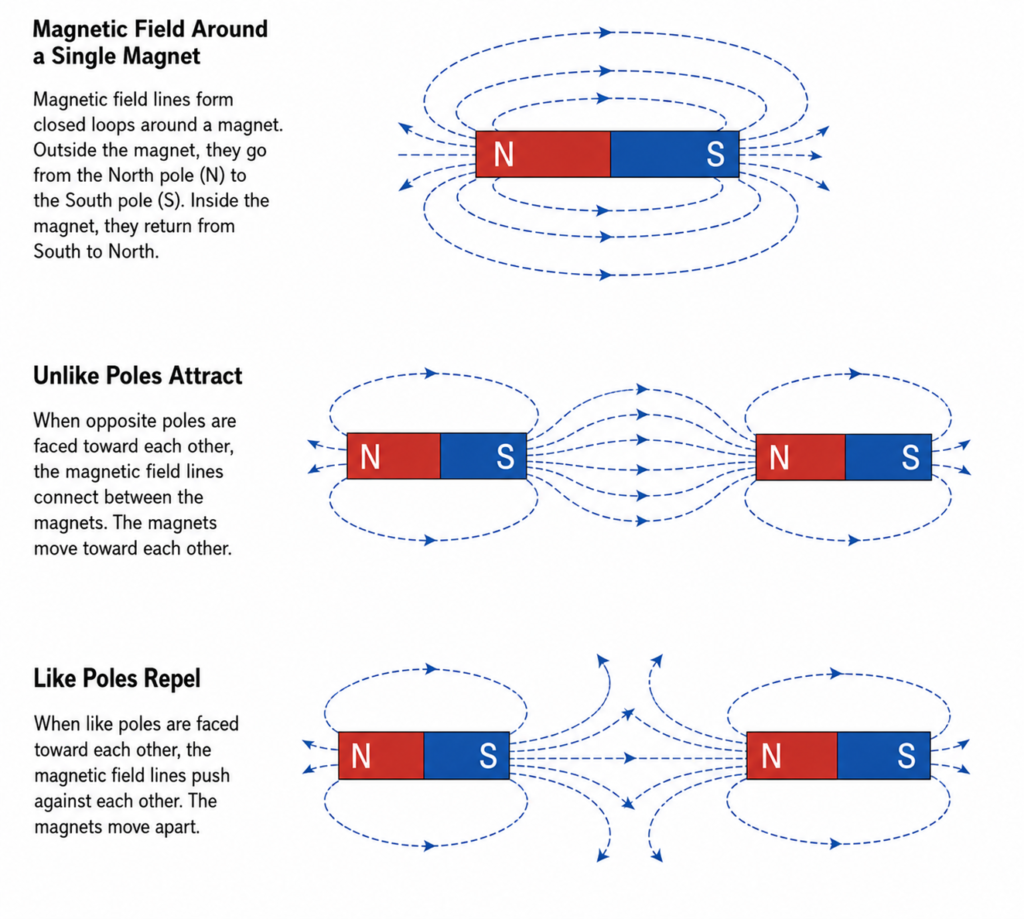
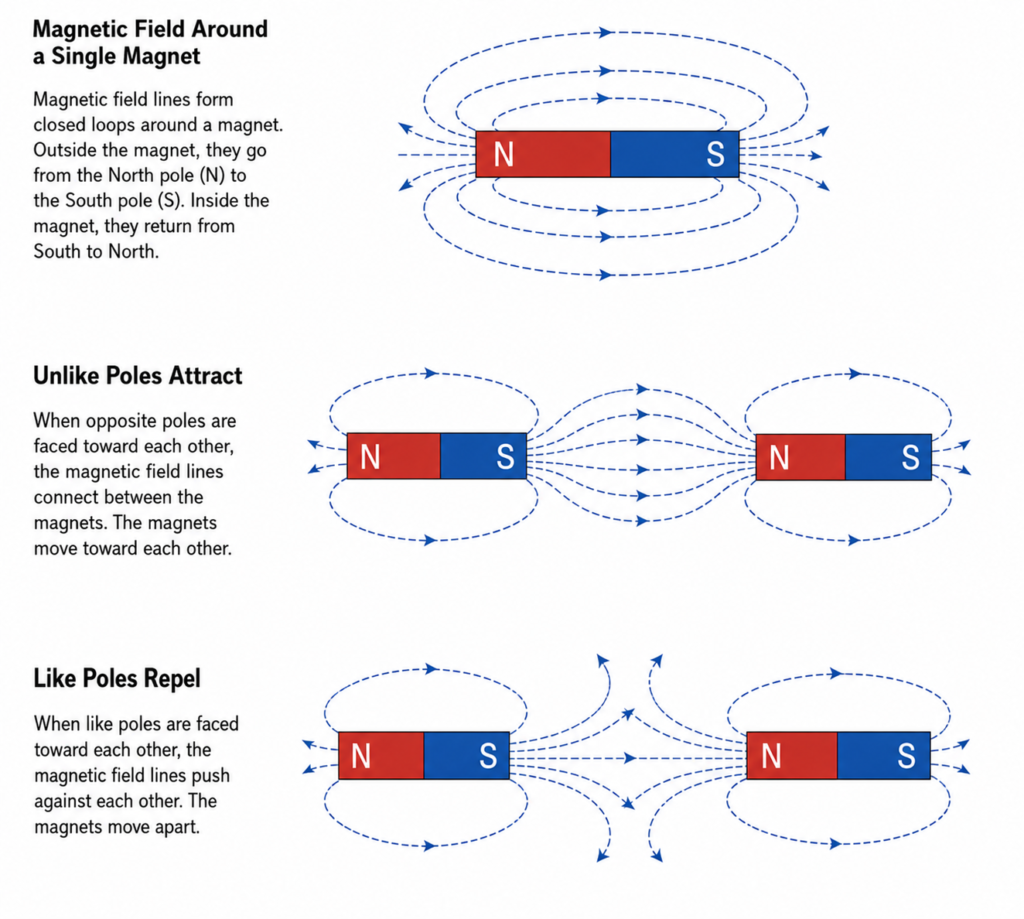
Outside a magnet, magnetic flux lines are shown leaving the north pole and entering the south pole.
Inside the magnet, the lines return from the south pole toward the north pole. As a result, magnetic lines of flux always form complete, closed loops.
The path can be summarised like this:
North pole → through the surrounding space → south pole → through the magnet → back to the north pole
The field does not simply begin at one point and disappear at another. It continues in an unbroken loop.
Making a Magnetic Field Visible
Although magnetic flux itself is invisible, there is a simple experiment that reveals the approximate shape of a magnetic field.
Place a sheet of paper over a bar magnet. Then scatter iron filings lightly across the paper.
Almost immediately, the filings begin lining up in curved patterns around the magnet.
Those tiny metal particles become temporarily magnetised and arrange themselves along the direction of the magnetic field. The result creates a rough picture of the otherwise invisible flux paths.
The filings usually gather more densely near the poles because the magnetic field is strongest in those areas.
It is one of those old classroom demonstrations that looks basic, perhaps even a little childish, yet it shows a fundamental principle behind industrial motors, transformers, relays, generators, and plenty of other electrical equipment.
Magnetic Flux and Field Strength
The number and concentration of flux lines in a drawing are commonly used to indicate magnetic field strength.
Where the lines are packed closely together, the field is considered stronger. Where they spread farther apart, the field is weaker.
In reality, a magnetic field does not consist of a limited number of separate lines. Engineers use the lines as a visual tool to make field direction and intensity easier to understand.
The total amount of magnetic field passing through a given area is called magnetic flux.
Magnetic flux is commonly represented by the Greek letter Φ, pronounced “phi,” and measured in webers.
For a basic introduction to AC motors, the most important points are simpler:
- Magnetic flux has a direction.
- It forms closed paths.
- It becomes stronger when the magnetic field becomes stronger.
- It can interact with other magnetic fields.
That final point is particularly important because magnetic interaction is what eventually produces force and torque inside a motor.
Opposite Magnetic Poles Attract
When the north pole of one magnet is brought close to the south pole of another, the two magnets pull toward each other.
Their magnetic fields interact in a way that encourages the flux paths to join together.
The lines of flux travel from the north pole of one magnet toward the south pole of the other. This creates an attractive force that attempts to move the magnets closer.
This behaviour is commonly expressed as:
Unlike poles attract.
In other words:
- North attracts south.
- South attracts north.
The closer the poles move, the stronger the attraction generally becomes.
Anyone who has played with two magnets has probably felt this. At first, the pull is mild. Move them closer and suddenly they snap together, usually catching a fingertip in the process. A small but memorable physics lesson.
Similar Magnetic Poles Repel
Now turn one of the magnets around so that two north poles face each other.
Instead of pulling together, the magnets resist.
Push harder and they continue trying to move apart. Their magnetic fields interact in a way that produces a repelling force between them.
The same thing happens when two south poles face each other.
This leads to the second basic rule:
Like poles repel.
That means:
- North repels north.
- South repels south.
The magnets do not need to touch for this force to act. Repulsion occurs through the surrounding magnetic fields.
Why Magnetic Attraction and Repulsion Matter in Motors
The attraction and repulsion between magnetic fields are not merely interesting properties of small refrigerator magnets.
They are central to the operation of electric motors.
Inside an AC motor, current flowing through the stator windings creates magnetic poles. Because the motor is supplied with alternating current, these magnetic conditions continually change.
In a three-phase motor, the arrangement of the windings and the timing of the three electrical phases produce a rotating magnetic field around the stator.
The rotor develops its own magnetic field in response.
The interaction between the stator field and the rotor field creates force. Because this force acts around the circumference of the rotor, it produces torque and causes the shaft to rotate.
The rotor is continuously pulled toward one magnetic condition while being pushed away from another. The magnetic field keeps moving, so the rotor keeps following it.
That is the basic idea. The actual electromagnetic process involves induced voltage, rotor current, slip, and torque production, but underneath all of it are the same simple rules:
Opposite poles attract. Similar poles repel.
Magnetism Created by Electric Current
Permanent magnets are useful for demonstrating magnetic behaviour, but many industrial AC motors do not rely on permanent magnets in the stator.
Instead, they use electromagnets.
Whenever electric current flows through a conductor, it creates a magnetic field around that conductor.
Wind the conductor into a coil and the magnetic fields from each turn combine. Place that coil around an iron or steel core and the field becomes much stronger.
This is exactly what happens in the stator windings of an AC induction motor.
The insulated copper windings carry current. The laminated steel stator core helps concentrate the magnetic flux. Together, the winding and core behave as an electromagnet.
Unlike a permanent magnet, an electromagnet can be controlled.
Its field can be:
- Switched on and off
- Increased or decreased
- Reversed
- Made to rotate
That level of control is what makes electromagnetism so useful in motors and automation equipment.
Magnetic Fields Are Invisible, but Not Mysterious
Magnetism can initially feel slightly strange because the force cannot be seen directly.
Yet its behaviour is predictable.
Every magnet has north and south poles. Magnetic flux forms closed loops. Outside the magnet, flux lines travel from north to south. Opposite poles attract, while similar poles repel.
Once those principles are clear, the operation of an AC motor becomes far easier to understand.
The stator creates a controlled magnetic field. The rotor reacts to it. Attraction and repulsion create force, and that force becomes rotation.
Invisible, yes. Magical, not quite.