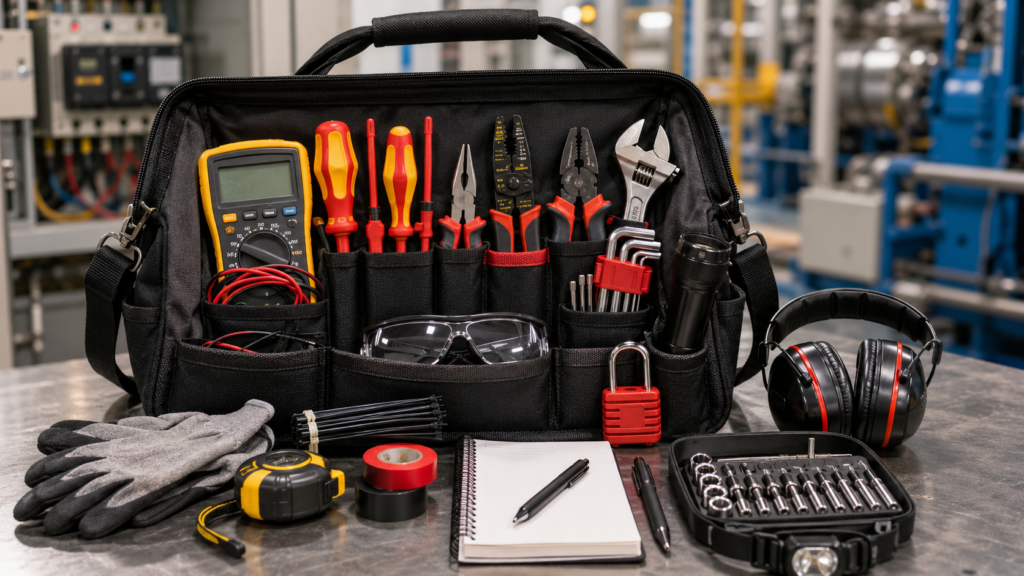
Your first day as a maintenance technician is not the time to arrive carrying an entire workshop.
You do not yet know which tools the company supplies, what voltages you are authorised to test, which machines you will support, or whether personal tools are allowed. Bringing a few useful items shows preparation. Arriving with unapproved electrical test equipment and immediately opening control panels can show poor judgement.
The best day-one bag contains tools for observing, recording, and handling simple tasks—not equipment for attempting every repair independently.
Start With a Notebook and Pen
A small notebook may be the most valuable item in your bag.
During the first few days, record:
- Machine names and numbers
- Production-area locations
- Common alarms
- Shutdown procedures
- Maintenance contacts
- Spare-parts locations
- Software versions
- Shift handover details
- Unfamiliar terminology
- Questions to ask later
Do not write passwords, access codes, or sensitive production information in an unsecured personal notebook. Follow the company’s rules for confidential information.
Use the notebook to capture facts, not criticism. Writing “Nobody here knows what they are doing” on your first day will not help your career. Writing “Line 4 uses a separate 24 V supply for remote I/O” might save time during a future breakdown.
A permanent marker and a fine-point pen can also be useful, provided the site allows technicians to label components and cables.
Bring a Small Flashlight
Industrial machines contain dark spaces, deep control cabinets, covered cable routes, and poorly illuminated areas behind guards.
A compact rechargeable flashlight is useful even when your phone has a light. A phone is awkward to hold while inspecting equipment and may be prohibited in certain production areas.
A small headlamp can be helpful, but check site rules before wearing it near operating machinery. Avoid loose straps or anything that could become caught.
The flashlight should be robust enough for workshop use and small enough to carry every day.
Carry a Basic Tape Measure
A compact tape measure helps with simple tasks such as checking:
- Motor dimensions
- Sensor positions
- Cable lengths
- Enclosure space
- Mounting-hole distances
- Belt widths
- Guard clearances
- Replacement-part dimensions
Many maintenance mistakes begin when someone orders a component based on appearance instead of measurements and a verified part number.
A 3- or 5-metre tape measure is sufficient for most day-one needs.
Add a Small Inspection Mirror
A telescopic inspection mirror allows you to see behind motors, under conveyors, around pipework, and inside equipment without dismantling everything immediately.
It can help locate:
- Hidden nameplates
- Loose connectors
- Oil leaks
- Damaged cables
- Misaligned sensors
- Missing fasteners
- Mechanical obstructions
A small magnetic pickup tool can also be useful for retrieving dropped screws and washers. However, keep magnets away from equipment that may be sensitive to them.
Bring Suitable Personal Protective Equipment
The employer should explain and provide the required personal protective equipment. Do not assume that your own equipment automatically meets site requirements.
Useful personal items may include:
- Safety glasses
- Work gloves
- Hearing protection
- Safety footwear
- High-visibility clothing
Confirm required ratings and standards before purchasing expensive PPE yourself. A factory may require specific footwear, arc-rated clothing, anti-static equipment, chemical-resistant gloves, or company-issued helmets.
Ordinary work gloves are not electrical-insulating gloves. Never treat them as protection for live electrical work.
Do not arrive wearing jewellery, loose clothing, or anything likely to catch in moving machinery. Long hair should be secured according to site rules.
Carry a Phone Charger or Power Bank
Maintenance work often involves photographs, calls, manuals, equipment applications, and communication with suppliers. A nearly empty phone battery becomes inconvenient quickly.
Bring a compact charger or approved power bank. Ask before plugging personal chargers into workshop sockets or control cabinets.
Never connect an unknown USB device to a PLC, HMI, industrial computer, or company laptop. A phone-charging cable does not belong in an automation controller.
Follow the company’s photography policy. Some factories prohibit personal photographs completely, while others allow them only for maintenance records stored in approved systems.
Consider a Small Mechanical Tool Set
A few hand tools may be useful, but only after checking what the company provides.
A minimal personal set could contain:
- Medium flat-head screwdriver
- Phillips screwdriver
- Small adjustable spanner
- Combination pliers
- Side cutters
- Hex-key set
- Small socket set
For electrical panels, use appropriately rated insulated tools where required. A normal screwdriver with a coloured plastic handle is not automatically an approved insulated tool.
Do not bring thirty cheap tools simply to fill a bag. Poorly fitting screwdrivers and damaged pliers can destroy terminals, round fasteners, and create additional faults.
Many employers prefer technicians to use company-issued tools so inspections, calibration, replacement, and liability can be managed properly.
Do Not Rush to Bring Your Own Multimeter
A multimeter is essential for many maintenance roles, but it is not automatically a day-one personal purchase.
First determine:
- Whether the company supplies meters
- Which measurement category is required
- What voltage levels you may test
- Whether calibration is controlled
- Which electrical authorisations you hold
- Whether personal test equipment is permitted
An inappropriate or poorly maintained meter can fail dangerously when used on an industrial distribution system.
The same caution applies to clamp meters, insulation-resistance testers, phase-rotation meters, loop calibrators, and voltage detectors. Use approved equipment and follow the site’s electrical-safety procedures.
Never perform live testing merely because you own a meter.
Leave the Laptop at Home Initially
A personal laptop containing PLC software may seem useful, but many companies prohibit connecting private computers to industrial networks.
Personal devices can introduce malware, create licensing problems, and result in uncontrolled copies of production software.
Use company-approved laptops, software, licences, cables, and storage locations. Do not copy PLC projects, drawings, machine backups, or customer files to personal cloud storage.
Once you understand the company’s policies, you will know whether any personal computer equipment is appropriate.
Pack Basic Comfort Items
Maintenance work may involve hot production areas, rooftops, cold stores, outdoor equipment, or long breakdowns.
Depending on the workplace, useful items include:
- Refillable water bottle
- Small lunch or snack
- Spare socks
- Light rain jacket
- Hand cleaner
- Basic plasters
- Necessary personal medication
The workplace should provide suitable first-aid facilities. Your bag is not a substitute for proper emergency equipment.
A change of shirt can also be useful when your first “quick inspection” involves oil, coolant, dust, or grease.
What Not to Bring
Avoid bringing:
- Large unapproved tool collections
- Homemade electrical test devices
- Uncalibrated meters
- Personal USB drives
- Unknown software or cracked licences
- Lock-bypass keys
- Jumper wires intended for defeating circuits
- Alcohol or impairing substances
- Valuable items you cannot secure
Never carry tools intended to bypass guards, emergency stops, safety relays, or machine interlocks. Safety faults must be investigated and repaired properly.
Ask What the Company Expects
During orientation, ask:
- Which tools are company-issued?
- May technicians use personal tools?
- Which PPE is required?
- Who is authorised for electrical work?
- Where are tools inspected and calibrated?
- Are phones and photographs permitted?
- Which laptop and software should be used?
- Where should maintenance records be stored?
The answers will determine what you should carry after the first week.
The Best Day-One Bag
A sensible first-day bag contains a notebook, pens, flashlight, tape measure, inspection mirror, phone charger, basic comfort items, and any PPE the employer has specifically instructed you to bring.
Add technical tools only after understanding the site, your responsibilities, and the company’s safety rules.
Nobody expects a new technician to repair every machine on the first day. A better first impression comes from listening carefully, taking useful notes, asking sensible questions, and refusing to guess when safety is involved.
Your most important day-one tools are not the ones made from steel. They are observation, patience, and the judgement to know when you are not yet authorised or informed enough to proceed.