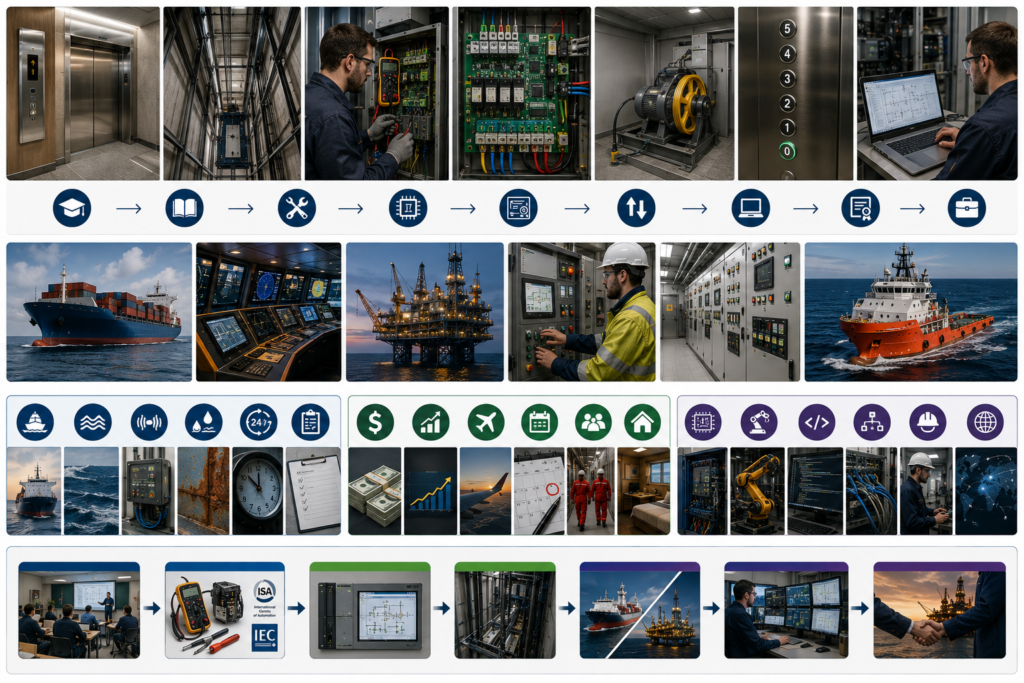
Marine and offshore automation jobs use familiar technologies: PLCs, SCADA systems, instrumentation, variable-frequency drives, industrial networks, electrical protection, and control panels.
The working environment, however, is very different from an ordinary factory.
An engineer may commission a vessel in a shipyard, troubleshoot a drilling platform in the North Sea, service an offshore wind installation, or sail with a ship while testing its automation systems. Access may require safety training, medical clearance, international travel, and weeks away from home.
The higher pay is not simply for writing more complicated PLC code. Employers are compensating people for difficult access, unusual schedules, greater responsibility, scarce platform knowledge, and working where immediate support may be thousands of kilometres away.
Marine and Offshore Are Not the Same Job
Marine automation generally refers to systems installed on ships and specialised vessels.
Offshore automation is associated with fixed or floating installations such as drilling platforms, production facilities, subsea systems, wind turbines, and offshore substations. Some vessels—such as drill ships, floating production units, and wind-turbine installation vessels—sit in both categories.
Typical job titles include:
- Marine automation engineer
- Offshore control-systems engineer
- Electrical and instrumentation technician
- Marine commissioning engineer
- Electro-technical officer
- PLC and SCADA service engineer
- Offshore wind commissioning technician
A shore-based marine engineer may travel to vessels only during installation and service. An electro-technical officer works as part of the ship’s crew. An offshore technician may work a fixed rotation, such as several weeks on the installation followed by several weeks at home.
These routes have different certification and lifestyle requirements.
You Control More Than a Production Machine
Factory automation usually focuses on manufacturing equipment. Marine systems may control functions required to keep the entire vessel operational.
A vessel automation system can integrate:
- Alarm and monitoring
- Power management
- Generator control and synchronisation
- Propulsion and thrusters
- Ballast and bilge systems
- Fuel and gas management
- Cargo handling
- Pumps, compressors, and auxiliary machinery
- Fire and safety systems
Kongsberg’s K-Chief platform, for example, combines alarm monitoring, power management, ballast, cargo, propulsion, thruster, auxiliary, and safety functions through an integrated marine control system. It uses redundant communication architecture because loss of one network or operator station must not disable the vessel’s essential systems.
The engineer must therefore understand electrical power, machinery, instrumentation, communication, and process control—not only ladder logic.
Reliability and Redundancy Matter More
A factory can sometimes stop a machine and wait for a specialist to arrive the following morning. A ship at sea or an offshore facility may not have that option.
Control systems are commonly designed with redundant servers, controllers, networks, power supplies, communication paths, and operator stations. The engineer must understand not only how the primary system works, but how it transfers to the backup system and how failed equipment can be replaced without creating a wider shutdown.
Changes are tightly controlled. A casual software update could affect propulsion, electrical generation, cargo operation, or safety systems.
Marine automation equipment may also need approval from classification societies and compliance with maritime authority requirements. Kongsberg notes that its vessel automation platform is designed around IMO, IACS, and major classification-society requirements.
The Environment Is Harder on Equipment
Salt, moisture, vibration, temperature changes, limited ventilation, and continuous movement affect equipment differently from a clean production facility.
An intermittent fault may appear only when the vessel vibrates, changes loading condition, or experiences rough weather. Corroded terminals, damaged cable glands, failing fans, loose connectors, and contaminated cabinets are common concerns.
Access may also be difficult. A technician cannot always walk to a storeroom for another PLC card. Spare parts, software versions, cables, licence files, and backups must be planned before travelling.
When the installation is offshore, bad weather can delay helicopter flights, boat transfers, parts deliveries, and the engineer’s return home.
Safety Training Is Part of the Entry Cost
Ordinary industrial training may not be enough to access the workplace.
Oil-and-gas personnel commonly require OPITO offshore safety training. BOSIET includes offshore induction and practical emergency-response preparation, while the exact version and breathing-system requirements depend on the region and method of travel.
Offshore-wind employers often require Global Wind Organisation training. Its Basic Safety Training standard covers the hazards workers may encounter during normal work and offshore emergencies, while offshore access normally includes a sea-survival element.
People serving in defined electrical roles aboard merchant ships may need an appropriate STCW qualification. The STCW framework includes formal requirements for electro-technical officers, covering electrical, electronic, automation, control, power-distribution, and ship-machinery competence.
Medical examinations, working-at-height qualifications, hazardous-area training, high-voltage authorisation, and survival refreshers may also be required.
The Working Schedule Is the Real Premium
Offshore work is frequently organised around rotations and long shifts.
A normal day during mobilisation or commissioning may involve twelve hours of work, followed by the same schedule every day until the assignment ends. Current North Sea job listings include packages calculated around approximately 160 offshore days annually and twelve-hour shifts.
Rotations can provide long periods at home, but they are not the same as ordinary paid leave. While offshore, you may miss weekends, birthdays, holidays, and family events. Delays can extend the trip unexpectedly.
Marine commissioning roles can be less predictable. You might spend several days in a European shipyard, return home briefly, and then fly to Asia because another vessel cannot complete its sea trial.
Why the Pay Can Be Higher
The premium normally comes from a combination of:
- Offshore or foreign-service allowances
- Overtime and twelve-hour shifts
- Weekend and night work
- Travel-day compensation
- Rotation or hardship payments
- Hazardous-environment qualifications
- Scarcity of experienced specialists
- Responsibility for critical systems
One current Dutch marine PLC and SCADA commissioning vacancy advertises a base range of approximately €50,000 to €72,000 per year. It also states that foreign-assignment allowances can potentially double the base income, depending on the amount of travel.
For comparison, the median advertised UK commissioning-engineer salary was approximately £47,500 in August 2026.
In the United States, ZipRecruiter estimated average offshore control-systems engineer pay at approximately $108,800 annually in July 2026. This is an indicative market estimate rather than a guaranteed salary for every offshore role.
Contractor day rates may look much higher, but contractors may fund their own insurance, certification, travel gaps, pension, and unpaid time between assignments.
Who Is Suited to the Work?
Marine and offshore automation can suit someone who:
- Enjoys complex electrical and control systems
- Can troubleshoot independently
- Remains calm when support is limited
- Accepts travel and irregular schedules
- Documents changes carefully
- Can work effectively in multinational teams
- Is comfortable with strict permits and safety procedures
It may be a poor fit if you need a predictable routine, dislike confined environments, become seasick easily, or do not want extended periods away from home.
The best entry route is usually to gain experience in PLCs, drives, instrumentation, commissioning, or industrial electrical maintenance first. From there, target marine integrators, shipyards, equipment manufacturers, offshore service companies, or wind-energy contractors that can sponsor the required training.
Marine and offshore automation pays more because the employer is buying more than technical knowledge. It is buying your availability, mobility, independence, safety discipline, and ability to restore critical systems in places where failure is difficult and expensive.