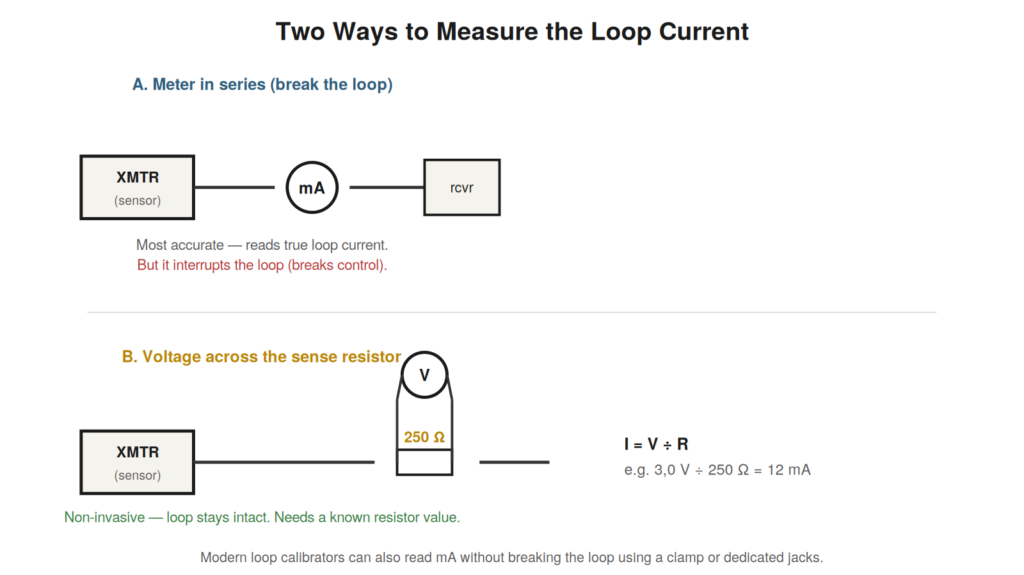
All loop troubleshooting rests on being able to measure the loop current, because the current is the signal and its value tells you almost everything about the loop’s state. There are two main ways to measure it — in series by breaking the loop, and indirectly by reading the voltage across the sense resistor — and knowing both, with their trade-offs, is a foundational troubleshooting skill.
Measuring in series
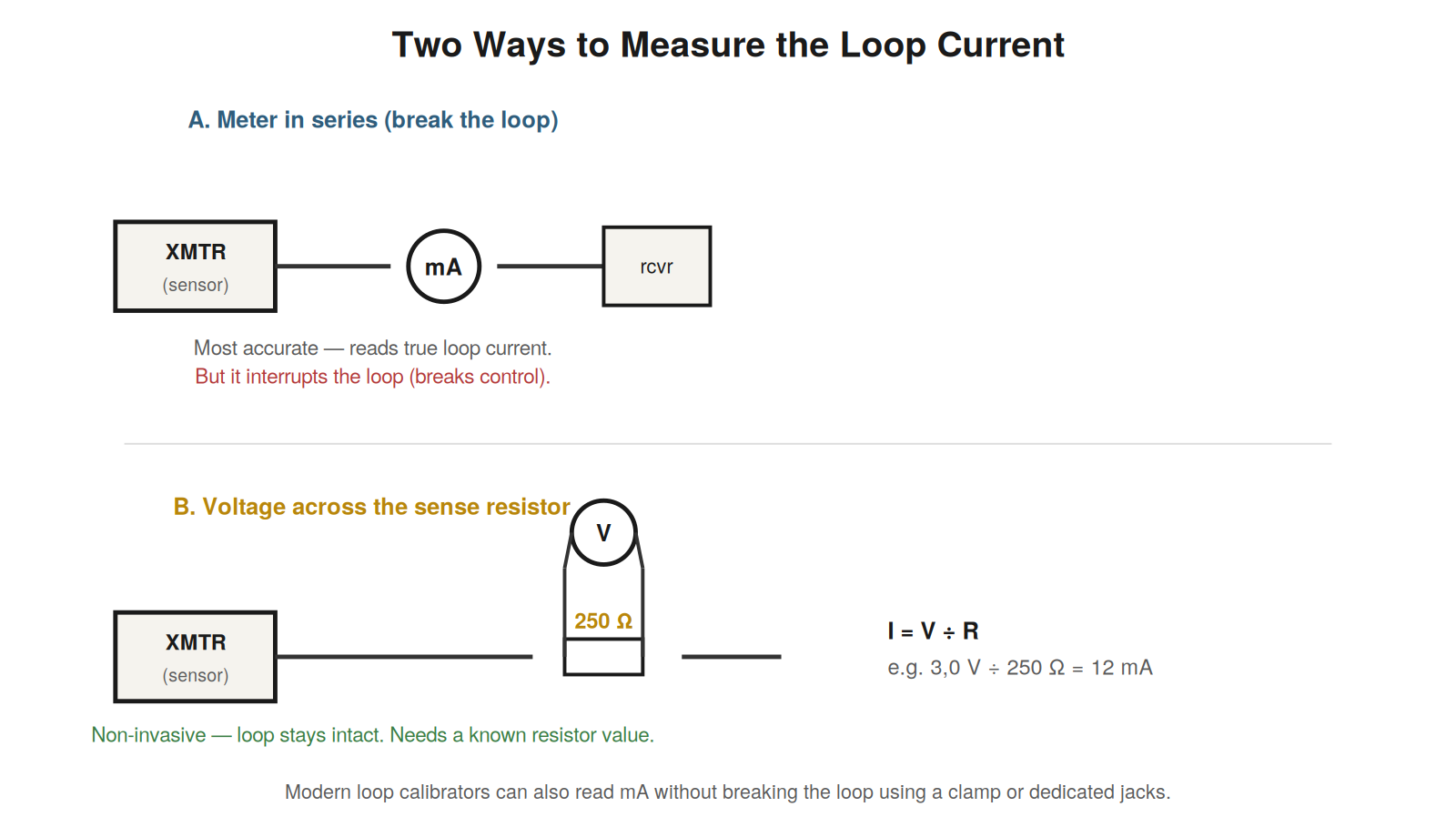
The most direct measurement is to put a current meter in series with the loop, which reads the true loop current. This means breaking the loop at some point — disconnecting a wire — and inserting the meter so the loop current flows through it. The reading is the actual current, accurate and unambiguous. The drawback is that breaking the loop interrupts it, momentarily stopping the signal and, if the loop is in active control, disturbing the process — so breaking a live loop must be done thoughtfully, with awareness of what the loop controls. Many meters and loop calibrators are designed for this series measurement, sometimes with features to break into the loop conveniently. The series measurement is the gold standard for reading loop current accurately, but its invasiveness — requiring the loop to be broken — means it is used with care on loops that are actively controlling a process.
Measuring across the sense resistor
A non-invasive alternative is to measure the voltage across the sense resistor and calculate the current from it, without breaking the loop. Since the current flows through the known sense resistor producing a proportional voltage, measuring that voltage and dividing by the resistance gives the current — for example, 3 volts across a 250-ohm resistor means 12 mA. This keeps the loop intact, disturbing nothing, which is a major advantage on a live controlling loop. It requires knowing the sense resistor’s value and being able to measure across it, and it is slightly less direct than the series measurement, but for a quick, non-invasive check of loop current it is excellent. Understanding this method — voltage across the known resistor, divided by resistance, gives current — provides a way to read loop current without the disruption of breaking the loop, which is often exactly what you want when the loop is in service. Modern loop calibrators may also offer non-invasive current reading through dedicated features.
Choosing the right measurement
Choosing between the two methods depends on the situation. For the most accurate reading and where breaking the loop is acceptable — the process can tolerate a momentary interruption, or the loop is out of service — the series measurement is best. For a non-invasive check on a live loop that must not be disturbed, measuring across the sense resistor is preferred. Understanding both, and when each is appropriate, lets you measure the loop current in any situation while managing the trade-off between accuracy and invasiveness. In practice, the non-invasive sense-resistor method is often used first for a quick check without disturbing anything, with the series measurement reserved for when the loop can be broken safely and maximum accuracy is wanted. Either way, obtaining the loop current is the key first step in most loop diagnostics, and being able to do it by whichever method suits the situation is fundamental to troubleshooting loops effectively.
The loop calibrator
The dedicated loop calibrator is worth knowing as the instrument-tech’s key tool, because it combines several loop functions in one device designed for the job. A loop calibrator can measure loop current, source a precise current into a loop, simulate a two-wire transmitter, supply loop power, and often read or drive the voltage that corresponds to the current — and better ones handle HART too. This versatility makes it far more convenient than a general meter for loop work: you can measure the current, then switch to sourcing a known current to test the receiver, then simulate a transmitter to isolate the field device, all with one tool designed to break into and drive loops safely. Many calibrators also have features to measure current without fully breaking the loop, or to break in with minimal disruption. Understanding what a loop calibrator does — measure, source, simulate, supply, and communicate — shows why it is the tool of choice for loop troubleshooting and calibration, bundling the measurement and signal-injection capabilities the systematic method relies on into a single purpose-built instrument.
Scenario: non-invasive measurement on a live loop
A scenario shows why the non-invasive measurement matters. A loop was in active control of a process, and its reading was suspect, but breaking the loop to measure the current in series would have interrupted the control and disturbed the process — undesirable on a running operation. Instead, the technician measured the voltage across the loop’s sense resistor and divided by its known resistance to get the current, without breaking the loop at all. The measurement showed the actual loop current, confirming whether it matched the expected value, while the loop continued controlling the process undisturbed. This non-invasive approach let the loop be checked in service, which the series measurement could not have done without interruption. The scenario shows the practical value of the sense-resistor method: on a live controlling loop that must not be disturbed, measuring the voltage across the sense resistor gives the current without breaking the loop, allowing diagnosis without disruption. It is often the preferred first measurement precisely because it is non-invasive, reserving the more accurate but disruptive series measurement for when the loop can safely be broken.
Safety when breaking a loop
Breaking a loop to measure current in series requires care, because the loop may be actively controlling a process, and interrupting it has consequences. When the loop feeds a control function, breaking it removes the signal, and the control system’s response to a lost signal — which might be to hold, to go to a fail state, or to alarm — must be anticipated. Breaking a loop that controls something important without understanding what will happen can disturb the process or trigger unwanted responses. So before breaking a live loop, you should know what it controls and what interrupting it will do, and take appropriate precautions — perhaps putting a controller in manual, or choosing the non-invasive sense-resistor measurement instead to avoid breaking the loop at all. This is why the non-invasive method is often preferred on live loops: it avoids the disruption and risk of breaking the loop. When a series measurement is necessary, doing it with awareness of what the loop controls and what the interruption will cause — rather than breaking it heedlessly — is the safe practice. Measuring loop current is routine, but on a live controlling loop it must be done thoughtfully, respecting what the loop is doing in the process.
Measurement as the foundation of diagnosis
Being able to measure the loop current reliably is the foundation on which all loop diagnosis rests, and it is worth recognizing this centrality. Almost every troubleshooting step involves measuring the current: reading the fault signature, checking against the expected value, splitting the loop, isolating elements, injecting known signals, verifying the fix. The measurement is the fundamental observation that all the reasoning acts upon. So being able to obtain the current accurately, by whichever method suits the situation, is the essential practical skill underlying the whole method. A technician who cannot reliably measure the loop current cannot execute the diagnosis, however well they understand the loop, because the method depends on the measurement at every step. Conversely, a technician who can measure the current confidently — in series or across the sense resistor, invasively or not, as the situation requires — has the foundation for the entire diagnostic method. Recognizing measurement as this foundation underscores why the measurement techniques are covered carefully: they are not a peripheral detail but the essential observation that the whole troubleshooting method is built upon, and competence with them is prerequisite to competence in loop diagnosis as a whole.
Reading the current as the diagnostic anchor
In practice, the loop current reading is the anchor around which a diagnosis is organized, and returning to it repeatedly structures the troubleshooting. You read the current to get the signature, measure it again at a split point to localize, measure it after injecting a known signal to test an element, and measure it after a fix to verify. The current reading recurs throughout the diagnosis as the fundamental observation each step relies on. Organizing the troubleshooting around this recurring measurement — read the current here, then there, then after this change — gives the diagnosis a concrete backbone of observations, each measurement advancing the localization or confirming a step. The current is what you keep coming back to, because it is the signal and its value at each point and stage tells you what you need to know. Recognizing the current reading as this diagnostic anchor — the observation you repeatedly make to drive the diagnosis — organizes the troubleshooting around concrete measurements rather than abstract reasoning alone, grounding each step in what the current actually is at the relevant point. The whole method, in practice, is a sequence of current measurements interpreted through understanding, and the current reading is the anchor that each step of the diagnosis returns to.
Confidence in measurement
Confidence in your loop current measurements underlies confidence in your whole diagnosis, and it is worth ensuring your measurements are trustworthy. A diagnosis reasons from the measured currents, so if the measurements are unreliable — taken carelessly, with a questionable meter, or by a method poorly applied — the reasoning built on them is undermined. Ensuring measurement confidence means using a suitable, trustworthy instrument, applying the measurement method correctly (proper series connection, or correct sense-resistor voltage and known resistance), and being sure the reading is genuine. With trustworthy measurements, you can reason confidently, knowing your observations are sound. With doubtful measurements, every conclusion is uncertain, because it rests on questionable data. So taking care with the measurements — good instrument, correct method, genuine readings — is foundational to a sound diagnosis, and confidence in the measurements translates into confidence in the conclusions drawn from them. This is why the measurement techniques deserve care: they produce the observations the whole diagnosis relies on, and their reliability determines the reliability of everything reasoned from them. Ensuring measurement confidence — by measuring carefully and correctly — secures the foundation on which the diagnosis is built, so that the reasoning rests on solid observations and the conclusions can be trusted, which is essential to confident, effective loop troubleshooting.