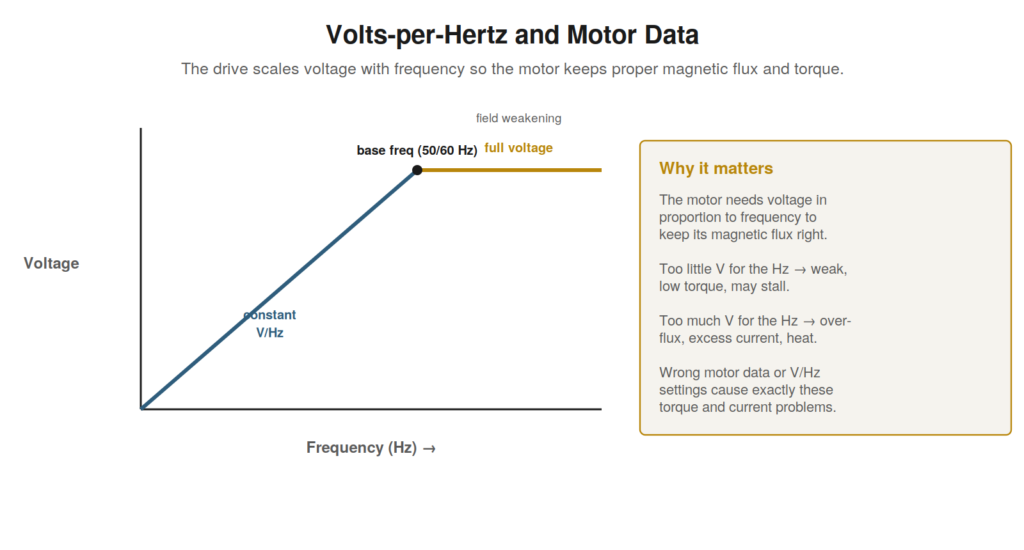
The relationship between the voltage and frequency the drive supplies
— volts-per-hertz — is central to how the drive controls the motor, and
understanding it explains a category of torque and current problems.
Because the motor needs its voltage scaled with frequency to maintain
proper magnetic flux, the drive’s handling of the volts-per-hertz
relationship, informed by the motor data, determines whether the motor
develops proper torque across its speed range. Understanding this
relationship and its dependence on correct motor data is important for
setup and troubleshooting.
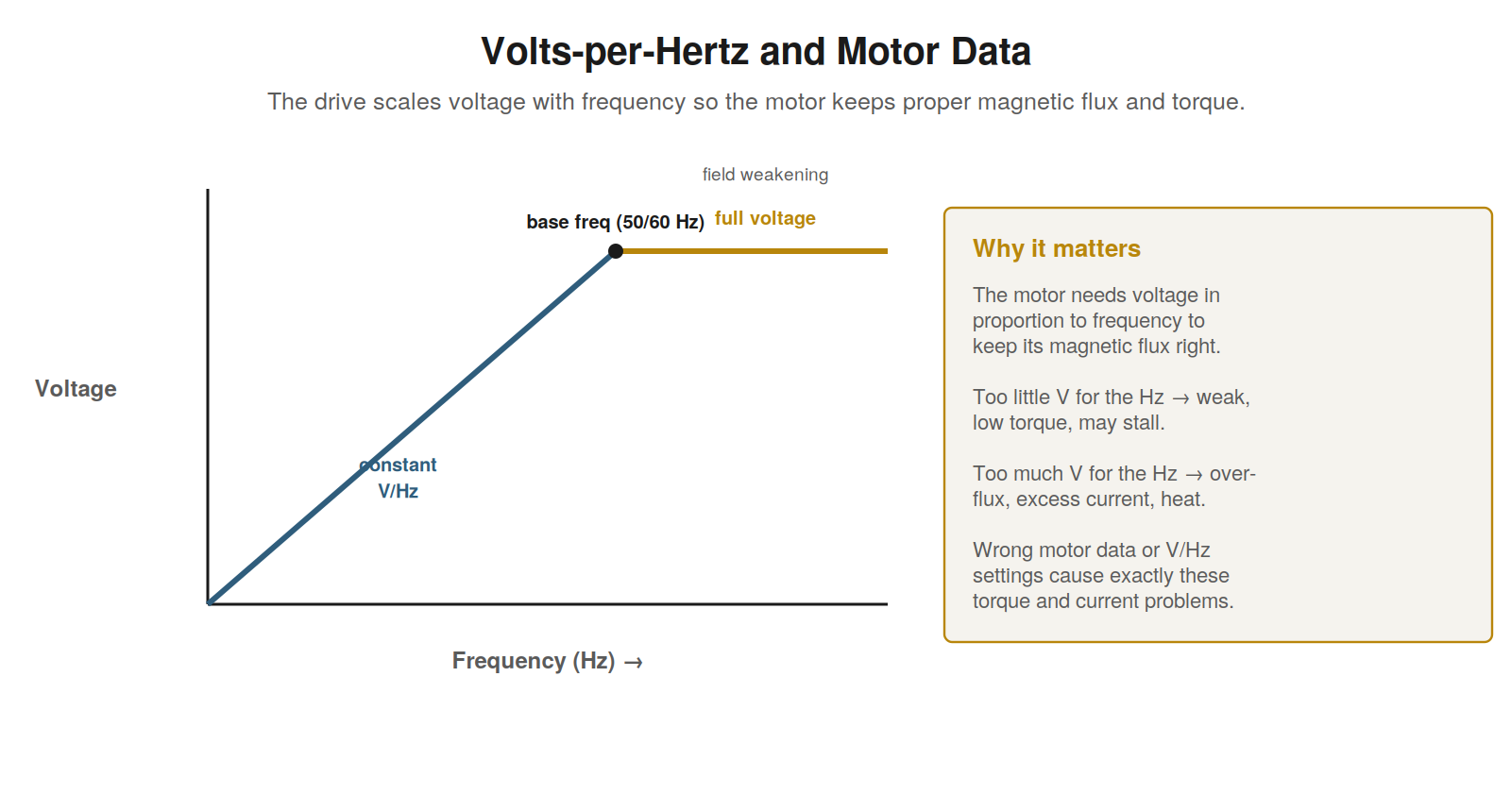
frequency up to the base frequency (constant V/Hz), then holds voltage
constant above it (field weakening). Correct motor data and V/Hz
settings keep the motor’s flux and torque right; wrong ones cause weak
torque or excess current.
Why voltage must scale with frequency
The reason the drive must scale voltage with frequency lies in the
motor’s magnetic flux, which depends on the ratio of voltage to
frequency. For the motor to develop proper torque, it needs the right
magnetic flux, and this flux is maintained by keeping the voltage
proportional to the frequency — constant volts-per-hertz. If the drive
supplied a fixed voltage while varying the frequency, the flux would be
wrong at most frequencies: too much flux at low frequency (excess
current, overheating) and too little at high frequency (weak torque). By
scaling the voltage with the frequency, the drive maintains proper flux
across the speed range, so the motor develops appropriate torque at all
speeds. Understanding why voltage must scale with frequency — to
maintain the magnetic flux that proper torque requires — explains the
volts-per-hertz relationship’s purpose. It clarifies that the drive is
not arbitrarily varying voltage but maintaining the motor’s flux, which
is essential for torque, so the volts-per-hertz relationship is
fundamental to the motor developing proper torque across its
variable-speed range. This understanding underlies the drive’s control
of the motor and explains why getting the voltage-frequency relationship
right — through correct motor data and settings — is essential for
proper motor operation, and why getting it wrong causes the flux-related
torque and current problems that misapplied volts-per-hertz
produces.
Base frequency and field weakening
The volts-per-hertz relationship has two regions, divided at the base
frequency, and understanding them completes the picture of how the drive
controls voltage across the speed range. Up to the base frequency
(typically the motor’s rated frequency), the drive scales voltage with
frequency, maintaining constant volts-per-hertz and thus constant flux —
this is the normal operating region where the motor develops full
torque. Above the base frequency, the drive cannot increase the voltage
further (it has reached the motor’s rated voltage), so it holds the
voltage constant while continuing to increase the frequency — this is
the field-weakening region, where the flux (and thus available torque)
decreases as frequency rises, though the motor can run faster. So below
base frequency, constant volts-per-hertz gives full torque; above it,
constant voltage gives reduced torque at higher speed. Understanding
these two regions — constant V/Hz up to base frequency, then field
weakening above — explains the full range of the drive’s voltage control
and the motor’s torque capability across speed. It clarifies that the
motor develops full torque up to base speed and reduced torque above it
(in field weakening), which matters for applications needing high speed
or high torque. Understanding the base frequency division and the two
regions completes the picture of volts-per-hertz control, explaining how
the drive manages voltage and thus torque across the whole speed range,
from full-torque operation below base frequency to field-weakened
higher-speed operation above it.
When motor data or V/Hz is wrong
Wrong motor data or volts-per-hertz settings cause characteristic
torque and current problems, and recognizing these connects the
volts-per-hertz understanding to troubleshooting. If the settings supply
too little voltage for the frequency — from wrong motor data or a
mis-set V/Hz curve — the motor is under-fluxed, developing weak torque,
possibly stalling under load, and running poorly. If the settings supply
too much voltage for the frequency, the motor is over-fluxed, drawing
excess current and overheating, possibly causing overcurrent or overload
faults. So wrong volts-per-hertz settings cause either weak torque (too
little voltage) or excess current and heat (too much voltage), depending
on the direction of the error. These problems have no hardware cause —
the drive and motor may be fine — but stem from the voltage-frequency
relationship being wrong for the motor, a parameter issue. Understanding
that wrong motor data or V/Hz settings cause these characteristic
problems — weak torque or excess current — connects the volts-per-hertz
relationship to troubleshooting. It reinforces checking the motor data
and control settings when a drive-motor combination has torque problems
(weak, stalling) or current problems (high current, overload,
overheating) without an obvious hardware cause, because these symptoms
point to a wrong volts-per-hertz relationship from incorrect motor data
or settings, resolved by correcting the configuration so the drive
supplies the proper voltage for each frequency, restoring the correct
flux and thus proper torque and current.
Auto-tuning the drive to the motor
Many drives offer an auto-tune procedure that measures the motor’s
actual characteristics, and understanding it clarifies how the drive
achieves precise control. Beyond the nameplate data, a drive —
especially in vector control mode — benefits from knowing the motor’s
actual electrical characteristics (such as its resistance and
inductance) more precisely than the nameplate provides. The auto-tune
procedure has the drive measure these characteristics directly, by
applying test signals to the motor and measuring its response, then
setting the relevant parameters automatically. This tunes the drive to
the specific motor, improving its control accuracy, particularly for
vector control which depends on an accurate motor model. Understanding
auto-tuning — the drive measuring the motor’s characteristics to tune
itself — explains how precise control modes get the accurate motor data
they need. It reinforces that for demanding control (vector mode),
entering nameplate data may not be enough, and running the auto-tune
procedure tunes the drive to the actual motor, improving control. In
troubleshooting, a drive in a precise control mode that controls poorly
may not have been auto-tuned, or the tuning may be wrong, so
understanding auto-tuning — its purpose and role — is relevant to
setting up and diagnosing precise control. It reinforces the auto-tune
as a step in commissioning drives for accurate control, giving the drive
the precise motor model that good vector control requires, beyond the
basic nameplate data, and as a consideration when a precisely-controlled
drive underperforms.
Scenario: the weak motor from wrong data
A scenario shows wrong motor data causing a torque problem. A
drive-driven motor ran weak — unable to develop full torque, struggling
under load — though the drive and motor seemed fine. Checking the motor
data parameters revealed the motor voltage had been entered wrongly,
lower than the motor’s actual rated voltage. As a result, the drive
applied the volts-per-hertz relationship based on the wrong (low)
voltage, supplying less voltage than the motor needed at each frequency,
under-fluxing the motor and leaving it weak. The cause was the wrong
motor voltage data, causing a wrong volts-per-hertz relationship and
thus insufficient voltage and weak torque. Correcting the motor voltage
data to the nameplate value restored the proper volts-per-hertz
relationship, giving the motor its proper voltage and full torque. This
scenario shows wrong motor data — an incorrect voltage value — causing
weak torque through a wrong volts-per-hertz relationship. Understanding
that the drive uses the motor data to set the volts-per-hertz
relationship explains this: wrong voltage data gave wrong voltage
output, under-fluxing the motor. It reinforces checking the motor data
when a drive-motor combination has torque problems, because incorrect
motor data causes a wrong volts-per-hertz relationship and thus torque
or current problems, resolved by correcting the data to the nameplate.
The scenario reinforces that accurate motor data is essential to correct
operation, and that wrong data — here the voltage — causes
characteristic problems (weak torque from under-fluxing) that correcting
the data resolves, connecting the motor data parameters directly to the
motor’s torque performance.
Vector control versus V/Hz
Understanding the difference between volts-per-hertz and vector
control modes clarifies when each is used and the different
considerations each brings. Volts-per-hertz control is the simpler mode:
the drive maintains the voltage-frequency relationship to control the
motor’s flux and speed, without precise feedback, suiting many
applications (pumps, fans) that do not need tight speed or torque
control. Vector control is more sophisticated: it models the motor more
precisely and regulates torque and speed accurately, suiting
applications needing precise control (positioning, tight speed
regulation, high torque at low speed). Vector control’s precision
requires accurate motor data and often an auto-tune, and it may use
feedback (an encoder) for the highest precision. So the modes differ in
sophistication and application: V/Hz for simpler needs, vector for
precise control, with vector requiring more accurate motor data and
setup. Understanding this difference — V/Hz simpler for basic needs,
vector precise for demanding control, with different data and setup
requirements — clarifies mode selection and its troubleshooting
implications. It reinforces that the control mode should suit the
application (V/Hz for simple, vector for precise), and that vector
control brings additional requirements (accurate motor data, auto-tune,
possibly an encoder) and thus additional things that can go wrong.
Understanding the two modes — their capabilities, applications, and
requirements — informs both setting up the correct mode and
troubleshooting mode-related problems, such as a vector-controlled drive
performing poorly due to inaccurate motor data or missing auto-tune that
its precise control depends on.
The drive-motor relationship
Volts-per-hertz and motor data are ultimately about the drive-motor
relationship, and recognizing this consolidates their importance. The
drive controls the motor, and to do so correctly it must know the motor
(the motor data) and apply the right voltage-frequency relationship
(volts-per-hertz) to maintain the motor’s flux and torque. So the motor
data and volts-per-hertz are the heart of the drive-motor relationship:
they are how the drive is matched to and controls its motor. Getting
them right means the drive controls the motor correctly; getting them
wrong means the drive mis-controls the motor, causing torque and current
problems. This makes the motor data and volts-per-hertz central to the
drive controlling its motor properly. Recognizing that they are about
the drive-motor relationship consolidates their importance: they are how
the drive knows and controls its motor, fundamental to correct
operation. It reinforces getting the motor data and volts-per-hertz
right as central to the drive-motor relationship, because they determine
whether the drive controls the motor correctly. Understanding that motor
data and volts-per-hertz are about the drive-motor relationship — how
the drive is matched to and controls its motor — consolidates their
importance, making them central to correct drive-motor operation and a
key area in both setup (matching the drive to the motor) and
troubleshooting (diagnosing the torque and current problems that a wrong
drive-motor relationship causes), because the drive controlling its
motor correctly depends on the accurate motor data and correct
volts-per-hertz that define their relationship.