The insulation that separates the motor’s windings from each other and from the grounded frame is critical to safe, reliable operation, and it degrades over time with heat, moisture, and contamination. Insulation resistance testing measures the condition of this insulation, catching degradation before it causes a fault. Understanding this test — how it is done and how to interpret it — is essential, because insulation failure is a common cause of motor faults and dangerous ground faults.
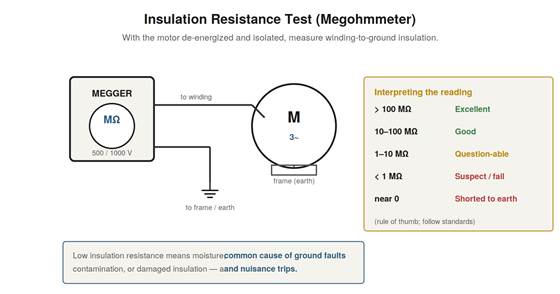
Figure 9.1 — Insulation resistance test with a megohmmeter. With the motor de-energized and isolated, measure winding-to-ground insulation. Low readings indicate moisture, contamination, or damaged insulation — a common cause of ground faults and nuisance trips.
What the test measures and how
The insulation resistance test measures the resistance of the insulation between the windings and the grounded frame — ideally very high, since the insulation should not conduct. It is performed with a megohmmeter (often called a megger), an instrument that applies a high test voltage (commonly 500 or 1000 volts) and measures the tiny resulting current to determine the very high resistance of good insulation. The motor must be de-energized, isolated, and safe before testing, and the test is applied between the windings and the frame (earth). Good insulation gives a very high resistance — many megohms — because it barely conducts; degraded insulation gives a lower resistance, as moisture, contamination, or damage lets more current through. Understanding the test — a high-voltage measurement of the winding-to-ground insulation resistance, done on a safely isolated motor — is the basis for using it to assess insulation condition. The high test voltage is important because insulation weaknesses may only show up under voltage, so the megger’s test voltage reveals problems that a low-voltage measurement would miss, making it the proper tool for assessing insulation.
Interpreting the reading
Interpreting the insulation resistance reading tells you the insulation’s condition. A very high reading — many tens or hundreds of megohms or more — indicates good insulation. A moderate reading of a few to some tens of megohms may be acceptable but bears watching. A low reading, around a megohm or below, is questionable to poor, indicating significant degradation. A reading near zero indicates the insulation has essentially failed, with the winding effectively shorted to the frame. These ranges are rules of thumb; specific acceptance criteria depend on the motor and standards, and the trend over time — a falling insulation resistance — is often more telling than a single reading. A low or falling insulation resistance means the insulation is degrading, from moisture, contamination, heat aging, or damage, and it warns of an impending fault: a ground fault, a nuisance trip, or a winding failure. Understanding how to interpret the reading — high is good, low is degraded, near zero is failed, and falling is a warning — lets you assess insulation condition and catch degradation before it causes a failure, which is the value of the test: it reveals a developing problem in time to address it.
When and why to test insulation
Insulation testing is valuable both in troubleshooting and in preventive maintenance. In troubleshooting, when a motor trips on ground fault, fails to run, or is suspected of a winding problem, an insulation test checks whether the insulation has failed — a common cause of such faults. In preventive maintenance, periodic insulation testing tracks the insulation’s condition over time, catching gradual degradation before it causes an unexpected failure, which is one of the most valuable predictive checks for motors. Testing is especially warranted for motors that have been exposed to moisture, that have been idle (and may have absorbed moisture), or that operate in harsh conditions. Understanding when to test — in troubleshooting ground faults and winding problems, and in preventive maintenance to track condition — lets you use the test to both diagnose faults and prevent them. Because insulation degradation is gradual and a common eventual cause of motor failure, regular insulation testing that catches the degradation early is a high-value practice, and understanding the test’s role in both diagnosis and prevention makes it a key part of competent motor care, catching insulation problems whether you are chasing a fault or working to prevent one.
Why insulation degrades
Understanding why insulation degrades explains what the insulation test is looking for and why the degradation is so common. Motor winding insulation is subjected to heat, and heat ages insulation — every period at elevated temperature gradually degrades it, which is why overheating shortens motor life so significantly and why keeping motors cool is so important. Insulation is also attacked by moisture, which can be absorbed especially by an idle or humid-environment motor, lowering its resistance; by contamination such as dust, oil, and chemicals that provide leakage paths; and by mechanical and electrical stresses that can damage it. Over time, these factors — heat aging, moisture, contamination, stress — degrade the insulation, lowering its resistance and eventually leading to failure. The insulation test detects this degradation by measuring the falling resistance. Understanding the causes — heat, moisture, contamination, stress — explains why insulation degrades and thus why regular testing catches a common and gradual failure mode, and it points to the preventive measures: keeping motors cool (limiting heat aging), dry (limiting moisture), and clean (limiting contamination) all preserve insulation. The insulation test tracks the result of these degradation factors, and understanding them connects the test to the physical processes it monitors and to the preventive care that slows them.
Scenario: the motor that failed after the weekend
A scenario shows insulation degradation from moisture. A motor that had worked fine on Friday tripped its ground-fault protection when started on Monday, after sitting idle over a damp weekend. An insulation resistance test revealed a low reading — far below normal — indicating the winding insulation had a low resistance to ground. Understanding insulation testing and moisture explained it: over the idle, damp weekend, the motor’s windings had absorbed moisture, lowering the insulation resistance enough to cause leakage to ground and trip the protection on starting. The insulation was not permanently failed but temporarily degraded by moisture. Drying the motor (by appropriate means) restored the insulation resistance to a normal high value, and the motor then started and ran normally. This scenario shows moisture as a cause of low insulation resistance and ground-fault tripping, diagnosed by the insulation test showing the low reading, and understanding that idle motors in damp conditions absorb moisture that lowers insulation resistance. It reinforces the insulation test as the tool for diagnosing ground faults and insulation problems, and the common scenario of moisture-related low insulation — especially in idle or damp-environment motors — being diagnosed by the test and often remedied by drying, restoring the insulation resistance that moisture had temporarily lowered.
Trending insulation over time
The most valuable use of insulation testing is trending the resistance over time, and understanding why makes insulation testing a powerful predictive tool. A single insulation reading tells you the current state, but the trend — how the resistance changes over repeated tests — tells you whether the insulation is degrading and how fast. A resistance that is high and stable indicates healthy insulation; a resistance that is falling over time indicates degrading insulation, warning of an approaching failure even if the current value is still acceptable. So trending catches degradation in progress, allowing action before the insulation fails, which a single reading might miss if it is still within acceptable range but falling. This makes regular insulation testing, with the readings recorded and trended, a powerful predictor of insulation failure — one of the main eventual causes of motor failure. Understanding the value of trending — the trend reveals degradation in progress, giving warning before failure — elevates insulation testing from a spot check to a predictive practice. It reinforces testing insulation regularly and recording the results to build a trend, because the falling trend is the early warning of insulation failure, allowing planned intervention (drying, cleaning, or replacement) before the insulation fails in service, which is far better than being surprised by a failure that trending would have predicted from the declining insulation resistance over time.
Insulation as the life of the motor
The insulation is, in an important sense, the life of the motor, and understanding this frames why insulation testing matters so much. A motor’s windings are copper that lasts nearly indefinitely; it is the insulation around them that ages and eventually fails, and insulation failure is a primary end-of-life mechanism for motors. So the condition of the insulation largely determines the motor’s remaining life: healthy insulation means a healthy motor, degrading insulation means a motor approaching failure. This makes insulation testing — which measures the insulation’s condition — essentially a measure of the motor’s health and remaining life, especially when trended over time. It also makes preserving the insulation (by keeping the motor cool, dry, and clean) essentially preserving the motor’s life. Understanding insulation as the life of the motor — the aging, failing element that determines motor longevity — frames the importance of insulation testing and care. It reinforces that testing insulation is checking the motor’s health and life, and that caring for insulation (cool, dry, clean operation) is extending the motor’s life, so that insulation testing and insulation care are central to motor longevity. Recognizing that the insulation is what ages and fails — the life of the motor — elevates insulation testing from one test among many to a key measure of motor health, and insulation care to a key practice for motor longevity, both following from the insulation being the critical, aging element on which the motor’s life depends.
Discharge after testing
A practical safety note specific to insulation testing: the megohmmeter applies a high voltage, and the winding (and any capacitance) can hold a charge after the test, so discharge the winding after testing before touching it. The high test voltage can leave the tested winding charged, and this charge, if not discharged, is a shock hazard and can be dangerous. Proper insulation testing includes discharging the winding after the test — many megohmmeters do this automatically, but the practice of ensuring the winding is discharged before handling it is important. Understanding that the insulation test applies a high voltage that can leave a charge motivates this discharge step, protecting against the shock hazard of a charged winding after testing. It reinforces that insulation testing, using a high voltage, requires the safety step of discharging afterward, so that the tested winding is safe to handle. This is a specific safety aspect of insulation testing: the high test voltage can charge the winding, and discharging it after the test — ensuring it is not left charged — is an important safety practice, part of doing insulation testing correctly and safely, given that the test deliberately applies a high voltage that can leave a hazardous charge on the winding if not discharged before the winding is handled after testing.