Reading the symptoms starts the diagnosis; a systematic method carries it to the located fault. Because a motor problem can lie in the supply, the control circuit, the starter, the motor, the load, or the mechanics, a structured approach that safely and efficiently narrows down which is essential. This chapter lays out a method that begins with safety and proceeds through gathering information, checking the supply and control, separating electrical from mechanical, testing the motor, and verifying the repair.
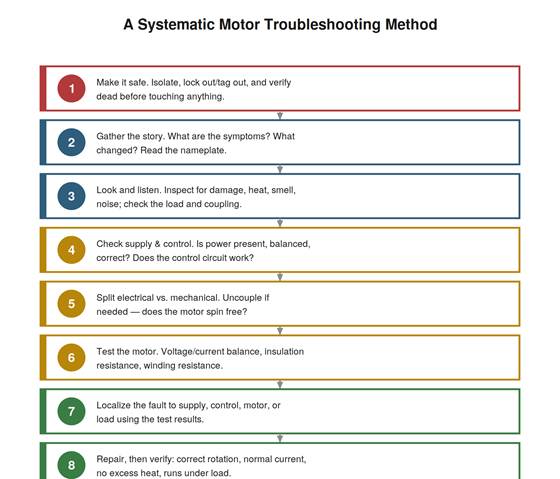
Figure 12.1 — A systematic motor troubleshooting method. Make it safe, gather the story, look and listen, check supply and control, split electrical from mechanical, test the motor, localize the fault, then repair and verify.
Safety first, always
The first step of any motor troubleshooting is to make the work safe, and this is not a formality but the essential precondition for everything else. Motor circuits carry lethal voltages, and motors can start unexpectedly or store mechanical energy, so before touching anything you must isolate the circuit, lock it out and tag it out so it cannot be re-energized, and verify it is dead. Only some tests are done with the circuit energized (like measuring running voltage and current), and those require appropriate procedures and precautions; many tests (insulation, winding resistance) require the circuit isolated and dead. Making the work safe first — isolating, locking out, verifying dead, and following safe procedures for any live measurements — protects you and others and is the non-negotiable first step. Understanding that safety comes first, always, and that the specific safe procedure depends on what you are doing (isolated for most tests, carefully controlled for the few live measurements), is the foundation of all motor work. No diagnosis is worth an injury, and the systematic method begins with safety because working safely is the precondition for doing any of the rest, which is why it is step one and why it is emphasized throughout this book.
Divide the problem: supply, control, motor, load
The core of the method is dividing the problem among the areas where a fault can lie — the supply, the control circuit, the motor, and the load — and narrowing down which contains the fault. After making it safe and gathering the story, you check each area in a sensible order. Is the supply present, correct, and balanced? Does the control circuit operate the contactor properly? Is the motor itself electrically sound (by testing)? Is the load or the mechanical drive the problem? Each area can be checked, and the symptom and story guide which to check first. This division — supply, control, motor, load — structures the diagnosis, ensuring you consider each place a fault can be and narrow down systematically rather than fixating on one area. A great many motor complaints turn out to be not the motor itself but the supply, the control, or the load, so dividing the problem this way and checking each area prevents the common error of assuming the motor is faulty when the real problem is elsewhere. Understanding this division and checking each area in turn — guided by the symptom — is the heart of the method, localizing the fault to the supply, control, motor, or load, from which the specific cause can be found.
Split electrical from mechanical
A particularly useful division is between electrical and mechanical problems, and a simple test often separates them: uncouple the motor from its load and see how each behaves. If the motor, uncoupled, runs normally, then the motor is electrically fine and the problem is in the load or the coupling — a mechanical problem. If the motor still misbehaves uncoupled, the problem is in the motor or its supply — electrical (or a motor-bearing problem). Similarly, with the power off, turning the shaft by hand tells you whether the motor spins freely or is mechanically obstructed: a free shaft points away from a motor-mechanical problem, a stiff or seized shaft points to a bearing or obstruction. This split — electrical versus mechanical, tested by uncoupling and by turning the shaft — is powerful because it quickly separates two large classes of problem, telling you whether to pursue the electrical side (supply, control, windings) or the mechanical side (bearings, load, coupling). Understanding this split and the simple tests that achieve it — uncouple and run, turn the shaft by hand — lets you rapidly determine whether a problem is electrical or mechanical, which is a major fork in the diagnosis that focuses all subsequent effort on the correct side rather than searching both.
Why method beats guessing
A systematic method beats guessing at motor faults, and understanding why justifies the discipline of following it. Guessing — jumping to a suspected cause and checking it — works when the guess is right, which for familiar faults it often is, but fails when the guess is wrong, leaving you to guess again with no assurance of progress. On unfamiliar, intermittent, or subtle faults, guessing can waste much time and still miss the cause. A systematic method — safety, story, supply and control, split electrical from mechanical, test the motor, localize, verify — makes steady progress regardless, methodically narrowing down the fault rather than relying on a lucky guess, so it finds the fault reliably. It is also safer, because it builds in the safety-first step and a sensible order rather than diving in haphazardly. The method does not preclude using intuition — a likely guess can be checked — but it provides the reliable fallback and structure that guessing lacks. Understanding why method beats guessing — reliability, steady progress, safety, and effectiveness on hard faults — justifies following it even when a guess tempts you, because the method guarantees you will get there, while guessing only sometimes does, and the method’s structure ensures nothing important, including safety, is skipped in the process.
Scenario: safety first prevents an accident
A scenario underscores the safety-first step. A technician was called to a motor that had stopped, and was tempted to quickly check it while it was still connected, to save time. Following the method’s safety-first step instead, they isolated the motor, locked it out, and verified it was dead before working. This proved important: the motor had stopped because of an intermittent fault, and had it not been isolated, it could have restarted unexpectedly — automatically or by remote control — while the technician was working on it, with serious injury possible. Because the method’s first step was to make it safe (isolate, lock out, verify dead), the motor could not restart during the work, and the technician was protected. This scenario shows why safety comes first, always: a motor can start unexpectedly, and only isolating and locking it out prevents this, protecting the worker. Understanding that the safety-first step is not a formality but essential protection — against unexpected starts and live conductors — reinforces always making the work safe before touching the motor. The scenario illustrates the real danger the safety step guards against (an unexpected restart during work) and why the method places safety first: because working on an unisolated motor risks exactly the kind of accident that isolation and lockout prevent, making the safety-first step the essential foundation of all motor work.
Adapting the method with judgment
The method is a reliable framework, and applying it with judgment — adapting to the situation rather than following it rigidly — makes it most effective. If the symptom and context clearly point to a cause, you may check that first rather than working through every step. If safety and a quick check resolve it, you need not do the full sequence. But the method remains the fallback when the quick approach does not work, and its structure ensures the essential steps — especially safety — are not skipped. So a skilled technician uses the method as a guiding framework, adapting it: shortcutting when the situation clearly allows, following it fully when the fault is not obvious, always keeping safety first. This adaptive use combines efficiency (shortcutting the obvious) with reliability (the full method as fallback) and safety (never skipped). Understanding that the method should be adapted with judgment — not followed rigidly nor abandoned, but used as a framework adapted to each situation — makes it practical. It reinforces the method as a flexible structure rather than a rigid checklist: experienced technicians adapt it to each fault, using its steps as the situation warrants while retaining its structure and its safety-first discipline as the reliable foundation, which is how the method serves both the quick resolution of obvious faults and the reliable diagnosis of difficult ones, adapted by judgment to fit each case.
The method as the book in action
The systematic method is the whole book in action, and seeing it this way ties the subject together. Each step of the method draws on the book’s understanding: safety from the constant emphasis on it; reading the symptom from the symptom knowledge; checking supply and control from understanding the circuit; splitting electrical from mechanical from understanding both sides; testing the motor from the measurement and testing chapters; localizing from understanding where faults lie; verifying from knowing correct operation. So the method is where all the book’s topics — the fundamentals, the circuit, the measurements, the faults — come together in the practical act of diagnosing a motor. Mastering the method is applying the whole book’s understanding in practice, and the method integrates the separate topics into a coherent diagnostic process. Understanding the method as the book in action — the integration of all its topics into the act of troubleshooting — shows that the method is the culmination of the fundamentals, not a separate technique. It reinforces that the method embodies everything the book teaches, organized into a reliable, safe process for diagnosing motors, so that mastering the method means bringing the full understanding — of three-phase power, the motor, the circuit, the measurements, and the faults — to bear on the practical goal of finding and fixing motor problems. The method is where understanding becomes competent, safe, practical troubleshooting, which is the aim of the whole book realized in action.
Documenting the diagnosis
A practical addition to the method: document the diagnosis and repair, because the record is valuable for the future. Recording what the symptom was, what was found, what the cause was, and what was done creates a history that helps with recurring problems (was this fault seen before?), with similar motors (does this pattern apply elsewhere?), and with tracking a motor’s health over time (how often has this motor had problems?). This documentation, though it takes a little effort at the end of a diagnosis, pays off by building a record that informs future troubleshooting and maintenance. Understanding the value of the record motivates documenting the diagnosis as part of completing it. It reinforces that the method’s completion includes recording the outcome: the symptom, cause, and repair documented for future reference, building the history that helps diagnose recurring and similar problems and track motor health. Documenting the diagnosis is good practice that extends the method’s value beyond the immediate repair: the record informs future work, so that a little documentation at the end of each diagnosis builds a valuable history of the motor’s and the plant’s motor problems, which supports better, faster future troubleshooting and more informed maintenance, making the documentation a worthwhile final step of the systematic method that captures the diagnosis for future benefit.