Motor troubleshooting begins with the symptoms — what the motor is doing wrong — because the symptom points toward the class of fault before any testing. A motor that will not start, one that hums but will not turn, one that trips its protection, one that runs hot, and one that is noisy each point to different areas, and reading the symptom correctly focuses the diagnosis from the outset. Understanding the common symptoms and where they point is the fast first step of motor diagnosis.
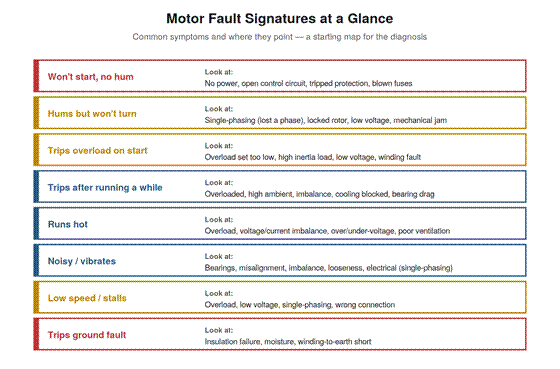
Figure 11.1 — Motor fault signatures at a glance. Common symptoms and where they point — a starting map for the diagnosis, turning the presenting complaint into a focused set of things to check.
The major symptom classes
Motor complaints fall into a handful of major symptom classes, each pointing toward characteristic causes. A motor that will not start at all, with no hum, points to a loss of power or control — no supply, an open control circuit, tripped protection, or blown fuses. A motor that hums but will not turn points to single-phasing (a lost phase), a locked rotor, low voltage, or a mechanical jam. A motor that trips its protection points to overload, a fault, imbalance, or a protection setting problem. A motor that runs hot points to overload, imbalance, voltage problems, or poor cooling. A motor that is noisy or vibrates points to bearings, alignment, balance, or looseness. Each symptom class narrows the likely causes, so reading which class the complaint falls into is the first diagnostic step, focusing the investigation on the relevant area. Understanding these major classes — won’t start, hums but won’t turn, trips, runs hot, noisy — and where each points lets you begin every diagnosis by classifying the symptom, which directs all the subsequent testing toward the area the symptom implicates rather than checking everything blindly.
Gathering the story
Beyond the immediate symptom, gathering the story around it sharpens the diagnosis considerably. When did the problem start — suddenly or gradually? What changed — was the motor or its circuit recently worked on, was the load changed, did something else happen in the plant? Is it consistent or intermittent? Has this motor or others had similar problems? The answers add context that, combined with the symptom, often points more specifically at the cause. A motor that failed suddenly after maintenance suggests something disturbed in the work; one that degraded gradually suggests wear or aging; one that trips only under certain conditions suggests a load or environmental factor. Gathering this story — the history, the changes, the pattern — enriches the symptom with context that focuses the diagnosis. It is worth taking the time to ask and observe before diving into testing, because the story frequently reveals the likely cause or at least narrows it, making the subsequent testing more targeted. Understanding the value of gathering the story — combining the symptom with its history and context — is part of efficient troubleshooting, turning a bare complaint into a richer picture that points more directly at the fault than the symptom alone.
Looking and listening
Much can be learned from simply looking and listening before any instrument comes out, and this observation is a valuable early step. Look for obvious damage, discoloration or burnt smells (indicating overheating), signs of moisture or contamination, and the state of the connections and the load. Listen for unusual noises — growling, grinding, squealing — that indicate electrical or mechanical problems. Feel (safely, when appropriate) for excessive heat or vibration. Check the load and the coupling for obvious problems. This sensory inspection often reveals the problem directly — a burnt smell and discoloration pointing to overheating, a grinding noise to a bearing, a jammed load to a mechanical cause — or at least adds important clues. Doing this observation before testing is efficient, because it may find the problem quickly or focus the testing, and it costs little. Understanding the value of looking and listening — using your senses to gather evidence before instruments — is part of good troubleshooting practice, because the motor and its surroundings often show or sound the problem, and a technician who observes first, then tests, gathers more evidence and diagnoses faster than one who reaches immediately for instruments without first taking in what the motor is plainly showing and telling.
The symptom narrows the field immediately
The great value of reading the symptom first is that it narrows the field of possible causes immediately, before any testing, focusing the diagnosis efficiently. Each symptom class points to a limited set of causes: a dead motor to power and control, a humming motor to single-phasing and mechanical locks, an overheating motor to overload and imbalance and cooling, a noisy motor to bearings and mechanical faults. So the very first step — reading which symptom class the complaint falls into — eliminates most possibilities and focuses on a relevant few. This is far more efficient than testing at random, because the symptom has already directed you to the likely area. A technician who reads the symptom first goes straight to the relevant checks, while one who ignores it may test unrelated things. The symptom is the motor showing you the class of problem, and reading it first is the fastest way to focus the diagnosis. Understanding that reading the symptom immediately narrows the field — turning a vague complaint into a focused investigation of a particular area — makes it the essential first step, ensuring every diagnosis begins by using the strong clue the symptom provides rather than starting a broad, unfocused search that the symptom could have narrowed from the outset.
Scenario: the symptom that redirected the search
A scenario shows a symptom redirecting a misguided search. A motor would not start, and a technician began suspecting the motor windings, preparing to test and possibly replace the motor. But reading the symptom more carefully — the motor was completely dead, with no hum at all — redirected the search: a dead motor with no hum is not getting power, so the problem is in the power or control path, not the motor windings. Checking the power and control path revealed the actual cause — a tripped protective device had opened the control circuit, leaving the motor unpowered. Resetting it (after checking why it tripped) restored operation, and the motor started fine, its windings having been healthy all along. Had the technician pursued the winding suspicion, they would have wasted effort testing a healthy motor while the real problem — the open control circuit — went unaddressed. This scenario shows reading the symptom correctly redirecting the search: the no-hum symptom indicated a power or control problem, not a winding fault, steering the diagnosis to the right area. It reinforces that reading the symptom accurately — here recognizing that no hum means no power — focuses the diagnosis correctly from the start, preventing the wasted effort of investigating the wrong area that ignoring or misreading the symptom would cause.
Symptom plus context equals a strong lead
The symptom is powerful, and combined with context it becomes a strong lead toward the cause, so gathering context alongside the symptom accelerates the diagnosis. The symptom classifies the problem (won’t start, overheats, trips, noisy), and the context — what changed, when it started, what else is affected, the history — often points to the specific cause within that class. A motor that won’t start right after maintenance suggests something disturbed in the work; an overheating motor after a hot spell suggests cooling or ambient; a tripping motor after a load change suggests overload; a group of motors affected suggests a supply problem. Combining the symptom with this context frequently narrows the cause much further than the symptom alone. So gathering context — the history, the changes, the pattern, what else is affected — alongside reading the symptom turns a classified problem into a strongly indicated cause. Understanding that symptom plus context equals a strong lead reinforces gathering the story as part of reading the symptoms: the symptom focuses the diagnosis on an area, and the context often points within that area to the likely cause, so that together they provide a strong lead. A technician who reads both the symptom and its context diagnoses faster than one who reads the symptom alone, because the context sharpens the symptom’s indication toward the specific cause.
The symptom as the diagnosis’s opening
Reading the symptom is the opening move of a motor diagnosis, and making it a consistent first step sets up the whole diagnosis well. Like a strong opening in any endeavor, reading the symptom first — classifying the complaint and gathering its context — orients the entire diagnosis, focusing it on the relevant area from the start. This opening is quick and informative: observing the symptom and its context immediately narrows the field and often points toward the cause, directing all the subsequent work. Making it a consistent first step ensures every diagnosis begins from the strong clue the symptom provides, oriented correctly rather than starting with an unfocused search. A diagnosis that opens with reading the symptom proceeds efficiently, guided by what the symptom revealed; one that skips it may wander before finding direction. Understanding the symptom as the diagnosis’s opening move — quick, informative, orienting — reinforces making it the consistent first step. It reinforces that every motor diagnosis should begin by reading the symptom and its context, because this opening focuses the diagnosis on the right area and often toward the cause, giving the whole diagnosis a strong, informed start. Establishing this habit — always opening with the symptom — ensures your motor diagnoses begin from the best available information, the symptom being the motor’s own indication of the problem’s nature, read first to orient everything that follows toward the fault.
Trusting the symptom but verifying
A balanced practical stance on symptoms: trust the symptom to focus the diagnosis, but verify the indicated cause rather than assuming it. The symptom is a strong guide, pointing to the likely area and often the likely cause, and trusting it focuses the diagnosis efficiently. But the symptom indicates the likely cause, not the certain one, so the indicated cause should be verified by checking before it is accepted and acted on. A humming motor likely has single-phasing, but verify by measuring all three phases before concluding it; an overheating motor is likely overloaded, but verify by measuring the current. This balance — trust the symptom to focus, verify the cause to confirm — combines the efficiency of following the symptom with the reliability of confirming the cause. Understanding this stance prevents both ignoring the symptom’s guidance (inefficient) and blindly assuming the symptom’s likely cause without checking (unreliable). It reinforces using the symptom as a strong guide while verifying its indicated cause: the symptom focuses the diagnosis, and verification confirms the actual cause, so that the diagnosis is both efficient (guided by the symptom) and reliable (confirmed by verification). Trusting the symptom to point the way while verifying what it points to is the balanced practical approach, using the symptom’s strong guidance without letting it substitute for the confirmation that ensures the diagnosis is correct rather than merely plausible.