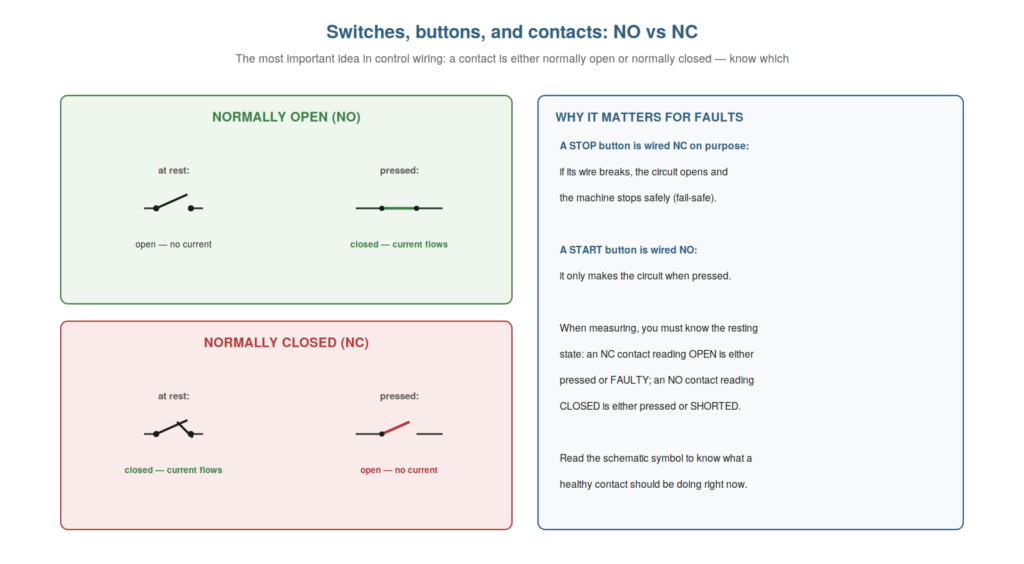
Switches, buttons, and contacts are the elements that open and close the circuit — the on-off elements of control — and understanding them, especially the crucial distinction between normally-open and normally-closed, is essential to troubleshooting. A great deal of control logic is built from these, and knowing whether a contact should be open or closed at any moment is fundamental to judging whether it is faulty. This chapter covers switches, buttons, and contacts with a focus on the normally-open versus normally-closed distinction that underlies so much control wiring.

Normally open and normally closed
The most important concept for switches and contacts is the distinction between normally open and normally closed, and understanding it is essential to judging whether a contact is behaving correctly. A normally-open (NO) contact is open at rest — no current flows through it — and closes when actuated (a button pressed, a relay energized), allowing current. A normally-closed (NC) contact is the opposite: closed at rest — current flows — and opens when actuated, stopping current. The terms describe the resting state (the state when nothing is acting on the contact), which is what the schematic symbol shows. So every contact is either NO or NC, and knowing which tells you what it should be doing at any moment: an NO contact should be open unless actuated, an NC contact closed unless actuated. This is essential for troubleshooting because it lets you judge a contact: an NO contact that is closed when nothing is actuating it is faulty (or something is actuating it); an NC contact that is open when nothing is actuating it is faulty. Understanding normally open and normally closed — the resting states of contacts — is essential to judging whether a contact is behaving correctly. It reinforces that NO contacts are open at rest and NC closed at rest, so knowing which a contact is tells you what it should be doing and whether it is faulty. Understanding normally open and normally closed — the NO contact open at rest and closing when actuated, the NC contact closed at rest and opening when actuated — is essential to control-circuit troubleshooting, because knowing which type a contact is tells you what it should be doing at any moment, which lets you judge whether it is behaving correctly or is faulty (an NO contact closed when nothing actuates it, or an NC contact open when nothing actuates it, is wrong), making the normally-open/normally-closed distinction the fundamental concept for reasoning about the switches and contacts that open and close the control circuit.
Why stop buttons are normally closed
A specific and important application of the NO/NC distinction is why stop and safety buttons are wired normally closed, and understanding the fail-safe reasoning explains a design you must respect when troubleshooting. A stop button (and safety devices like E-stops and interlocks) is wired normally closed: at rest, it is closed, allowing the circuit to run; pressing it opens the contact, breaking the circuit and stopping the machine. The reason is fail-safe design: because the contact is normally closed and carries the running circuit, any fault that opens it — a broken wire, a loose terminal, a failed contact — also stops the machine, just as pressing it would. So a wiring fault fails safe (stops the machine) rather than failing dangerous (leaving it unable to stop). This is why stop and safety circuits are normally closed: so that faults stop the machine. Understanding this has a crucial troubleshooting implication: a machine that will not start or run because a normally-closed safety contact is open may have a genuine fault (a broken wire in the safety string) — or the safety device may simply be doing its job (an E-stop pressed, an interlock open). You must find which. Understanding why stop buttons are normally closed — the fail-safe design where faults open the circuit and stop the machine — explains a design you respect and diagnose carefully. Understanding why stop and safety buttons are wired normally closed — the fail-safe reasoning that a normally-closed contact carrying the running circuit will stop the machine if any fault opens it, just as pressing it would — explains a crucial design, so that you understand safety circuits fail safe by design and you diagnose them carefully: a machine stopped by an open normally-closed safety contact may have a real fault (a break in the safety string) or the safety device may simply be doing its job (an E-stop pressed, a guard open), and you must determine which, never defeating the safety device but tracing the safety string to find whether an open is a fault or intended.
Testing a contact
Bringing the NO/NC understanding to practice, understanding how to test a contact lets you determine whether it is doing its job. To test a contact, you first establish what it should be doing (from the schematic: is it NO or NC, and is it being actuated right now?), then measure whether it is doing that. You can test with voltage (live): a closed contact should pass the voltage, so you read the same voltage on both sides; an open contact drops the voltage, so you read voltage on one side and not the other. Or you can test with continuity (dead, isolated): a closed contact has continuity (beeps), an open contact does not. Comparing what the contact should be doing to what your measurement shows tells you whether it is faulty: a contact that should be closed but shows open (no continuity, or drops the voltage) is faulty or not actuated; one that should be open but shows closed is faulty or actuated. So testing a contact means measuring its state and comparing to what it should be. Understanding how to test a contact — measuring its state and comparing to its intended state — lets you determine whether it is doing its job. It reinforces that you test a contact by establishing what it should be doing and measuring whether it is, using voltage (live) or continuity (dead). Understanding how to test a contact — establishing from the schematic what it should be doing (NO or NC, actuated or not) and measuring whether it is, using voltage across it on a live circuit or continuity on a dead isolated one — lets you determine whether the contact is doing its job, so that you compare the contact’s measured state to its intended state and judge it faulty when they differ (a contact that should be closed showing open, or one that should be open showing closed), which is the practical application of the NO/NC understanding to the everyday task of testing the switches and contacts that make up so much of the control circuit.
Changeover contacts and contact blocks
A practical detail is the changeover contact and the modular contact block, because understanding them clarifies the real switches and buttons you meet. Many switches and buttons have changeover (or common) contacts: a single actuator operates both a normally-open and a normally-closed contact together, sharing a common terminal — so pressing it closes one path and opens another simultaneously. And industrial pushbuttons are often modular: the operator (the button head) has separate contact blocks clipped behind it, each providing NO or NC contacts, so a single button can carry several contacts. Understanding this clarifies the wiring: a button may have multiple contacts (some NO, some NC) that all operate together when pressed, and the contact blocks are separate components that can fail or be added. So when troubleshooting a button, you consider which of its contacts you are dealing with and that the contact blocks are distinct parts. Understanding changeover contacts and contact blocks — multiple contacts operating together, in modular blocks — clarifies the real switches and buttons. Understanding changeover contacts and contact blocks — the changeover contact operating an NO and an NC path together from a common terminal, and the modular contact blocks that clip behind a pushbutton to provide its contacts — clarifies the real switches and buttons you meet, so that you recognize a button may carry several contacts (some NO, some NC) operating together and that the contact blocks are separate components which can fail or be changed, which helps you troubleshoot real industrial switches by understanding their changeover action and modular construction rather than assuming each button is a single simple contact.
Scenario: the stop button that stopped everything
A scenario shows NO/NC understanding resolving a puzzling won’t-start fault. A machine would not start at all, and the technician was puzzled until he thought about the normally-closed safety contacts. Understanding that stop and safety buttons are wired normally-closed (so a break stops the machine), he traced the safety string and measured along it, finding an open at one of the normally-closed stop buttons — it was reading open when it should have been closed. At first he suspected the button faulty, but on inspection found the button’s contact had genuinely failed open (a worn contact not making). Because it was normally-closed in the safety string, its failure opened the circuit and prevented starting — exactly the fail-safe behavior by design, though here caused by a fault. Replacing the failed contact restored starting. Understanding the normally-closed safety wiring led him to trace the string and find the open contact. This scenario shows NO/NC understanding resolving a won’t-start fault in the safety string. Understanding that safety contacts are normally-closed and a break stops the machine led the technician to trace the string and find the failed-open contact. It reinforces that understanding NC safety wiring directs you to trace the safety string for an open when a machine won’t start. The scenario reinforces the NO/NC distinction: the technician resolved a won’t-start fault by understanding the normally-closed safety string and tracing it to a failed-open contact, illustrating how knowing that safety contacts are normally-closed (and that a break, whether intended or a fault, stops the machine) directs you to trace the safety string for the open, which is the key to diagnosing the common won’t-start faults rooted in the normally-closed safety circuit.
Contact bounce and wear
A nuance of contacts worth understanding is bounce and wear, because these explain some subtle contact behaviors and failures. Contact bounce is the brief, rapid making-and-breaking that happens for a few milliseconds when a contact first closes, as the mechanical contact settles — usually harmless and handled by the circuit or PLC, but occasionally a cause of subtle signal problems. Contact wear is the gradual degradation of contacts over many operations: the contact surfaces erode or oxidize from the small arcing that occurs each time they open under load, eventually leading to higher resistance (voltage drop), unreliable making, or failure to conduct. Understanding wear explains why an old, heavily-cycled contact may become unreliable or high-resistance over time, and why a worn contact is a plausible cause of an intermittent or weak connection. So understanding contact bounce and wear explains subtle contact behaviors and the gradual failure of contacts. This helps you consider a worn contact as a cause and understand its symptoms. Understanding contact bounce and wear — the brief settling bounce on closure and the gradual erosion of contacts from arcing over many operations — explains subtle contact behaviors and failures, so that you understand why an old, heavily-cycled contact may become high-resistance, unreliable, or intermittent, and can consider contact wear as a plausible cause of a weak or intermittent connection on a much-used switch or relay, which adds the gradual degradation of contacts to your understanding of how the switches and contacts of a control circuit fail over their working life.
Knowing the resting state as a habit
To close, it helps to crystallize the habit this chapter builds: always knowing a contact’s resting state, because this habit underlies judging every switch and contact. Faced with any contact, the habit is to ask: is it NO or NC, and is it being actuated right now? — which tells you what state it should be in, against which you judge what you measure. This habit turns every contact into something you can assess: a contact not in the state it should be is faulty or actuated. Building this habit — always establishing the resting state and current actuation before judging a contact — makes the switches and contacts of the circuit readable rather than confusing. So knowing the resting state as a habit underlies all contact troubleshooting. Understanding to make knowing the resting state a habit — always establishing NO/NC and actuation before judging a contact — underlies judging every switch and contact. Understanding to make knowing the resting state a habit — always asking whether a contact is NO or NC and whether it is actuated, so you know what state it should be in before judging what you measure — underlies troubleshooting every switch and contact, so that you build the habit of establishing a contact’s intended state before assessing it, which turns every contact into something you can judge (faulty if not in the state it should be) and makes the switches and contacts of the control circuit readable rather than confusing, the practical habit that flows from the NO/NC distinction this chapter teaches.