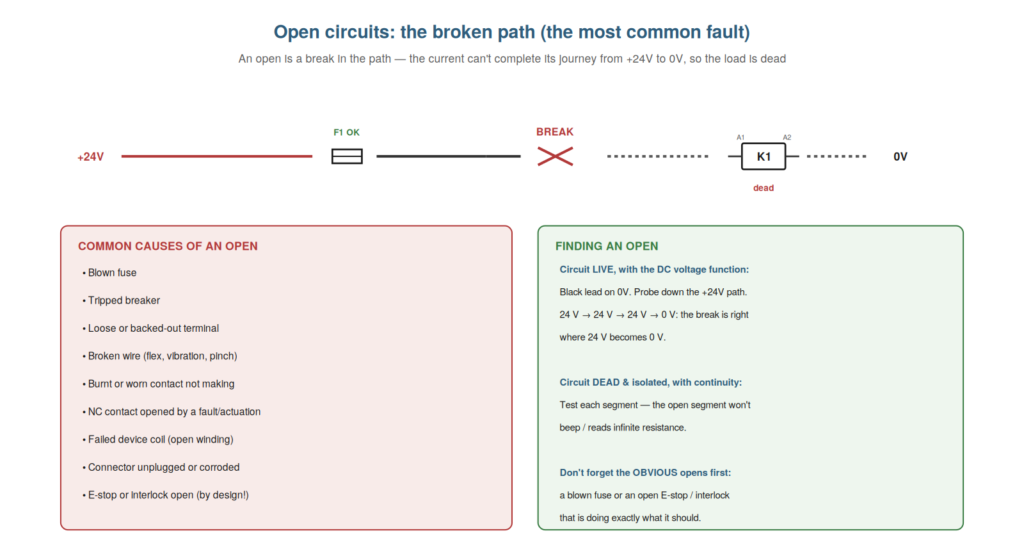
The open circuit — a break in the path so current cannot flow — is the most common control-circuit fault, and understanding its causes and how to find it builds directly on the divide-and-conquer method. Whether a blown fuse, a loose terminal, a broken wire, or an open contact, an open leaves the load dead, and the methods for finding it are the bread and butter of troubleshooting. This chapter covers open circuits and broken paths in depth.
What an open is and its causes
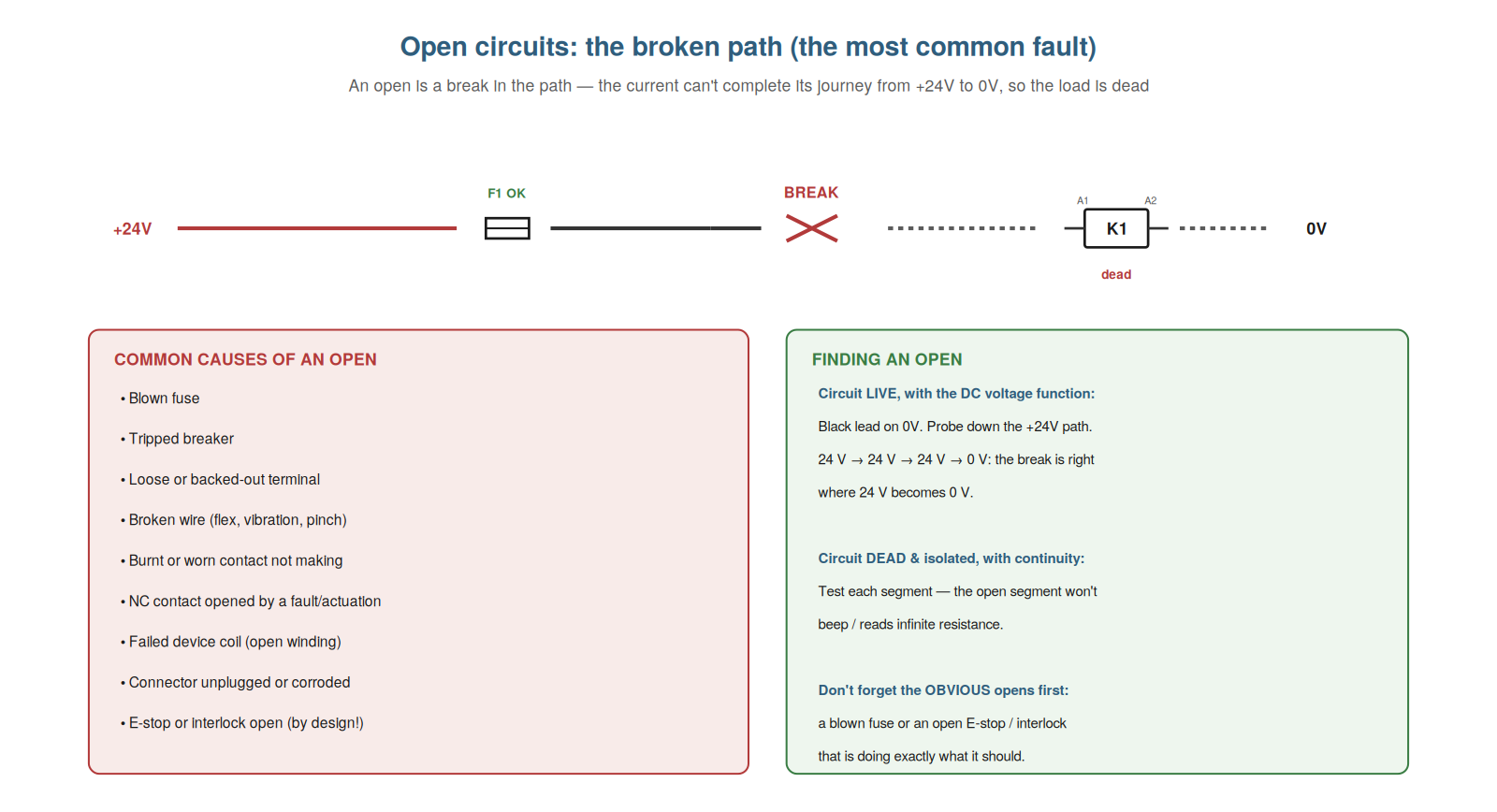
Understanding what an open circuit is, and its common causes, prepares you to recognize and find this most frequent fault. An open is a break in the path — a point where the circuit is interrupted, so current cannot flow from +24V to 0V, leaving the load dead. Its causes are many but familiar: a blown fuse or tripped breaker (a protective open), a loose or backed-out terminal, a broken wire (often where it flexes or is pinched), a burnt or worn contact not making, an open coil (a failed device winding), an unplugged or corroded connector, and — importantly — a safety device open by design (an E-stop pressed, an interlock open). So an open is a break, and its causes span protective devices, connections, wires, contacts, and safety devices. Understanding what an open is (a break stopping current) and its range of causes prepares you to recognize the fault (a dead load with a broken path) and to consider the likely causes when finding it. Notably, some opens are intended (a safety device doing its job), which you must distinguish from faults. Understanding what an open is and its causes — a break in the path with causes spanning fuses, terminals, wires, contacts, coils, connectors, and intended safety-device opens — prepares you to recognize and find this most frequent fault, so that you understand an open as the interruption that leaves a load dead and you know its familiar causes, which lets you recognize the fault and consider the likely culprits, while remembering that some opens are intended (a safety device doing its job) and must be distinguished from genuine faults, an essential grounding for the most common control-circuit fault you will meet.
Finding an open: two approaches
There are two complementary approaches to finding an open — voltage tracing on a live circuit and continuity testing on a dead one — and understanding both lets you choose the right one for the situation. The voltage approach (live): with the black lead on 0V, probe down the +24V path; where 24 volts becomes 0 volts, the break lies. This is often the quickest, done on the live circuit with the divide-and-conquer method, and it directly locates the break. The continuity approach (dead, isolated): with the circuit dead and segments isolated, test each segment for continuity; the open segment will not beep (infinite resistance). This is useful when you cannot safely or conveniently work live, or to confirm a specific segment. So the two approaches — voltage tracing live, continuity testing dead — both find an open, and you choose based on the situation: voltage for quick live tracing, continuity for dead-circuit confirmation. Understanding both approaches lets you find an open in whatever way suits the circumstances. Understanding the two approaches to finding an open — voltage tracing down the live path to where 24 volts becomes 0 volts, and continuity testing the dead, isolated segments to find the one that does not beep — lets you choose the right method for the situation, so that you can trace an open quickly on a live circuit with voltage and divide-and-conquer, or confirm it on a dead isolated circuit with continuity when working live is unsuitable, which gives you complementary techniques for the most common fault and the flexibility to find an open in whatever way the circumstances call for, always locating the break in the path.
Don’t overlook the intended opens
A crucial point in finding opens is not to overlook the intended opens — the safety devices doing their job — and understanding this prevents both wasted effort and dangerous mistakes. Among the causes of an open are safety devices that open by design: an E-stop that has been pressed, an interlock or guard switch that is open because a door is open, a limit reached. These produce a dead circuit exactly as a fault would, but they are not faults — they are the safety system working correctly. Overlooking this leads to wasted effort (hunting for a fault when a guard is simply open) or, far worse, dangerous mistakes (defeating a safety device to ‘fix’ the open, disabling the protection). So when finding an open, you must check the obvious intended opens first: is an E-stop pressed, a guard open, an interlock not made? These are common and are resolved by addressing the condition (close the guard, reset the E-stop), not by treating them as faults. Understanding not to overlook intended opens — the safety devices doing their job — prevents wasted effort and dangerous defeating of safety systems. It reinforces that some opens are intended (safety devices working), which you check first and resolve properly, never by defeating them. Understanding not to overlook the intended opens — the E-stops, interlocks, and guard switches that open by design and produce a dead circuit that is not a fault — prevents both wasted effort and dangerous mistakes, so that when finding an open you check these intended opens first (is an E-stop pressed, a guard open, an interlock not made?) and resolve them by addressing the condition rather than hunting for a fault or, catastrophically, defeating the safety device to force operation, which keeps your troubleshooting both efficient and safe by recognizing that a safety device doing its job is the commonest ‘open’ of all and must never be treated as a mere fault to bypass.
The open coil and the open load
A particular kind of open worth understanding is the open load itself — a failed coil or device winding — because it is found at the end of the path and confirmed differently from a wiring open. Most opens are in the wiring (a broken wire, loose terminal, blown fuse), but the load itself can be open: a relay coil with a broken winding, a solenoid with an open coil, a lamp with a burnt filament. In this case, the path up to the load is good (24 volts reaches the load’s input), but the load does not operate because it is internally open. You confirm this by measuring: 24 volts reaches the load’s positive terminal, and 0 volts is at its negative terminal (the load should have 24 volts across it), yet it does not operate — or, isolated and dead, the coil reads infinite resistance (an open winding) rather than its normal resistance. So an open load is distinguished by the path being good up to it but the device itself being internally open. Understanding the open coil and open load — the failed device at the end of the path — completes the picture of opens beyond the wiring. Understanding the open coil and the open load — a failed coil or device winding that is internally open, found at the end of the path with the wiring good up to it — completes the picture of opens beyond wiring faults, so that when 24 volts reaches a load that still does not operate, you consider the load itself being open (confirmed by measuring its resistance dead, an open coil reading infinite rather than its normal value), which distinguishes the failed device from a wiring open and ensures you check the load itself when the path to it proves good but the device remains dead.
Scenario: the open that was doing its job
A scenario shows the importance of not overlooking an intended open. A machine section was dead, and the technician began tracing for an open — but before diving deep, he checked the obvious intended opens. He found that an interlock guard on that section was open (a door was ajar), which, being in the safety string, had opened the circuit and stopped the section — exactly as designed. There was no fault at all: the safety system was doing its job. Closing the guard properly restored the section immediately. Had he not checked the intended opens first, he might have spent time hunting a ‘fault’ that was simply a guard doing what guards do — or, worse, been tempted to defeat the interlock to ‘fix’ it, disabling the safety. Checking the intended opens first saved time and avoided a dangerous mistake. This scenario shows checking intended opens first saving effort and preventing a dangerous defeat. Understanding not to overlook intended opens led the technician to find the open guard doing its job rather than hunting a phantom fault. It reinforces that checking intended opens (guards, E-stops) first avoids wasted effort and dangerous defeating of safety. The scenario reinforces not overlooking intended opens: the technician saved time and avoided a dangerous mistake by checking the intended opens first and finding an open guard doing its job, illustrating how remembering that safety devices open by design — and checking them before hunting a fault — prevents both wasted effort chasing a phantom fault and the catastrophic error of defeating a safety device that is simply working correctly.
The half-open: high resistance versus full open
A nuance worth understanding is the difference between a full open and a ‘half-open’ high-resistance connection, because they present differently and are found differently. A full open is a complete break — no current can flow, the load is fully dead, and voltage tracing cleanly shows 24 volts becoming 0 volts at the break. A half-open is a high-resistance connection that is not fully broken — some current can flow, but the connection drops voltage, so the load may work weakly or unreliably rather than being fully dead. The half-open presents as a weak or intermittent symptom rather than a dead one, and it is found not by tracing where voltage disappears (it may not fully disappear) but by measuring voltage drop across connections under load (the high-resistance connection drops significant voltage). So understanding the half-open distinguishes the weak/unreliable fault (high resistance, found by voltage drop) from the dead fault (full open, found by voltage tracing). Recognizing which you have directs the right technique. Understanding the half-open versus the full open — the complete break that leaves the load dead and is found by voltage tracing, versus the high-resistance connection that leaves the load weak or unreliable and is found by voltage drop under load — distinguishes two related faults, so that you recognize a fully dead load as a full open (traced by where voltage disappears) and a weak or unreliable one as a possible half-open high-resistance connection (found by measuring voltage drop under load), directing you to the right technique for each and ensuring you do not miss the high-resistance half-open by looking only for a clean full break.
The open as the fault to master first
To close, it is worth emphasizing that the open is the fault to master first, because it is the most common and its methods are the most broadly useful. Opens — breaks in the path — are the commonest control-circuit fault, from blown fuses to broken wires to open contacts, and the methods for finding them (voltage tracing, continuity testing, divide and conquer) are the core techniques that also serve other faults. So mastering the open — recognizing it, and finding it by tracing and dividing — handles the largest share of faults and builds the skills that transfer. This makes the open the natural fault to master first. Understanding the open as the fault to master first — the most common, with the most broadly useful methods — makes it the natural priority. Understanding the open as the fault to master first — the most common control-circuit fault, whose finding methods (voltage tracing, continuity, divide and conquer) are the core techniques that also serve other faults — makes it the natural priority, so that mastering the open handles the largest share of faults you will meet and builds the transferable skills of tracing and dividing, which is why the open, more than any other fault, rewards being learned thoroughly first as the foundation of practical control-circuit troubleshooting.