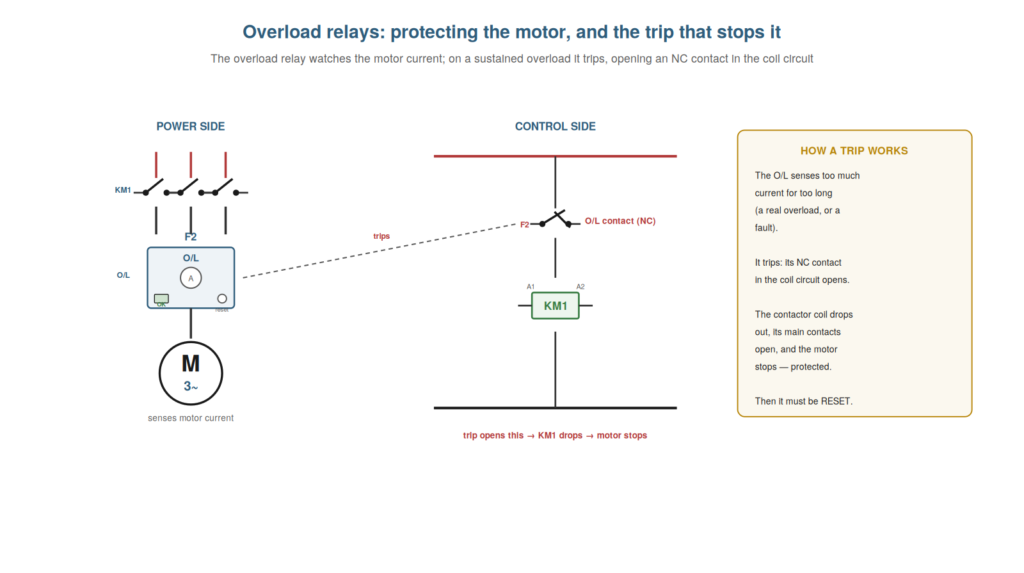
Motors are protected by overload relays, and understanding how they work — sensing the motor current and tripping to stop the motor on a sustained overload — is essential, because overload trips are a common event and telling a real overload from a nuisance trip is a frequent troubleshooting task. An overload relay watches the current and, on too much for too long, trips an aux contact that drops the contactor and stops the motor. Understanding this protection, and the trip, lets you respond correctly when a motor stops on an overload. This chapter covers overload relays and protection.
What the overload relay does
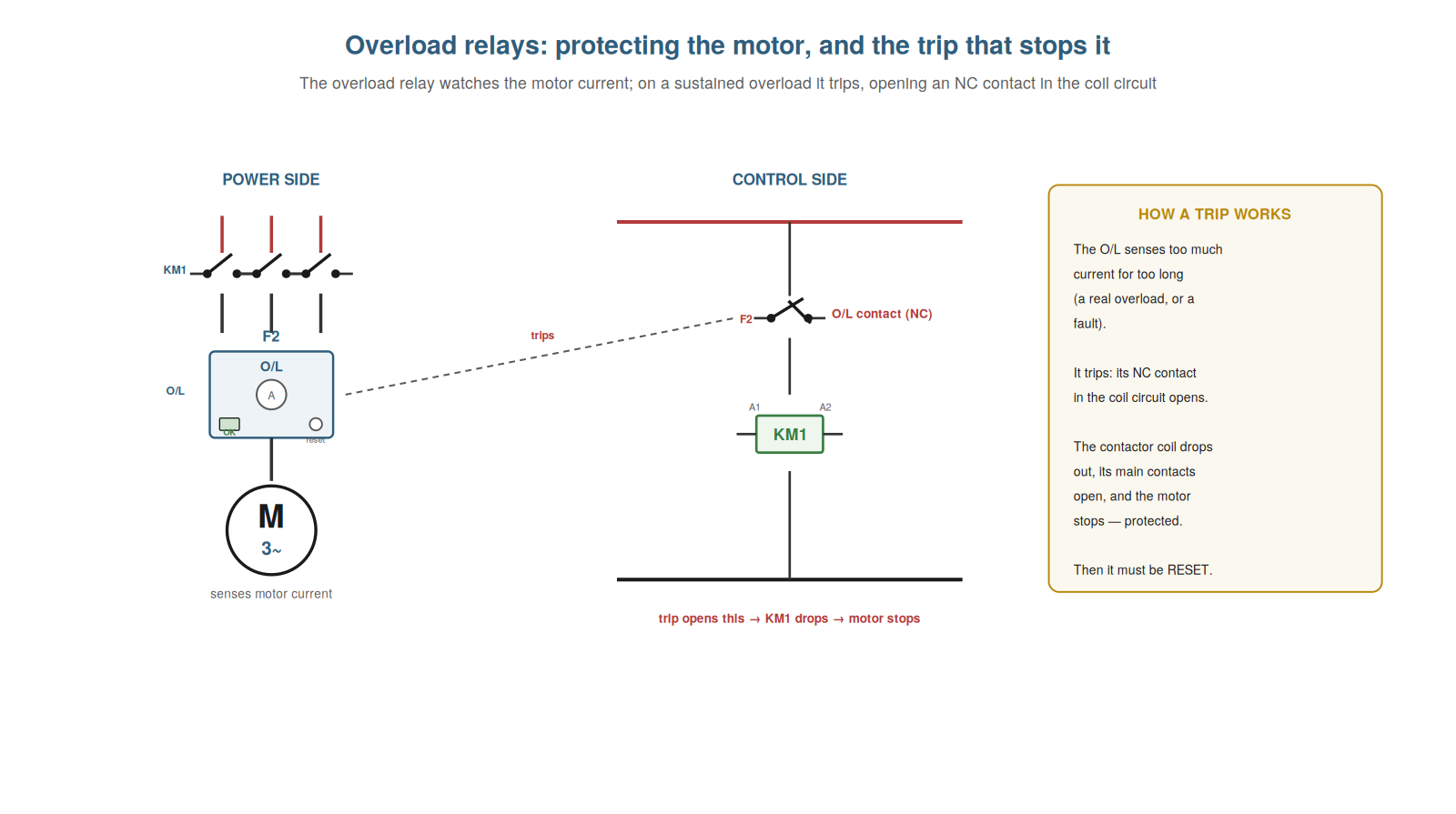
Understanding what the overload relay does — protecting the motor by sensing current and tripping on a sustained overload — clarifies its role and the meaning of a trip. The overload relay is placed in the motor’s power circuit, where it senses the current the motor draws. It is designed to allow normal current (including the brief high inrush at starting) but to trip if the current is too high for too long — a sustained overload that would overheat and damage the motor. When it trips, it operates a normally-closed contact wired in the contactor’s coil circuit: the contact opens, dropping the contactor, which opens the main contacts and stops the motor — protecting it from the overload. So the overload relay protects the motor by sensing sustained overcurrent and tripping to stop it. Understanding this clarifies that a trip is protective: the overload relay stopped the motor because it sensed a sustained overload, so a trip is telling you the motor was drawing too much current for too long. This meaning — a trip signals a real or apparent overload — is the basis for responding to a trip correctly. So understanding what the overload relay does explains its protective role and the meaning of a trip. Understanding what the overload relay does — sensing the motor current and tripping on a sustained overload to open its contact in the coil circuit, dropping the contactor and stopping the motor — clarifies its protective role and the meaning of a trip, so that you understand a trip as the overload relay protecting the motor because it sensed too much current for too long, which tells you a trip is signalling a real or apparent overload condition and is the basis for the important troubleshooting task of responding to a trip correctly rather than simply resetting it.
Setting the overload to the motor
A crucial practical point is that the overload relay must be set to the motor’s current, and understanding this explains a common cause of nuisance tripping and how to check it. An overload relay has an adjustable setting (a dial) that you set to the motor’s full-load current (FLC), taken from the motor nameplate. This setting tells the overload what current is normal for this motor, so it trips only on a genuine overload above that. If the dial is set too low (below the motor’s FLC), the overload trips on the motor’s normal running current — a nuisance trip, not a real overload. If set too high, it fails to protect. So the setting must match the motor’s FLC for correct protection. Understanding this explains a very common nuisance-trip cause: a mis-set dial, set below the motor’s actual current, tripping on normal operation. And it gives a first check for any nuisance trip: is the dial set correctly to the motor’s nameplate FLC? So understanding setting the overload to the motor explains a common nuisance-trip cause and its first check. Understanding that the overload must be set to the motor’s current — the dial set to the motor’s full-load current from the nameplate, so it trips only on a genuine overload — explains a common cause of nuisance tripping and how to check it, so that you recognize a dial set too low will trip on the motor’s normal current (a nuisance trip), and your first check for any nuisance trip is whether the dial is set correctly to the motor’s nameplate full-load current, which addresses one of the most frequent and easily-corrected causes of an overload relay tripping when it should not.
Responding to a trip
The key troubleshooting skill with overloads is responding to a trip correctly — finding why it tripped before resetting — and understanding this prevents both wasted effort and motor damage. When an overload trips, the wrong response is to simply reset it and run again: if a real overload caused the trip, resetting into it just trips again (or damages the motor). The right response is to find why it tripped. Is it a real overload — the motor genuinely drawing too much current (a mechanical problem like a jammed or stiff load, a bearing failure, single-phasing, a winding fault, or low supply voltage)? Or a nuisance trip — the motor fine but the overload tripping wrongly (dial set too low, wrong size, high ambient temperature, frequent starting, a faulty overload, or loose heating connections)? You tell them apart by measuring the motor’s actual current and comparing to its FLC and the overload setting. Understanding this directs the correct response: find the cause, distinguish real from nuisance, and address it — never just repeatedly reset. So understanding how to respond to a trip — finding why, distinguishing real from nuisance — prevents wasted resets and motor damage. Understanding how to respond to a trip — finding why it tripped and distinguishing a real overload (the motor genuinely overcurrent from a mechanical or electrical cause) from a nuisance trip (the motor fine but the overload tripping wrongly), by measuring the actual current against the motor’s FLC and the setting — prevents both wasted effort and motor damage, so that instead of simply resetting into a possible real fault, you determine the cause and address it, which is the correct and safe response to an overload trip and the key skill for the common event of a motor stopping on its overload.
Thermal versus electronic overloads
A useful distinction is between thermal and electronic overload relays, because they work differently and this affects their behavior and setting. A thermal overload relay uses bimetallic strips heated by the motor current: sustained overcurrent heats the strips, which bend and trip the relay — a thermal analogue of the motor’s own heating, so it inherently allows brief high currents (like starting inrush) but trips on sustained overload. Its trip time depends on the current and its own temperature (so ambient heat affects it). An electronic overload relay measures the current electronically and trips based on a programmed characteristic, often with more features (adjustable trip class, phase-loss detection, better accuracy) and less sensitivity to ambient temperature. Understanding the difference explains their behavior: a thermal overload’s sensitivity to ambient heat and its thermal memory (it may not reset instantly while warm), versus an electronic one’s programmable, more precise behavior. So understanding thermal versus electronic overloads explains their differing behavior and setting. Understanding thermal versus electronic overload relays — the thermal type using bimetallic strips heated by the current (inherently allowing inrush but sensitive to ambient heat and with thermal memory) and the electronic type measuring current electronically with programmable, more precise, temperature-independent behavior — explains their differing behavior and setting, so that you understand why a thermal overload is affected by ambient temperature and may not reset instantly while warm, and why an electronic overload offers features like phase-loss detection and precise trip classes, which helps you interpret and set the particular kind of overload relay protecting a motor.
Scenario: the trip that meant something
A scenario shows the value of finding why an overload tripped rather than just resetting. A motor’s overload kept tripping, and the operators had been resetting and restarting it repeatedly. The technician stopped this and investigated why. Understanding that a trip signals a real or apparent overload, he measured the motor’s running current with a clamp meter and compared it to the nameplate FLC: the current was well above FLC — a real overload. He then looked for the cause of the excess current and found the driven machine was partially seized, forcing the motor to draw excess current. The overload had been correctly protecting the motor; repeatedly resetting into the seizure risked burning out the motor. Fixing the seized machine returned the current to normal, and the overload stopped tripping. Understanding to find why — and measuring the current — revealed a real overload the resets were ignoring. This scenario shows finding why an overload tripped revealing a real overload behind repeated resets. Understanding that a trip signals a real overload led the technician to measure the current and find the seized machine. It reinforces that finding why an overload tripped — measuring the current — reveals a real overload that resetting would ignore and worsen. The scenario reinforces responding to a trip: understanding that an overload trips for a reason led the technician to measure the motor current (well above FLC) and find a seizing machine, illustrating how finding why before resetting reveals a real overload the repeated resets were dangerously ignoring, protecting the motor by fixing the cause rather than resetting into it.
Trip class and starting duty
A nuance worth understanding is the overload’s trip class and how it relates to the motor’s starting duty, because a mismatch causes nuisance trips on starting. An overload relay has a trip class (like Class 10, 20, or 30) that defines how long it tolerates a given overcurrent before tripping — a higher class tolerates the overcurrent longer. This matters for starting: a motor draws a high current for the duration of its start (accelerating the load), and the overload must tolerate this starting current for long enough without tripping. A motor with a long, hard start (a high-inertia load taking many seconds to accelerate) needs a higher trip class (tolerating the starting current longer); if the overload’s class is too low for the start, it trips during starting — a nuisance trip caused by a class mismatch, not a real overload. Understanding trip class and starting duty explains this: a nuisance trip on starting (but not running) may be too low a trip class for the motor’s start. So understanding trip class and starting duty explains nuisance trips on starting from a class mismatch. Understanding the overload’s trip class and its relation to starting duty — the class defining how long the overload tolerates an overcurrent, and a motor’s start drawing high current that the class must tolerate — explains nuisance trips on starting, so that you understand a motor with a long, hard start needs a high enough trip class to ride through its starting current, and a nuisance trip during starting (but not running) may be too low a trip class for the motor’s start rather than a real overload, which adds the trip class and starting duty to your understanding of overload nuisance trips and their causes.
The trip as information, not just an inconvenience
To close, it helps to see an overload trip as information rather than just an inconvenience, because this framing leads to the right response every time. A trip is easy to see as a nuisance — the machine stopped, reset it and carry on. But a trip is information: the overload is telling you it sensed too much current for too long. That information is valuable — it points to a real overload (a motor or machine problem to fix) or a nuisance condition (an overload setting or condition to correct). Treating the trip as information leads to the right response: find what it is telling you, and address that. Treating it as a mere inconvenience leads to the wrong response: reset and repeat, ignoring the message. So seeing the trip as information is the framing that leads to finding and fixing the cause. Understanding this makes you respond to every trip correctly. So understanding the trip as information, not an inconvenience, leads to the right response. Understanding an overload trip as information rather than an inconvenience — the overload telling you it sensed too much current for too long, pointing to a real overload to fix or a nuisance condition to correct — leads to the right response every time, so that instead of treating a trip as a nuisance to reset and forget, you treat it as valuable information to investigate and address, which leads you to find and fix the cause (a real overload or a nuisance condition) rather than resetting and repeating, the framing that makes you respond correctly to every trip.