Hiring a PLC programmer sounds simple until you try to write the job description.
Many companies publish something vague such as: “We are looking for an experienced PLC programmer to design, program, and commission automation systems.” Then they add a long list of PLC brands, robotics platforms, electrical skills, networking knowledge, and maintenance duties.
The result is often predictable. Strong candidates ignore the advert, unsuitable candidates apply anyway, and the company eventually hires someone whose real experience does not match the work.
A PLC programmer can mean very different things depending on the business. In one company, the role mainly involves creating new machine software. In another, it means fixing production breakdowns. Elsewhere, the programmer spends half the year travelling to customer sites.
A good job description must explain the actual work, not just repeat generic automation terminology.
Start With the Real Purpose of the Role
Before listing qualifications, define why the company is hiring.
Is the person expected to develop new machines, modify existing production equipment, support maintenance teams, commission systems at customer sites, or replace an engineer who is leaving?
A clear opening might say:
We are hiring a PLC programmer to develop, test, commission, and support PLC and HMI software for custom material-handling systems. The role includes workshop testing and approximately 30% travel to customer sites across Europe.
That gives candidates more useful information than a paragraph about being “dynamic, motivated, and passionate about innovation.”
The first section should clarify:
- What the company builds or operates
- Whether the work involves new systems or existing machinery
- How much programming is involved
- How much commissioning and troubleshooting is involved
- Whether travel, shift work, or on-call support is required
If those details are hidden, candidates may accept interviews without understanding the role.
Use a Specific Job Title
The title should match the real seniority and responsibilities.
Common titles include:
- Junior PLC Programmer
- PLC Programmer
- Automation Engineer
- Controls Engineer
- PLC and HMI Engineer
- Commissioning Engineer
- Industrial Automation Specialist
- Controls and Electrical Engineer
Do not call the position “Junior PLC Programmer” while expecting five years of experience, independent commissioning, safety programming, electrical design, and customer management.
Likewise, do not advertise for a “Senior Automation Engineer” if the work is mostly changing sensor timers and responding to breakdowns.
An inaccurate title damages trust before the candidate even reads the full advert.
Describe the Daily Responsibilities
Candidates want to know what they will actually do.
A realistic responsibilities section may include:
- Develop and modify PLC software
- Create HMI screens, alarms, and operator controls
- Configure VFDs, servo drives, remote I/O, and industrial networks
- Read and update electrical drawings
- Perform software simulations and workshop testing
- Participate in factory acceptance testing
- Commission systems at customer sites
- Diagnose PLC, sensor, actuator, and communication faults
- Create backups and technical documentation
- Train operators or maintenance technicians
- Provide remote support after project handover
Only include duties that genuinely belong to the role.
Some companies copy responsibilities from several different jobs and combine them into one advert. They ask for PLC programming, robot programming, electrical design, SCADA development, IT networking, project management, mechanical troubleshooting, maintenance, and technical sales.
One person may have some of those skills, but expecting deep expertise in all of them dramatically reduces the candidate pool.
Name the Actual PLC Platforms
“Experience with leading PLC systems” is too vague.
State the platforms the employee will use. For example:
- Siemens S7-1200 and S7-1500
- Siemens TIA Portal
- Allen-Bradley CompactLogix and ControlLogix
- Studio 5000
- Siemens WinCC
- FactoryTalk View
- Beckhoff TwinCAT
- Codesys
- Schneider EcoStruxure Control Expert
Separate required experience from preferred experience.
For example:
Required: Siemens TIA Portal experience, including S7-1200 or S7-1500 programming.
Preferred: Experience with Allen-Bradley PLCs, servo systems, or industrial robots.
Do not require experience with ten PLC brands when most projects use only one or two.
A capable Siemens programmer can usually learn another platform. Rejecting that person because they have not used the exact brand may cost the company a strong hire.
Explain the Technical Scope
Not all PLC programming is equally complex.
A candidate who has programmed small pump stations may not be ready to develop coordinated motion systems. A programmer experienced in high-speed packaging may not enjoy maintaining old factory machines.
Mention the type of systems involved:
- Conveyors
- Packaging machines
- Process control systems
- HVAC systems
- Pumping stations
- Water treatment
- Robotics cells
- Warehousing systems
- Food production machinery
- Automotive manufacturing
- Building automation
Also explain whether the role involves standard ladder logic, structured text, safety programming, motion control, SCADA, databases, recipe systems, or production reporting.
This helps candidates judge whether their experience is relevant.
Be Honest About Travel and Working Hours
Travel is one of the biggest reasons automation engineers leave jobs.
Do not describe a role as office-based if the programmer will spend three months commissioning abroad. Do not say “occasional travel” when it regularly reaches 40% or 50%.
Include realistic information about:
- Expected travel percentage
- Typical trip length
- Countries or regions covered
- Weekend work
- Night commissioning
- Shutdown work
- On-call responsibilities
- Overtime payment
- Time off after travel
The same applies to maintenance roles. A PLC programmer supporting a 24/7 factory may receive calls at night even if the official schedule is Monday to Friday.
Hiding this may help fill the role temporarily, but it increases the chance that the employee leaves during the first year.
Separate Essential and Desirable Requirements
The essential list should contain only the skills needed to perform the role.
Possible essential requirements include:
- Practical PLC programming experience
- Ability to read electrical schematics
- Basic understanding of industrial sensors and actuators
- Experience troubleshooting machinery
- Knowledge of industrial Ethernet or fieldbus systems
- Ability to work independently during commissioning
- Good written documentation habits
Desirable requirements may include:
- Functional safety experience
- Robot programming
- SCADA development
- Servo and motion control
- SQL or database knowledge
- Electrical CAD experience
- Experience in a specific industry
Avoid making every skill mandatory. Candidates often assume the company will reject them unless they meet almost every point.
Include Salary and Benefits
A job description without a salary range wastes everyone’s time.
PLC programmers vary widely in experience, travel tolerance, and technical specialisation. A salary suitable for a junior maintenance programmer will not attract an engineer who independently commissions complex machinery internationally.
List the salary range and explain what affects the final offer.
Also include benefits that matter to technical candidates:
- Paid overtime
- Commissioning bonuses
- Travel allowances
- Company vehicle
- Flexible or remote programming days
- Training budgets
- PLC software licences
- Laptop and test equipment
- Additional leave after long commissioning trips
- Private health insurance
- Certification support
Free coffee and a “friendly atmosphere” are not strong differentiators.
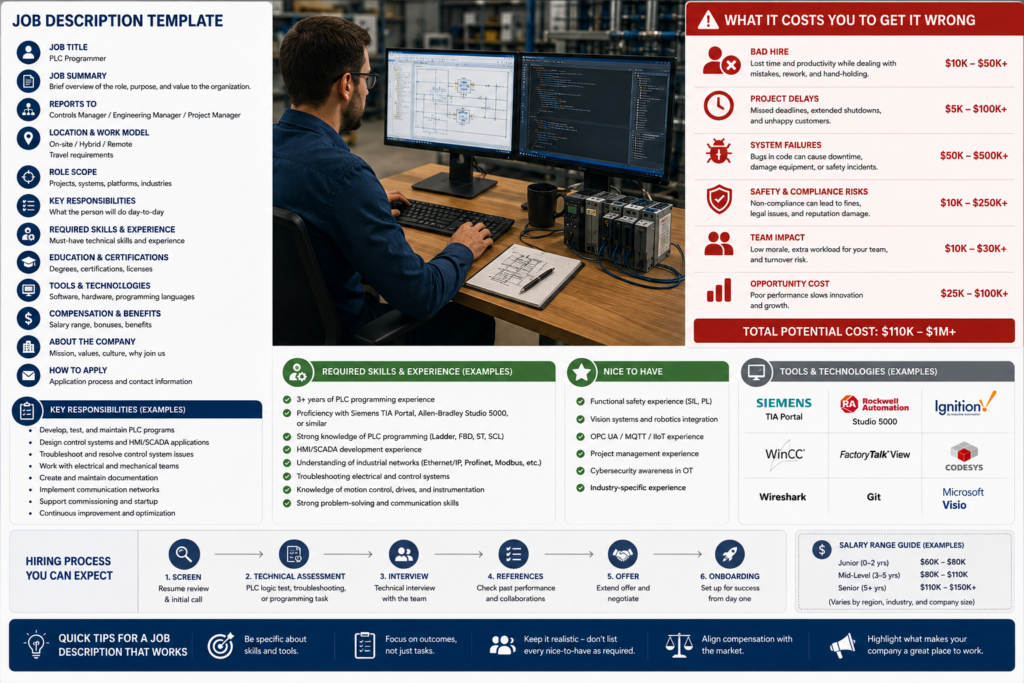
PLC Programmer Job Description Template
Job title: PLC Programmer / Automation Engineer
Role summary:
We are looking for a PLC programmer to develop, modify, test, and commission automation software for [type of machines or processes]. The role includes [workshop programming, site commissioning, maintenance support, or customer training].
Main responsibilities:
- Develop and modify PLC software using [platforms]
- Create HMI and operator-interface applications
- Configure drives, remote I/O, and industrial communication networks
- Test software during workshop and factory acceptance testing
- Commission automation systems at customer sites
- Diagnose electrical, software, and communication faults
- Maintain software backups and project documentation
- Support customers and internal technicians
- Update electrical drawings and I/O documentation when required
Required experience:
- Experience programming [Siemens, Allen-Bradley, Beckhoff, or other platform]
- Ability to read electrical schematics
- Understanding of sensors, actuators, motors, and control circuits
- Experience troubleshooting industrial machinery
- Good communication and documentation skills
- Ability to travel approximately [percentage]
Preferred experience:
- Safety PLC programming
- HMI or SCADA development
- VFD and servo commissioning
- Industrial robot integration
- Knowledge of PROFINET, EtherNet/IP, Modbus TCP, or other networks
- Electrical CAD experience
Working conditions:
- Location: [location]
- Travel: [percentage and typical trip duration]
- Schedule: [working hours]
- On-call or weekend work: [details]
- Remote work: [details]
Compensation:
- Salary: [range]
- Overtime: [payment or time-off policy]
- Travel allowance: [details]
- Benefits: [list relevant benefits]
What It Costs to Get the Job Description Wrong
A poor advert does more than attract the wrong applicants.
It can lead to months of recruitment, repeated interviews, agency fees, delayed projects, increased overtime, and lost customers.
Hiring the wrong programmer can be even more expensive. The company may need to rewrite software, correct unsafe logic, repeat commissioning, or send another engineer to repair the project.
There are also less visible costs. Senior employees lose time training someone who was never suitable. Customers lose confidence. Project managers become cautious about assigning responsibility. The new employee may become stressed and leave quickly.
A low salary combined with excessive responsibilities usually produces one of two outcomes: no suitable candidates, or a candidate who accepts the role temporarily while continuing to search elsewhere.
A well-written PLC programmer job description will not solve every recruitment problem. It will, however, remove unnecessary confusion and attract candidates who understand the role before applying.
The goal is not to make the job sound perfect. The goal is to make it accurate.