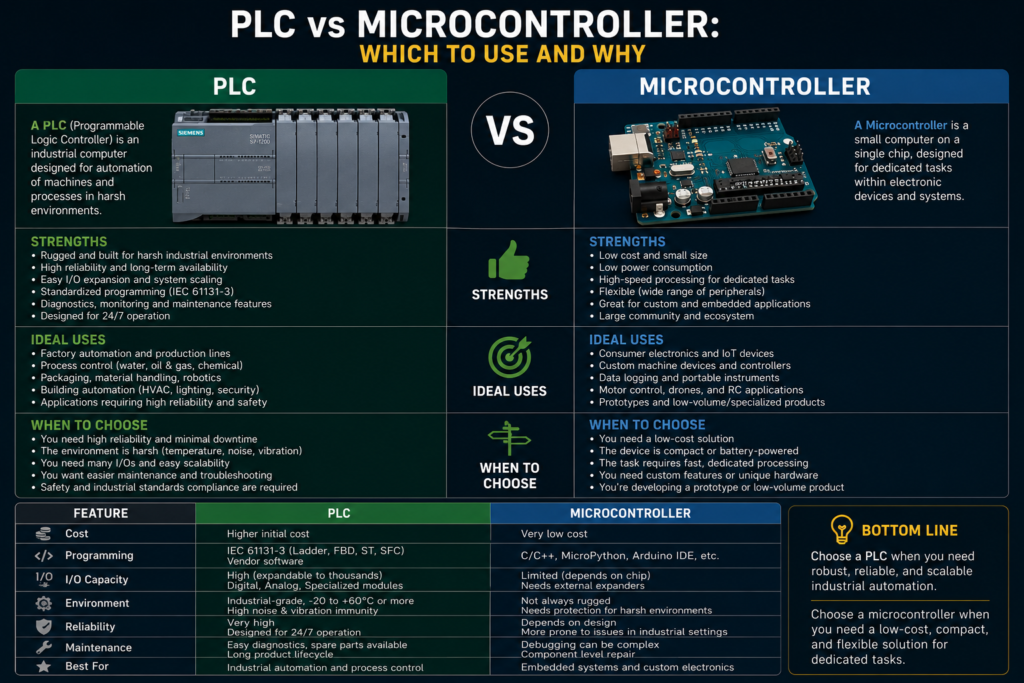
A PLC and a microcontroller can both read a sensor, make a decision and switch an output.
On paper, that makes them look almost interchangeable.
An Arduino can turn on a pump when a tank level drops. A Siemens PLC can do the same. Both devices run programs, process digital signals and control electrical equipment. Yet one might cost less than a decent restaurant meal, while the other can cost hundreds—or thousands—of euros once the power supply, I/O modules and software are included.
So why do factories keep buying PLCs?
And if microcontrollers are cheaper, smaller and more flexible, why not build every machine around one?
Because the processor is only a small part of the problem.
The real choice involves electrical protection, environmental conditions, maintenance, programming tools, certification, replacement parts, production volume and what happens when the system fails at three o’clock on a Monday morning.
For a one-off industrial machine, a PLC is often the practical choice. For a mass-produced electronic product, a microcontroller usually makes far more sense.
There is plenty of territory between those two extremes, though.
What Is a PLC?
A programmable logic controller, or PLC, is an industrial computer designed to control machines and processes.
It typically includes:
- a processor;
- program memory;
- industrial communication ports;
- digital and analogue I/O;
- diagnostic functions;
- a rugged enclosure;
- electrical isolation and protection;
- an industrial programming environment.
PLCs commonly control:
- conveyors;
- packaging machines;
- pumps;
- production lines;
- robotic cells;
- water-treatment systems;
- building services;
- material-handling equipment;
- industrial safety functions.
The PLC continuously reads its inputs, executes its control program and updates its outputs. This repeated process is known as the scan cycle.
A basic scan might look like this:
- Read input states.
- Execute the user program.
- Update outputs.
- Perform diagnostics and communication.
- Repeat.
This happens rapidly—often thousands of times per second.
PLCs are built around predictable, maintainable machine control. They are expected to operate for years in cabinets full of electrical noise, heat, dust and vibration while being serviced by technicians who did not design the original system.
That last part matters more than people think.
What Is a Microcontroller?
A microcontroller, often abbreviated as MCU, is a small integrated circuit containing a processor, memory and peripheral hardware.
Common microcontroller families include:
- AVR;
- PIC;
- STM32;
- ESP32;
- RP2040;
- MSP430;
- NXP i.MX RT;
- Microchip SAM;
- Renesas RA.
The microcontroller chip itself may contain:
- digital inputs and outputs;
- analogue-to-digital converters;
- timers;
- communication interfaces;
- PWM outputs;
- flash memory;
- RAM;
- watchdog timers;
- sometimes wireless communication.
Unlike a PLC, a bare microcontroller cannot normally be wired directly to an industrial sensor or contactor coil.
It needs supporting circuitry.
That may include:
- a regulated power supply;
- input protection;
- output drivers;
- galvanic isolation;
- communication transceivers;
- connectors;
- surge suppression;
- a printed circuit board;
- an enclosure;
- firmware-programming hardware.
Development boards such as Arduino, ESP32 and Raspberry Pi Pico make microcontrollers easier to experiment with because much of that support hardware is already present.
Still, a development board is not automatically an industrial controller.
It may work perfectly on a workbench and behave rather differently inside a cabinet beside a 75 kW variable-frequency drive.
The Simplest Difference
A PLC is usually a finished industrial control product.
A microcontroller is usually a component around which you build a product.
That distinction explains much of the price difference.
When you purchase a PLC, you are not paying only for its processor. You are also paying for:
- protected I/O;
- industrial connectors;
- isolation;
- diagnostics;
- certifications;
- programming software;
- communication support;
- documented operating limits;
- long-term product availability;
- manufacturer support;
- replaceability.
When you buy a microcontroller chip, you receive remarkable computing capability at a very low cost—but the rest is your responsibility.
For a custom electronic product manufactured 100,000 times, taking responsibility for the design can save enormous amounts of money.
For one factory machine, designing and validating a complete controller from scratch may cost far more than buying a PLC.
Cheap hardware does not always create a cheap project.
PLC vs Microcontroller at a Glance
| Feature | PLC | Microcontroller |
|---|---|---|
| Primary use | Industrial machinery and process control | Embedded electronic products |
| Typical form | Finished controller or modular system | Chip or development board |
| Programming | Ladder logic, function block, structured text | C, C++, Rust, assembly, MicroPython |
| Industrial I/O | Usually built in or available as modules | Must normally be designed externally |
| Electrical protection | Commonly included | Designer must add it |
| Diagnostics | Strong built-in diagnostics | Must be developed |
| Environmental durability | Designed for industrial cabinets | Depends on the finished hardware |
| Unit cost | Usually higher | Usually lower |
| Customisation | Moderate | Extremely high |
| Maintenance | Technician-friendly | Often requires firmware expertise |
| Mass production | Usually expensive per unit | Very cost-effective |
| Rapid machine integration | Excellent | Requires more engineering |
| Physical size | Larger | Can be extremely small |
This table points in the right direction, but it does not show the whole picture.
The correct choice depends on what you are building.
PLCs Are Designed for Industrial Electrical Signals
Industrial sensors commonly operate at 24V DC.
A standard PLC digital-input module is designed to recognise those signals while tolerating a certain amount of electrical noise, voltage variation and wiring imperfection.
The input may contain:
- filtering;
- current limiting;
- reverse-polarity protection;
- surge protection;
- galvanic isolation;
- status indication;
- diagnostic circuitry.
A microcontroller input pin may operate at 3.3V.
Apply 24V directly to it and the result may be a very brief, very unsuccessful electronics experiment.
To connect the same industrial sensor to a microcontroller, you may need an interface using:
- resistors;
- optocouplers;
- digital isolators;
- voltage dividers;
- transient suppressors;
- Schmitt triggers;
- protected input ICs.
That interface can be designed well. Plenty of industrial products use microcontrollers internally.
The point is that the protection does not come automatically.
Someone must calculate it, build it, test it and accept responsibility for it.
PLC Outputs Are Ready for Real Loads
PLC outputs are commonly designed to control industrial devices such as:
- relay coils;
- contactors;
- solenoid valves;
- indicator lamps;
- small DC loads;
- interface relays.
Depending on the module, the outputs may be:
- relay outputs;
- PNP transistor outputs;
- NPN transistor outputs;
- triac outputs;
- high-speed pulse outputs.
They usually include documented current ratings and may provide overload, short-circuit or thermal protection.
Microcontroller GPIO pins are intended for tiny electronic currents.
A pin might control an LED directly through a resistor, but it should not directly energise a contactor coil or solenoid valve. Doing so would overload the pin and expose the microcontroller to inductive voltage spikes.
External circuitry is required:
- transistor or MOSFET driver;
- relay;
- flyback diode;
- optocoupler;
- gate driver;
- protected high-side switch;
- suitable power supply.
Again, entirely possible.
Just not already done for you.
PLCs Handle Electrical Noise More Gracefully
Industrial machines are noisy—not only acoustically, but electrically.
Common sources of interference include:
- VFD output cables;
- contactor coils;
- relays;
- solenoid valves;
- welders;
- large motors;
- switching power supplies;
- long parallel cable runs;
- poor grounding.
These can produce voltage spikes, induced signals and electromagnetic interference.
A PLC is built with this environment in mind. Its power supply, enclosure, I/O and communication ports are designed and tested to tolerate specified industrial disturbances.
A custom microcontroller system can achieve similar immunity, but doing so requires careful attention to:
- printed circuit board layout;
- grounding;
- shielding;
- filtering;
- isolation;
- surge protection;
- enclosure design;
- connector selection;
- cable routing;
- electromagnetic compatibility testing.
The microcontroller itself may be perfectly reliable.
The trouble often arrives through the wires attached to it.
PLC Programming Is Designed Around Machine Logic
PLCs are commonly programmed using languages defined by the IEC 61131-3 industrial automation standard.
Widely used languages include:
- Ladder Diagram;
- Function Block Diagram;
- Structured Text;
- Sequential Function Chart.
Ladder logic
Ladder logic resembles electrical relay schematics.
It uses contacts, coils, timers, counters and function blocks. Electricians and maintenance technicians often find it easier to follow than traditional software code.
A motor-start circuit can be represented in a way that resembles its original relay wiring.
That familiarity is valuable during troubleshooting.
Structured Text
Structured Text resembles a high-level programming language.
It is useful for:
- calculations;
- loops;
- data handling;
- recipes;
- communication;
- complex algorithms.
Modern PLC projects often combine Ladder Diagram and Structured Text rather than treating them as competing choices.
The machine interlocks may be in ladder. The mathematical processing may be in structured text.
Practical beats ideological.
Microcontrollers Usually Use Software-Oriented Languages
Microcontroller firmware is often written in:
- C;
- C++;
- Rust;
- assembly language;
- MicroPython;
- manufacturer-specific frameworks.
These languages provide detailed control over:
- memory;
- interrupts;
- timing;
- communications;
- power consumption;
- peripheral hardware.
This makes microcontrollers extremely flexible.
You can optimise execution down to individual processor cycles, build custom communication protocols or create functionality that would be awkward inside a PLC.
But that freedom increases complexity.
Firmware developers may need to manage:
- interrupts;
- memory allocation;
- race conditions;
- real-time scheduling;
- hardware drivers;
- bootloaders;
- update mechanisms;
- fault recovery;
- cybersecurity.
A PLC hides much of that low-level work.
A microcontroller invites you behind the curtain.
PLCs Make Online Troubleshooting Easier
One of the strongest PLC advantages appears after the machine is commissioned.
A technician can connect to the PLC and monitor the program while it is running.
Depending on the platform, they can view:
- input and output states;
- active ladder contacts;
- timer values;
- counter values;
- analogue readings;
- communication status;
- module diagnostics;
- fault history;
- CPU operating mode.
In ladder logic, the live power flow is often highlighted visually. The technician can follow the logic and see exactly which condition prevents a motor from starting.
That is enormously useful on a production machine.
Microcontroller systems can also provide diagnostics, but someone must create them.
Possible options include:
- serial console;
- USB connection;
- web interface;
- diagnostic LEDs;
- service software;
- JTAG or SWD debugging;
- error logs;
- mobile application.
If these tools were not designed into the product, troubleshooting may involve connecting a debugger, reading source code and recompiling firmware.
That is fine in a development laboratory.
On a production floor with operators waiting, it can feel slightly less charming.
PLC Programs Are Easier for Maintenance Teams to Modify
Industrial machines often operate for decades.
During that time:
- sensors are replaced;
- sequences change;
- conveyors are extended;
- new products are introduced;
- safety systems are upgraded;
- remote I/O is added;
- old equipment is removed.
A PLC project is normally designed to be modified after installation.
Manufacturers provide programming software, online monitoring, hardware catalogues and migration paths.
A trained automation technician may be able to make a small change without redesigning the control hardware.
A microcontroller-based product may require:
- source-code access;
- the correct compiler;
- library versions;
- a programming adapter;
- hardware documentation;
- a firmware developer;
- a new validation cycle.
If the original developer disappeared six years ago and nobody can find the source code, the inexpensive custom board becomes less inexpensive rather quickly.
Microcontrollers Win on Unit Cost
When products are manufactured in large quantities, microcontrollers become extremely attractive.
A microcontroller chip may cost only a few euros—or less—depending on features and production volume.
The designer can include exactly what the product needs:
- required inputs;
- required outputs;
- selected communication ports;
- custom display;
- wireless connectivity;
- battery management;
- motor control;
- data storage.
There are no unused PLC modules, terminal bases or expensive industrial connectors unless the application requires them.
For a product manufactured once, custom development costs dominate.
For a product manufactured 100,000 times, per-unit hardware cost becomes critical.
This is why consumer appliances, power tools, toys, vehicle electronics and smart-home products are generally built around microcontrollers rather than modular PLCs.
Putting a PLC inside every coffee machine would make the coffee machine magnificently maintainable.
It would also make it rather expensive.
PLCs Often Win on Total Cost for One-Off Machines
Suppose you need to build one automated test station with:
- 20 digital inputs;
- 16 digital outputs;
- 4 analogue inputs;
- an HMI;
- a safety relay;
- Ethernet communication;
- several alarms.
A microcontroller board may initially look cheaper.
Then you need to design:
- the PCB;
- input protection;
- isolated outputs;
- power conversion;
- connectors;
- communication hardware;
- enclosure mounting;
- diagnostics;
- firmware;
- test procedures.
You may also need electromagnetic compatibility testing and electrical safety documentation.
A PLC system costs more as hardware but arrives largely ready to assemble and program.
For one machine, the engineering time saved can exceed the hardware-price difference.
The cheapest processor is irrelevant if the project needs an extra six months of development around it.
Microcontrollers Offer More Hardware Freedom
A PLC provides a defined ecosystem.
You choose from the modules, communication interfaces and features supported by the manufacturer.
A microcontroller lets you design almost anything.
You can create:
- a board shaped to fit a product;
- ultra-low-power battery operation;
- custom motor-control electronics;
- integrated wireless communication;
- specialised sensor interfaces;
- very high-speed timing;
- miniature wearable devices;
- custom displays;
- unusual communication protocols.
This flexibility is difficult to match with a conventional PLC.
A PLC is configurable.
A microcontroller is designable.
That difference becomes important when the controller itself is part of the product rather than simply controlling the product.
Real-Time Performance Is More Complicated Than It Looks
Both PLCs and microcontrollers can perform real-time control.
However, they approach it differently.
A PLC commonly uses a predictable cyclic scan. Inputs are read, logic executes, and outputs update in an organised sequence.
Many PLCs also support:
- timed interrupt tasks;
- hardware interrupts;
- high-speed counters;
- motion-control tasks;
- deterministic industrial networks;
- safety tasks.
A microcontroller may respond directly to hardware interrupts with extremely low latency. It can generate precise PWM, capture microsecond events and execute tightly timed control loops.
For very high-speed embedded control, a microcontroller can outperform a standard PLC at a fraction of the cost.
Examples include:
- drone flight control;
- switch-mode power conversion;
- digital audio processing;
- engine-control systems;
- compact motor drives;
- high-speed sensing.
For ordinary conveyor sequencing, tank control or valve operation, the PLC’s scan-based model is usually more than fast enough and much easier to maintain.
Faster is not automatically better.
A control system needs to be fast enough, predictable enough and understandable enough for the job.
PLCs Are Usually Easier to Expand
Industrial systems change.
A machine may begin with eight inputs and later need forty. A new analogue transmitter is added. Remote I/O is installed at the other end of the line. A second communication network becomes necessary.
Modular PLCs are designed for this kind of growth.
You can often add:
- digital modules;
- analogue modules;
- communication cards;
- remote I/O stations;
- motion modules;
- temperature modules;
- weighing interfaces.
The hardware configuration and program are then updated in the engineering software.
A custom microcontroller system may not have spare pins, PCB space, processing capacity or connectors.
Expansion could require a new board revision.
For products manufactured in volume, a board revision may be acceptable.
For a one-off production machine that needs one extra sensor on Friday afternoon, installing another PLC input module is much more convenient.
Communication Support
Modern PLCs commonly support industrial networks such as:
- PROFINET;
- EtherNet/IP;
- Modbus TCP;
- Modbus RTU;
- PROFIBUS;
- EtherCAT;
- CANopen;
- IO-Link;
- OPC UA.
Support depends on the PLC brand and model, but the integration is often well documented.
Device descriptions, hardware catalogues and diagnostic tools simplify connection to:
- VFDs;
- remote I/O;
- HMIs;
- robots;
- safety devices;
- valve manifolds;
- vision systems.
Microcontrollers can communicate through many of the same protocols, but stacks and transceivers must be developed, purchased or integrated.
Basic Modbus RTU may be straightforward.
Certified industrial Ethernet with real-time behaviour, diagnostics and conformance testing is another matter entirely.
The wires may still be Ethernet cables.
The engineering behind them is not ordinary office networking.
Safety Control Is a Major Dividing Line
A standard PLC and ordinary microcontroller should not be assumed suitable for safety-related control.
Applications involving emergency stops, guard switches, light curtains and hazardous motion often require safety-rated hardware.
Manufacturers offer:
- safety relays;
- safety PLCs;
- safety-rated I/O;
- certified communication;
- monitored drive functions.
These systems are designed and certified according to relevant functional-safety requirements.
A microcontroller can be used inside a certified safety product, but creating such a product is a specialised engineering task involving:
- redundant architecture;
- diagnostic coverage;
- failure analysis;
- software lifecycle controls;
- hardware reliability calculations;
- independent certification;
- extensive testing.
Using two inexpensive microcontroller boards does not automatically create a safety PLC.
Redundancy without controlled diagnostics can simply produce two ways to be wrong.
PLCs Usually Have Better Industrial Certifications
Commercial PLCs may be certified for industrial requirements involving:
- electromagnetic compatibility;
- electrical safety;
- temperature;
- vibration;
- shock;
- hazardous locations;
- marine use;
- functional safety;
- environmental standards.
The exact approvals vary by product.
These certifications help machine builders demonstrate that the selected components are suitable for their intended environment.
A microcontroller chip also has specifications, but your finished board and enclosure become a new product.
The complete design may require testing for:
- conducted emissions;
- radiated emissions;
- electrostatic discharge;
- electrical fast transients;
- surge immunity;
- radio-frequency immunity;
- temperature performance;
- safety clearances.
Development boards are especially easy to misunderstand here.
A board being available for sale does not mean your finished industrial machine automatically inherits every required certification.
PLCs Are Built for Long Product Lifecycles
Industrial controllers often remain in service for 10, 15 or 20 years.
PLC manufacturers generally provide:
- documented product lifecycles;
- replacement families;
- firmware support;
- migration tools;
- spare modules;
- service channels.
Products still become obsolete, of course. Industrial automation has no magical exemption from ageing.
But the ecosystem is built around long-lived installations.
Microcontroller families may also remain available for many years, but consumer-oriented boards, libraries and modules can change quickly.
A Wi-Fi module used in a prototype may disappear from the market. A development framework may break compatibility. A cloud service may close.
For a long-term product, component-lifecycle planning matters regardless of the platform.
The difference is that PLC vendors usually make it a visible part of the industrial sales proposition.
PLCs Tend to Be Physically Larger
A compact PLC may still occupy considerable DIN-rail space once its modules, power supply and terminals are installed.
For a factory cabinet, that may be acceptable.
For a handheld device, wearable sensor or compact appliance, it is not.
A microcontroller can be integrated onto a tiny custom PCB with only the supporting components required by the design.
It can fit inside:
- a sensor housing;
- a wall switch;
- a power tool;
- a remote control;
- a medical device;
- a wearable product.
The size difference is one reason microcontrollers dominate embedded electronics.
A PLC controls equipment from a cabinet.
A microcontroller often disappears inside the equipment itself.
Power Consumption
Microcontrollers can be designed for extremely low power consumption.
Some spend most of their time asleep and wake only when:
- a timer expires;
- a sensor changes;
- a radio message arrives;
- a button is pressed.
This makes them suitable for battery-powered and energy-harvesting devices.
A PLC is normally intended for continuously powered industrial systems. Its processor, communication interfaces and I/O remain active.
For a mains-powered machine, the PLC’s extra few watts may be insignificant.
For a remote sensor expected to run from one battery for five years, it is unacceptable.
Startup Time and Boot Behaviour
PLCs are designed to start in a controlled way after power is applied.
They may:
- perform internal diagnostics;
- check hardware configuration;
- enter STARTUP;
- initialise outputs;
- execute startup blocks;
- transition to RUN.
The behaviour is documented and configurable.
Microcontroller startup can be faster, but the designer must define what happens during:
- power rise;
- brownout;
- firmware boot;
- pin initialisation;
- communication startup;
- corrupted memory;
- watchdog reset.
Output pins may briefly float or enter default states before firmware configures them. If those pins control real equipment, the interface must prevent unintended activation.
The code beginning at main() is not the whole startup story.
Watchdog and Fault Recovery
Both platforms can use watchdog systems.
A watchdog monitors program execution and reacts if the controller becomes unresponsive.
A PLC typically includes built-in monitoring for:
- excessive scan time;
- hardware faults;
- communication faults;
- memory errors;
- module failures.
The response is often standardised and recorded in a diagnostic buffer.
Microcontrollers commonly include hardware watchdog timers, but firmware must configure and use them correctly.
A poorly written program can even refresh the watchdog while the application itself is stuck in an unsafe state.
Resetting a crashed controller is useful.
Understanding whether the reset restored a safe process condition is more important.
Security
Both PLCs and microcontrollers can become cybersecurity targets when connected to networks.
PLCs may provide:
- user accounts;
- access levels;
- protected projects;
- encrypted communication;
- signed firmware;
- security logs;
- network-management tools.
The actual features vary widely and must be configured correctly.
Microcontroller security can include:
- secure boot;
- flash encryption;
- signed updates;
- hardware security modules;
- protected keys;
- encrypted communication.
Microcontrollers may offer excellent security, but implementing it is largely the product developer’s responsibility.
A hobby project that places an ESP32 web server on a network is not automatically equivalent to a managed industrial-control system.
Neither platform is secure merely because it has a password somewhere in a menu.
When You Should Choose a PLC
A PLC is usually the stronger choice when:
- you are building a one-off industrial machine;
- the system uses many 24V industrial sensors and actuators;
- electricians or automation technicians must maintain it;
- online monitoring is important;
- the control system must be expanded later;
- industrial communication is required;
- downtime is expensive;
- long product support matters;
- safety-rated control is needed;
- the environment is electrically noisy;
- the project must be commissioned quickly.
Typical PLC applications include:
- conveyor control;
- pump stations;
- packaging machinery;
- process skids;
- material handling;
- production cells;
- building automation;
- water treatment;
- industrial test equipment.
In these applications, the hardware cost is often a small part of the machine’s total value.
Saving €300 on the controller makes little sense if troubleshooting takes three extra days.
When You Should Choose a Microcontroller
A microcontroller is usually the stronger choice when:
- the controller will be part of a manufactured product;
- low unit cost is essential;
- physical size must be minimal;
- battery operation is required;
- custom electronics are unavoidable;
- specialised high-speed control is needed;
- the product needs integrated wireless communication;
- production volume justifies hardware development;
- firmware developers will support the product;
- industrial modularity is not required.
Typical applications include:
- consumer appliances;
- smart sensors;
- toys;
- handheld devices;
- battery-powered products;
- motor controllers;
- wearable electronics;
- automotive modules;
- compact instruments;
- custom IoT devices.
The microcontroller is especially powerful when you control the complete product design and can optimise everything around one defined task.
When Either One Could Work
Some projects sit directly in the middle.
Examples include:
- greenhouse controllers;
- small irrigation systems;
- workshop machines;
- home automation;
- simple test equipment;
- educational trainers;
- small pumps;
- prototype production equipment.
Both platforms may be capable.
The better choice depends on the project’s priorities.
Choose a PLC when you value:
- quick wiring;
- easy troubleshooting;
- industrial reliability;
- technician access;
- modular expansion.
Choose a microcontroller when you value:
- low cost;
- compact size;
- custom features;
- wireless capability;
- production scalability.
The question is not only “Can it control the machine?”
Both probably can.
The better question is “Who will build it, maintain it, modify it and repair it five years from now?”
Can You Use Both Together?
Absolutely.
Many modern industrial systems combine PLCs and microcontrollers.
The PLC handles:
- machine sequencing;
- process interlocks;
- alarms;
- operator controls;
- communication with the factory network.
A microcontroller-based device handles a specialised local function such as:
- sensor processing;
- motor control;
- data acquisition;
- wireless communication;
- custom measurement;
- high-speed timing.
The microcontroller device may communicate with the PLC through:
- Modbus;
- CAN;
- IO-Link;
- Ethernet;
- serial communication;
- discrete I/O;
- analogue signals.
This hybrid architecture uses each platform where it performs best.
A smart sensor, for example, may contain a microcontroller internally while presenting a standard 24V output or IO-Link interface to the PLC.
The PLC does not need to know what happens inside.
It only needs reliable data.
Is Arduino a Replacement for a PLC?
An Arduino can perform PLC-like logic.
It can read switches, control relays, operate timers and communicate with external devices. For learning, prototyping and low-risk projects, it is extremely useful.
But a standard Arduino development board does not provide the same industrial features as a PLC.
It may lack:
- protected 24V inputs;
- isolated outputs;
- industrial connectors;
- surge immunity;
- certified environmental ratings;
- industrial diagnostic tools;
- long-term product support;
- functional-safety certification.
Industrialised Arduino-compatible controllers do exist. Some include DIN-rail mounting, 24V I/O and improved protection.
At that point, however, the comparison changes.
You are no longer comparing a €20 hobby board with a PLC. You are comparing two industrial controllers built around different software ecosystems.
The processor brand is not what makes a product industrial.
The complete design does.
Is a Raspberry Pi a Microcontroller?
A standard Raspberry Pi is a single-board computer, not a conventional microcontroller or PLC.
It runs an operating system such as Linux and offers significantly more computing power than many PLCs.
It is excellent for:
- data logging;
- databases;
- dashboards;
- vision processing;
- edge computing;
- network services.
However, a general-purpose operating system is not automatically deterministic enough for every real-time control task.
The Raspberry Pi Pico is different. It is a microcontroller development board based on the RP2040 chip.
Names can be confusing.
The enclosure says Raspberry Pi, but the architecture and intended use may be entirely different.
A Practical Decision Checklist
Before choosing a controller, answer these questions.
What voltage and signal types must it handle?
Industrial 24V signals favour a PLC or a properly designed industrial microcontroller interface.
How many units will be built?
One machine often favours a PLC. Thousands of products may justify custom microcontroller hardware.
Who will maintain it?
Electricians and automation technicians may prefer PLC tools. Firmware engineers may be comfortable with a microcontroller platform.
How expensive is downtime?
High downtime costs favour strong diagnostics, replaceable modules and readily available support.
Will the system expand?
Modular PLC hardware is usually easier to extend.
Does it need battery operation?
Microcontrollers are generally far better for ultra-low-power designs.
Is high-speed custom control required?
Microcontrollers may provide better direct access to timers, interrupts and specialised peripherals.
Is functional safety required?
Use appropriate certified safety equipment and architecture.
What environment will it operate in?
Temperature, electrical noise, vibration, moisture and hazardous locations all matter.
How long must replacement parts remain available?
Consider the full product lifecycle, not only today’s purchase price.
The Real Cost Is Engineering and Ownership
The initial hardware cost is easy to compare.
The total cost is harder.
For a PLC system, total cost may include:
- PLC hardware;
- modules;
- programming software;
- engineering time;
- cabinet space.
For a microcontroller system, it may include:
- circuit design;
- PCB layout;
- prototypes;
- firmware development;
- testing;
- certification;
- manufacturing setup;
- service tools;
- long-term software maintenance.
A €10 microcontroller can sit at the centre of a €100,000 development project.
A €1,000 PLC may be programmed and commissioned within days.
Neither figure alone tells you which choice is cheaper.
PLC or Microcontroller?
Choose a PLC when the controller must operate as part of an industrial machine, connect easily to standard field devices and remain understandable to maintenance technicians.
Choose a microcontroller when you are designing a dedicated electronic product where cost, size, power consumption and custom functionality matter more than modular industrial support.
A PLC gives you a finished control platform.
A microcontroller gives you the freedom to build one.
That freedom can be incredibly powerful, but it comes with responsibility for every power supply, input circuit, output driver, firmware fault and diagnostic feature surrounding the chip.
For factory automation, the PLC is often worth its higher price because it reduces engineering risk and makes future maintenance easier.
For mass-produced embedded products, a PLC would usually be bulky and unnecessarily expensive, while a microcontroller can be shaped precisely around the application.
Both are computers.
They simply solve different parts of the engineering problem.