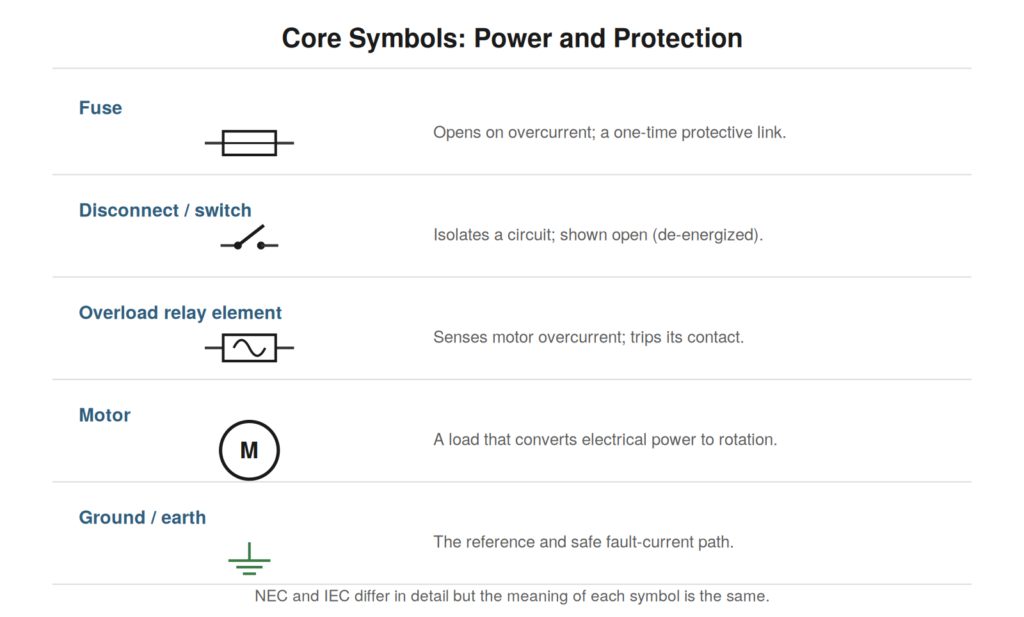
With lines understood, we turn to the symbols for the components that supply, switch, and protect power. These are the symbols you meet on the power side of a drawing — the part that delivers energy to the loads — and they follow directly from the functions they represent.
Sources, disconnects, and switches
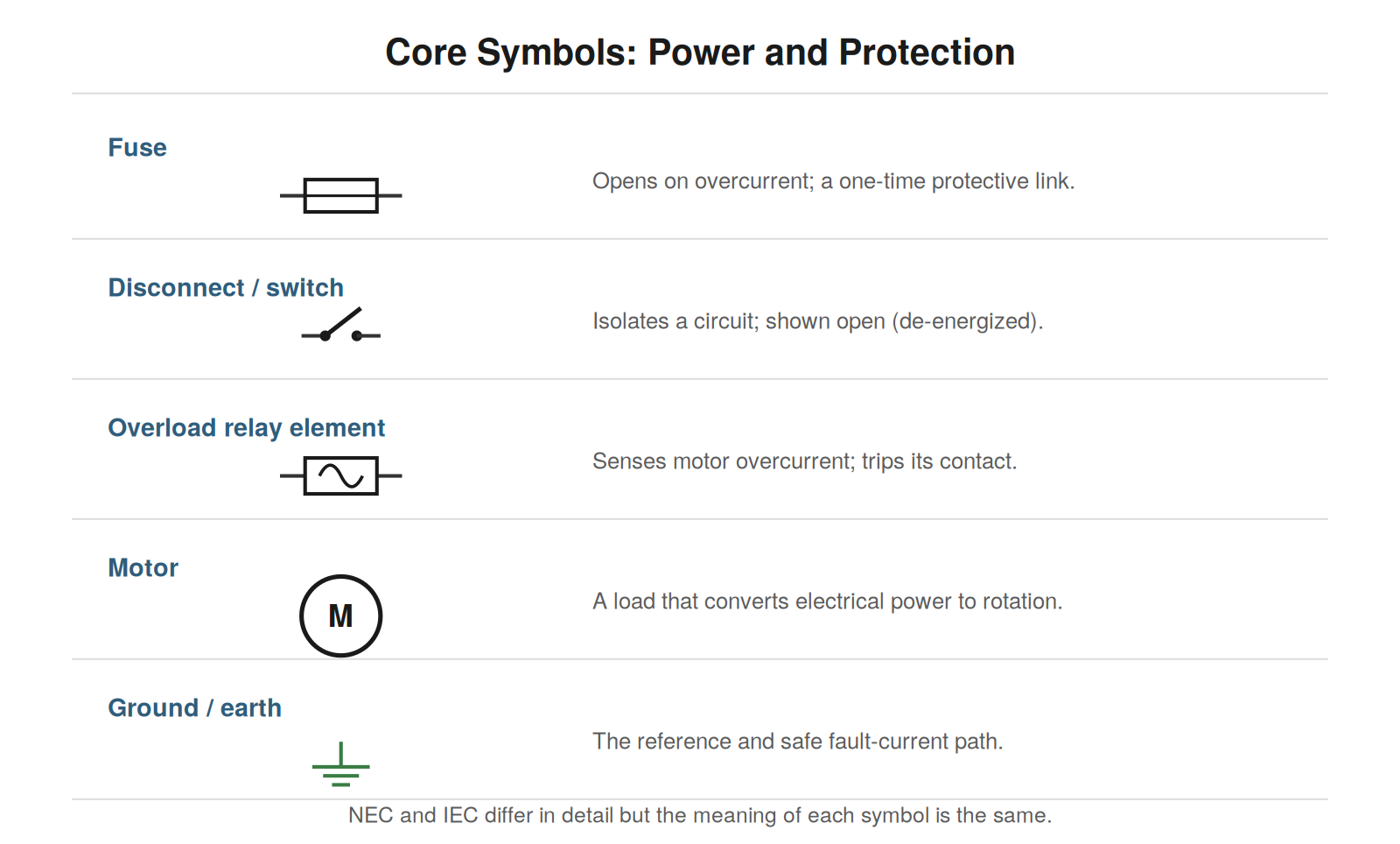
Power enters a drawing from a source — often shown as supply lines labeled with their identity, such as L1, L2, L3 for the three phases, or as a transformer symbol where the voltage is changed. The first thing power usually meets is a means of disconnection: a disconnect switch or isolator, drawn as a switch that can open to break the circuit. A switch is drawn to show whether it is open or closed at rest, with a disconnect typically shown open, representing the de-energized state. Reading these symbols tells you where power comes from and where it can be isolated — the starting points of any power circuit and the first things to check when a circuit is dead.
Fuses and circuit breakers
Protection against overcurrent appears as fuses and circuit breakers. A fuse is drawn as a small rectangle, sometimes with a line through it, representing the element that melts and opens the circuit on excessive current. A circuit breaker is drawn as a switch with an indication of its automatic tripping function. Both interrupt the circuit when current is too high, and both appear in the power path between the source and the loads. Reading them tells you where the circuit’s protection is, which matters because a blown fuse or tripped breaker is one of the most common reasons a circuit is dead, and knowing where the protection sits on the drawing tells you where to look. The symbol shows the protection; its position shows what it protects.
Transformers, overloads, and grounds
A few more power symbols round out the vocabulary. A transformer, drawn as two coupled coils, changes voltage — often stepping the supply down to a lower control voltage, which is why a control transformer appears where the control circuit branches off. An overload relay element, associated with motor circuits, senses excessive motor current and is drawn as a heater element that trips an associated contact when the motor draws too much for too long. And the ground or earth symbol, drawn as a set of diminishing horizontal lines, marks the connection to the grounding system — the reference point and the safe path for fault current. Recognizing these completes the power-side vocabulary, so that a power drawing reads as a clear story: source, isolation, protection, voltage change where needed, and the grounding that underlies safety.
Reading the power path as a story
The power symbols, read in sequence, tell a story: the story of how energy travels from the source to the load and what happens to it along the way. Beginning at the source — the supply lines or transformer — the story proceeds through the means of isolation (the disconnect), the protection (fuses or breaker), any switching (contactor contacts), any current sensing (overload heaters), and finally to the load. Reading the power symbols in this order narrates the energy’s journey, and understanding the journey tells you both how the circuit works and where to look when it fails. A dead load, read against this story, prompts the questions in order: is there power at the source, is the disconnect closed, is the protection intact, is the switching device operating, does power reach the load? The power symbols are the chapters of this story, and reading them in sequence turns a power drawing into a clear narrative of energy from source to load.
Reading exercise: narrating a power circuit
Practice reading power symbols by narrating a power circuit aloud, from source to load, naming each device and its function as you go. ‘Power comes from the three-phase supply; through the disconnect, which can isolate it; through the fuses, which protect against overcurrent; through the contactor’s main contacts, which switch it under control; through the overload heaters, which sense the motor current; to the motor.’ This narration exercises the skill of reading the power symbols in sequence and understanding the energy’s journey, and it reveals immediately if you cannot name a device’s function — a gap to fill. Narrating the circuit also builds the mental model of the power path that guides troubleshooting, because a dead load prompts you to narrate the path and check each stage in turn. The exercise is simple: find a power circuit and tell its story from source to load, naming every device and what it does. Do this until the narration flows, and you will read power circuits as clear stories of energy from source to load rather than as puzzles.
Reading protection to understand what it guards
Reading the protective devices in a power circuit — fuses, breakers, overloads — tells you not just where the protection is but what it guards and therefore what a tripped device implies. A fuse or breaker protects the circuit downstream of it against overcurrent, so a blown fuse means excessive current flowed in what it protects — a hint about the fault. An overload relay protects a motor against sustained overcurrent, so a tripped overload means the motor drew too much for too long — pointing at the motor or its load. Reading protection this way turns a tripped protective device from a mere obstacle into a clue: it tells you that excessive current occurred in a specific part of the circuit, which narrows the underlying cause. Rather than simply resetting or replacing the protective device and moving on, the reader asks what the protection guards and why it operated, using the drawing to understand what the trip reveals about the fault. Protective devices are the circuit’s own diagnosis of overcurrent, and reading what each one guards lets you interpret its operation as information about where and why excessive current flowed.
Reading the power circuit for safety isolation
One of the most important practical uses of reading a power circuit is identifying how to isolate it safely for work — finding the disconnecting means and understanding what it isolates, which is fundamental to safe maintenance. Before working on equipment, it must be safely isolated from its energy sources, and the power drawing shows where the disconnecting means are and what each isolates. Reading the drawing to identify all the energy sources and their disconnects — recognizing that a machine may have multiple sources requiring multiple isolations — is essential to isolating it completely and safely. A source overlooked because its disconnect was not identified on the drawing is a source that remains live during work, which is dangerous. Reading the power drawing thoroughly for all sources and their disconnects supports the safe isolation that must precede work, ensuring nothing is missed. While the actual isolation follows strict safety procedures beyond this book’s scope, the reading that identifies what must be isolated is a direct application of reading power symbols, and it underscores that reading the drawing is not only for troubleshooting but for the safety-critical task of knowing how to fully de-energize equipment before touching it.
Case: the blown fuse that told a story
A blown fuse is not just an obstacle to clear but a clue to read, as this case shows. A circuit was dead, and reading the power drawing led to a fuse, which was found blown. The naive response is to replace the fuse and move on, but reading the drawing to understand what the fuse protects prompts a better question: why did it blow? A fuse blows from overcurrent in what it protects, so the blown fuse indicated excessive current had flowed downstream — pointing to a fault there, perhaps a short or an overloaded component. Simply replacing the fuse without addressing the cause would likely blow it again. Reading the drawing to see what the fuse protected directed the investigation downstream, where the actual fault — the cause of the overcurrent — was found and fixed, after which the replaced fuse held. This case illustrates reading protective devices as clues: the blown fuse, read against the drawing showing what it protects, pointed to a downstream fault as the cause, rather than being treated as the problem itself. Reading what protection guards turns a blown fuse from a mere thing to replace into a diagnostic pointer toward the overcurrent’s cause, which is the real fault to fix so the fuse does not simply blow again.
Reading power circuits with respect for energy
Reading power circuits carries a dimension beyond understanding: respect for the energy they carry, because power circuits handle levels of energy that demand caution. While reading the drawing is a paper exercise, it informs work on circuits that can injure or kill, and the reading should be done with awareness of what the circuit’s energy means for safety. Reading a power circuit to understand its isolation, its protection, and its energy levels supports the safe work practices that handling such circuits requires. The reading tells you where the dangerous energy is, how it is controlled, and how it can be isolated — knowledge that underlies working safely. This respect for energy in reading power circuits is not fear but appropriate caution: understanding that the lines you read carry real, potentially lethal energy, and that reading the circuit correctly is part of working with it safely. The best readers of power circuits combine technical understanding with this respect for energy, reading not just to understand the circuit but to work with it safely, informed by what the reading reveals about where the energy is and how it is controlled. Reading power circuits with respect for the energy they carry is part of the professionalism that safe work in industrial electrical environments demands, where understanding and caution go together.