Since the majority of PROFINET faults are physical, understanding the
physical network — the cables, connectors, and topology — is where
practical troubleshooting truly begins. This is the part of the network
you can see and touch, and a technician who understands it well and
inspects it first will resolve most faults quickly. This chapter covers
the cabling and topology in the practical terms a maintenance technician
needs, so that you can reason about and inspect the physical network
with confidence.
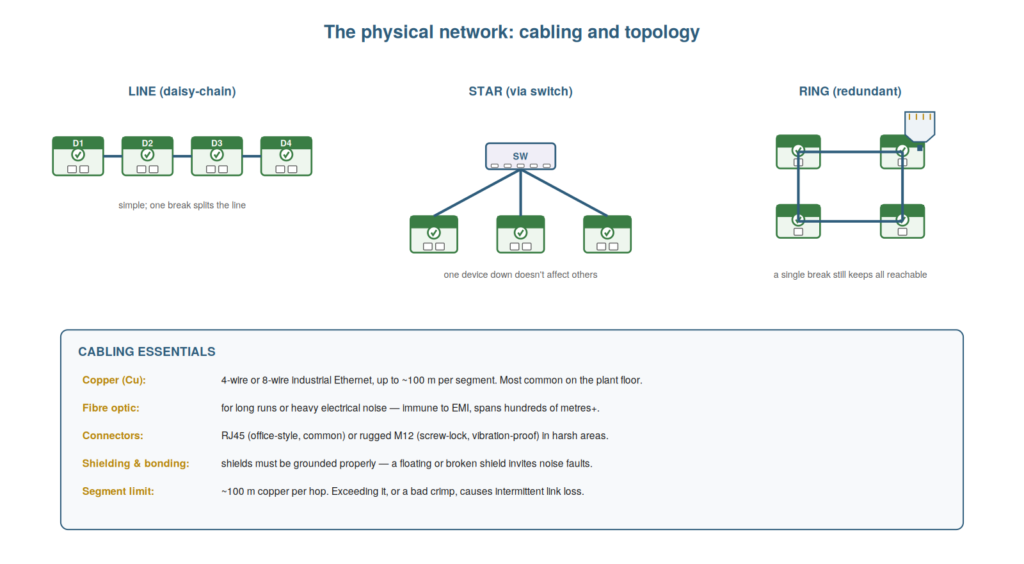
switch), and ring (redundant) topologies, and the cabling essentials —
copper vs fibre, RJ45 vs M12 connectors, shielding and bonding, and the
~100 m copper segment limit. The topology shapes how faults
present.
Cables and connectors
The cables and connectors are the literal, physical carriers of the
network, and understanding their types and limits is fundamental to
diagnosing the physical faults that dominate PROFINET troubleshooting.
PROFINET typically uses copper industrial Ethernet cable for most runs —
with a segment limit of about 100 metres per hop — and fibre optic cable
for long distances or electrically noisy environments, where fibre’s
immunity to electrical interference is valuable. Connectors are commonly
RJ45 (the familiar office-style connector) or, in harsh environments,
rugged M12 connectors (screw-locking, resistant to vibration and
moisture). These physical components are where many faults originate: a
damaged or kinked cable, a poorly-crimped or loose connector, a cable
run too long, or a connector corroded or vibrated loose. Understanding
the cable types (copper, fibre), their limits (the 100 m copper
segment), and the connectors (RJ45, M12) equips you to inspect and
reason about the physical carriers. Understanding cables and connectors
— their types, limits, and failure modes — is fundamental to
physical-layer troubleshooting. It reinforces that PROFINET uses copper
(with a ~100 m limit) and fibre cable, with RJ45 or M12 connectors, and
that these physical carriers are where many faults originate, so that
understanding them equips you to inspect and diagnose the physical
network. Understanding cables and connectors — the copper and fibre
cables, their limits like the 100 m copper segment, and the RJ45 and M12
connectors — is fundamental to PROFINET troubleshooting, because these
physical carriers are where the majority of faults live, so that knowing
their types, limits, and failure modes lets you inspect and reason about
the physical layer effectively, which is where practical PROFINET
diagnosis most often succeeds.
Topology: line, star, and ring
The topology — how the devices are physically connected together —
shapes how faults present, and understanding the common topologies is
important for interpreting the pattern of a fault. In a line
(daisy-chain) topology, devices are connected in a chain, each to the
next, often using the two-port switches built into the devices; this is
simple and common, but a break in the chain cuts off everything
downstream of it. In a star topology, devices connect individually to a
central switch, so one device’s failure does not affect the others. In a
ring topology, the line is closed into a loop with redundancy, so that a
single break still leaves every device reachable (via the other
direction around the ring). Understanding these topologies matters for
diagnosis because the topology determines what you see when a fault
occurs: on a line, a break takes out everything downstream; on a star,
only the affected device; on a ring, redundancy may keep everything
running despite a break. So knowing the topology lets you interpret the
pattern of lost devices. Understanding the topologies — line, star, ring
— and how each shapes a fault’s presentation is important for
interpreting faults. It reinforces that line, star, and ring topologies
present faults differently (a line break cuts downstream, a star
isolates, a ring tolerates a single break), so knowing the topology
helps interpret the pattern. Understanding topology — line, star, and
ring, and how each shapes what you see when a fault occurs — is
important for PROFINET troubleshooting, because the pattern of which
devices are lost, read against the topology, points toward the fault’s
location, so that knowing how the network is physically connected lets
you interpret the symptoms (several devices down together, one isolated
device, or everything tolerant of a break) and reason toward where the
problem lies.
Shielding, grounding, and noise
An aspect of the physical network that causes subtle, frustrating
faults is shielding, grounding, and electrical noise, and understanding
it is key to diagnosing the intermittent problems that plague industrial
networks. Industrial environments are electrically noisy — drives,
motors, welders, and switching equipment generate interference — and
PROFINET copper cabling is shielded to protect the signal from this
noise. But the shielding only works if it is properly grounded and
bonded: a shield that is broken, floating, or poorly connected does not
protect the signal, letting noise corrupt the data. Similarly, routing
data cables alongside power or drive cables exposes them to
interference. So noise-related faults arise from inadequate
shielding/grounding or poor cable routing, and they often present as
intermittent, hard-to-catch problems — the network works until a noisy
device switches on, then errors appear. Understanding shielding,
grounding, and noise — the protection of the signal and how its failure
causes intermittent faults — is key to diagnosing these frustrating
problems. It reinforces that proper shielding and grounding protect
PROFINET signals from industrial noise, and that inadequate
shielding/grounding or poor routing causes intermittent, noise-related
faults. Understanding shielding, grounding, and noise — how shielding
protects the signal, why proper grounding and bonding are essential, and
how noise causes intermittent faults — is key to diagnosing some of the
most frustrating PROFINET problems, because inadequate shielding,
floating grounds, or data cables run alongside power cables let
electrical noise corrupt the signal intermittently, so that when a
network drops out in step with a noisy machine action, shielding,
grounding, and cable routing are exactly where to look.
Reading a cable’s markings and ratings
A practical skill for the physical layer is reading a cable’s
markings and ratings, because using the right cable for the situation
prevents faults. Industrial Ethernet cables are marked with information:
the type and category, whether they are rated for the environment
(flexing for drag chains, oil resistance, temperature), and their
construction. Using the right cable matters: a cable meant for fixed
installation will fatigue and fail if used where it must flex
continuously (a drag chain needs a flex-rated cable); a cable not rated
for the temperature or chemicals present may degrade. So reading the
markings and choosing a cable rated for its actual use — flexing,
temperature, chemical exposure — prevents the premature failures that
come from using an unsuitable cable. Understanding how to read cable
markings and match the cable to its use prevents these avoidable
physical faults. Understanding how to read a cable’s markings and
ratings — and to match the cable to its actual use, especially
flex-rated cable for drag chains and appropriately-rated cable for the
temperature and chemical environment — prevents the premature failures
that come from using an unsuitable cable, so that when you replace or
route a cable, you choose one rated for what it must endure, which
avoids the fatigue and degradation faults that result from using, say, a
fixed-installation cable where it must continuously flex, making cable
selection a practical part of preventing physical-layer faults.
Scenario: the drag-chain cable
A scenario shows a topology and cable understanding solving an
intermittent fault. A machine’s devices beyond a certain point on a line
kept dropping out intermittently, always together. Reading the loss
pattern against the line topology, the technician localized the fault to
the link at the point where the drops began — the last good device sat
just before the affected group. Inspecting that link, he found the cable
ran through a drag chain where it flexed constantly, and understanding
that a non-flex-rated cable fatigues in such use, he examined it and
found the cable damaged from the repeated flexing, intermittently
breaking a conductor. Replacing it with a proper flex-rated cable
resolved the intermittent drops. The topology reading localized the
fault, and the cable understanding explained it. This scenario shows
topology and cable knowledge combining to solve an intermittent line
fault. Understanding the line topology (to read the loss pattern) and
cable ratings (to explain the drag-chain damage) let the technician
localize and explain the fault. It reinforces that reading the loss
pattern localizes a line fault and that understanding cable ratings
explains drag-chain fatigue, combining to solve the fault. The scenario
reinforces the value of topology and cabling knowledge: the technician
localized an intermittent fault by reading the loss pattern on the line
and explained it through understanding drag-chain cable fatigue,
illustrating how understanding the physical network — its topology and
its cables — combines to diagnose the physical faults that dominate
PROFINET troubleshooting, here an improperly-rated cable failing where
it flexed.
Fibre where copper struggles
A practical nuance of cabling choice is knowing when to use fibre
instead of copper, and understanding the cases where fibre solves
problems copper cannot helps you address certain persistent faults.
Fibre optic cable has advantages copper lacks: it is immune to
electrical noise (carrying light, not electricity), and it spans far
greater distances than copper’s ~100 m limit. So in electrically very
noisy environments (near large drives, welders, or other heavy
interference), where copper links suffer noise-related faults despite
good shielding, fibre can solve the problem by being immune to the
noise. And for long runs exceeding copper’s limit, fibre is the answer.
So understanding when to use fibre — for noise immunity and long
distance — helps you address faults that copper struggles with. If a
copper link in a noisy area persistently suffers noise faults,
converting it to fibre may be the durable fix. Understanding fibre where
copper struggles — its noise immunity and long reach — helps address
persistent noise or distance problems. Understanding when to use fibre
where copper struggles — for its immunity to electrical noise and its
far greater reach than copper’s 100 m limit — helps you address faults
that copper cannot overcome, so that in electrically very noisy
environments where copper links suffer persistent noise faults, or over
distances beyond copper’s limit, fibre provides a durable solution by
carrying light immune to interference, which makes knowing when to reach
for fibre a valuable part of addressing the noise and distance problems
that copper cabling struggles with.
The physical network as your home ground
To close this chapter, it helps to frame the physical network as the
maintenance technician’s home ground, because embracing this framing
focuses your troubleshooting where you are strongest and where the
faults are. The physical network — the cables, connectors, and topology
— is tangible, inspectable, and familiar to anyone with maintenance
experience, unlike the abstract configuration. And it is where most
faults live. So the physical network is your home ground: the part you
can see and touch, where your existing skills apply, and where the
majority of faults are found. Embracing this — approaching PROFINET
faults by heading first to the physical network you understand well —
focuses your troubleshooting on your strength and on the likely cause.
This is empowering: the intangible network has a tangible layer that is
both diagnosable by you and the usual source of faults. Understanding
the physical network as your home ground — tangible, familiar, and where
most faults live — focuses troubleshooting on your strength and the
likely cause. Understanding the physical network as your home ground —
the tangible, inspectable, familiar layer of cables, connectors, and
topology where your maintenance skills apply and where most faults live
— focuses your troubleshooting on both your strength and the likely
cause, so that you approach PROFINET faults by heading confidently to
the physical network you understand well, which is empowering because it
means the seemingly intangible network has a tangible layer that you are
well-equipped to diagnose and that is the usual source of faults, making
the physical network the home ground from which you tackle most PROFINET
troubleshooting.