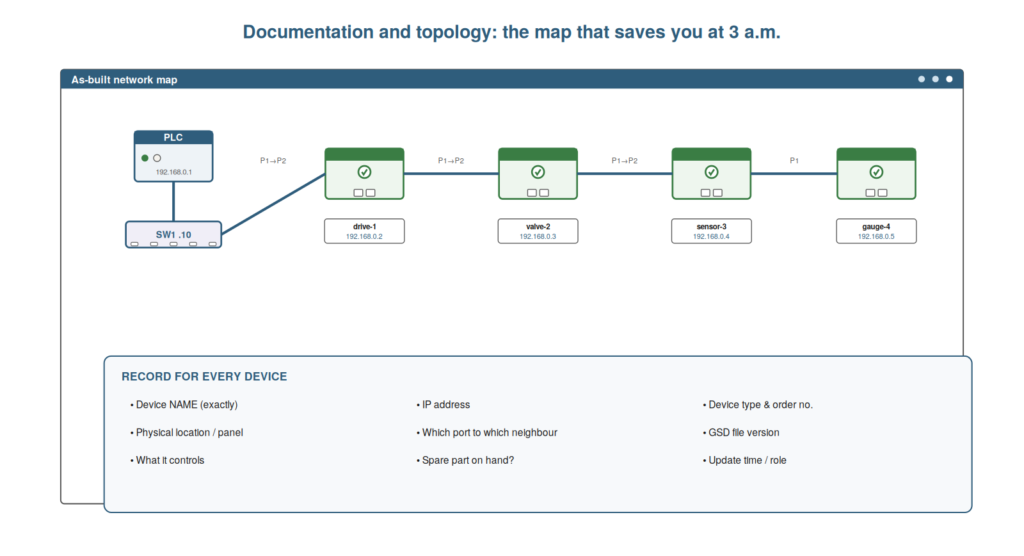
Good documentation — especially of the network topology and device
identities — is what turns a difficult 3 a.m. fault into a manageable
one, and understanding what to document and why is part of responsible
PROFINET maintenance. When a device fails or a network problem arises,
having an accurate record of the network saves enormous time and
prevents mistakes. This chapter covers documentation and topology from
the maintenance perspective.
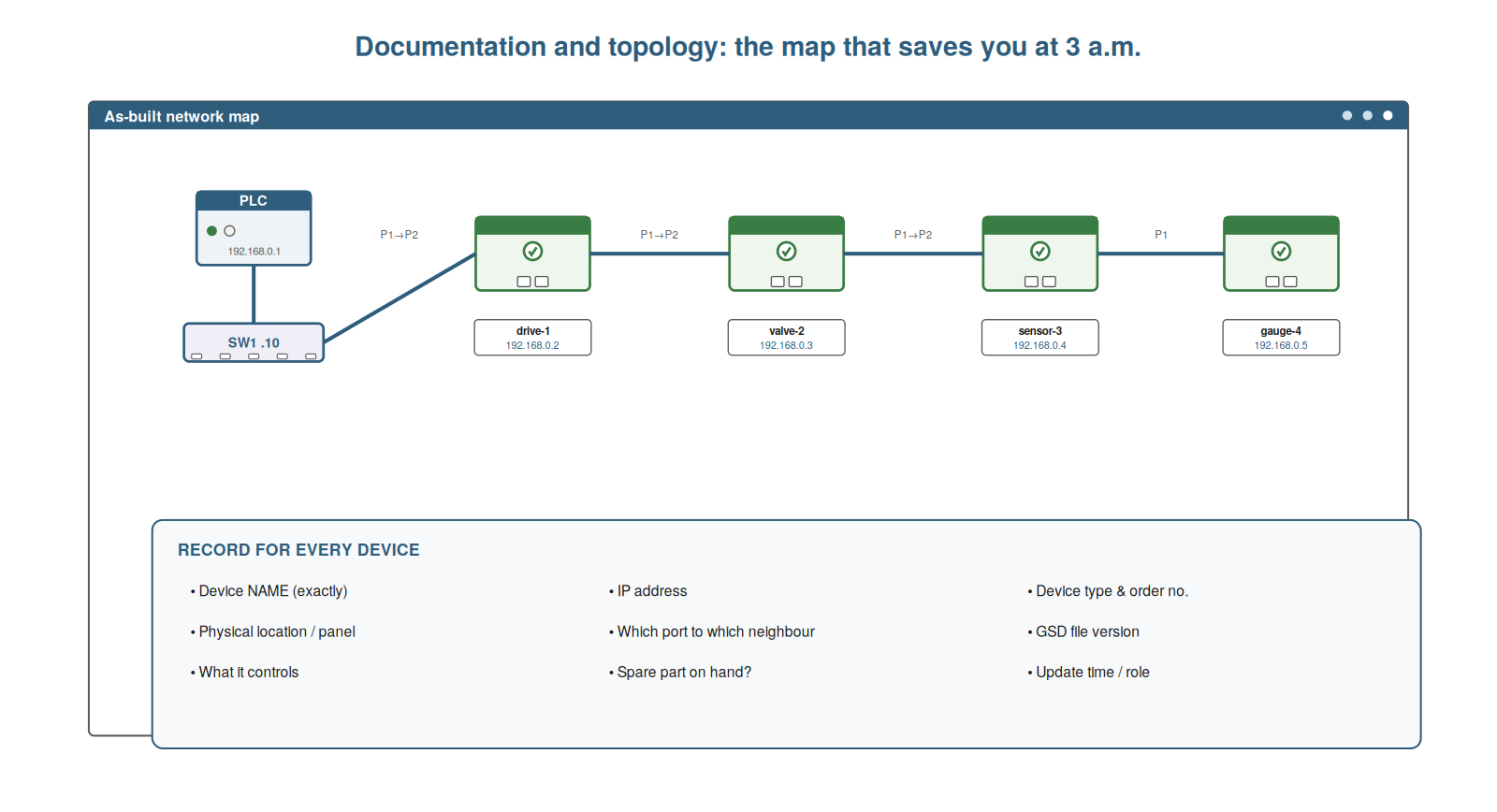
the controller, switches, and devices with their names, IPs, types,
locations, and port-to-port connections. Record for every device its
name, IP, type, location, neighbours, GSD version, function, and
spare-part status.
What to document
Understanding what to document — the specific information about each
device and the network — ensures your records are actually useful when a
fault occurs. For every device, record: the device name (exactly), the
IP address, the device type and order number, the physical location
(which panel, where on the machine), which port connects to which
neighbour (the topology), the GSD file version, what the device controls
(its function), and whether a spare is on hand. For the network as a
whole, an as-built topology map showing the controller, switches, and
devices with their connections ties it together. This information is
what you need when a device fails: the name and type to get and
configure the right replacement, the location to find it, the topology
to understand the network, the function to assess the impact, the spare
status to know if you can fix it now. So documenting this specific
information makes your records genuinely useful. Understanding what to
document — the device identities, types, locations, connections, and
functions — ensures useful records. It reinforces documenting for each
device its name, IP, type, location, port connections, GSD version,
function, and spare status, plus an as-built topology map, which makes
records useful in a fault. Understanding what to document — each
device’s name, IP, type and order number, location, port-to-port
connections, GSD version, function, and spare-part status, plus an
as-built topology map — ensures your records are genuinely useful when a
fault occurs, so that you have exactly the information a fault demands:
what the device is and where, how the network is connected, what the
device does, and whether you can replace it immediately, which is what
turns documentation from a neglected chore into the resource that makes
fault resolution fast and reliable.
Why topology documentation pays off
Beyond general documentation, understanding why topology
documentation specifically pays off reinforces the effort of recording
and configuring it. Documenting the topology — which device connects to
which, on which ports — pays off in several ways. It lets you read the
loss pattern accurately: knowing the physical connections, you can
interpret which devices being lost points where. It enables automatic
device replacement: a configured topology lets the controller auto-name
blank replacements by position. It speeds fault location: the topology
map shows you where each device is and how the network is laid out, so
you can find and reason about faults physically. And it prevents
mistakes: an accurate topology record means you connect replacements
correctly and understand the network as it really is. So topology
documentation pays off in reading patterns, enabling auto-replacement,
speeding location, and preventing mistakes. Understanding why it pays
off reinforces the effort to document and configure the topology. It
reinforces that topology documentation enables accurate pattern-reading,
automatic replacement, faster fault location, and fewer mistakes, which
justifies the effort. Understanding why topology documentation pays off
— enabling accurate loss-pattern reading, automatic device replacement,
faster fault location, and fewer mistakes — reinforces the effort of
recording and configuring the topology, so that you see the concrete
benefits that make topology documentation worthwhile: it is not merely
tidy record-keeping but a practical investment that makes faults easier
to read, replacements easier to perform, locations easier to find, and
mistakes less likely, which is why configuring and documenting the
topology is among the most valuable preventive practices in PROFINET
maintenance.
Keeping records current
Documentation is only useful if it is current, and understanding the
importance of keeping records up to date — and the discipline it
requires — ensures your documentation remains reliable. Records that
were accurate once but not maintained become misleading: a topology map
that does not reflect a change made since, a device list with an old
name or a since-replaced type, an outdated network diagram. Relying on
stale records can mislead a diagnosis or cause a mistake (connecting to
the wrong device, configuring the wrong replacement). So keeping records
current — updating them whenever the network changes (a device added,
replaced, renamed, or rewired) — is essential to their usefulness. This
requires discipline: making the update part of any change, so the
records always reflect reality. Current records are a reliable resource;
stale ones are a liability. So the discipline of keeping records current
maintains their value. Understanding the importance of current records —
and the discipline to update them with every change — ensures reliable
documentation. It reinforces that documentation must be kept current
(updated with every network change) to remain useful, requiring the
discipline to update records as part of any change. Understanding the
importance of keeping records current — updating the documentation
whenever the network changes, as a disciplined part of any change —
ensures your records remain a reliable resource rather than a misleading
liability, so that your topology maps, device lists, and diagrams always
reflect the network as it actually is, which is what makes documentation
trustworthy in a fault, because stale records can mislead a diagnosis or
cause a mistake, while current records — maintained through the
discipline of updating with every change — provide the accurate picture
that makes fault resolution fast and safe.
Labelling devices and cables physically
A practical complement to documented records is physically labelling
the devices and cables, and understanding its value speeds fault-finding
at the machine. Beyond records in the tool or on paper, physically
labelling the hardware — marking each device with its name, and
labelling cables with their source and destination — helps enormously
when you are at the machine diagnosing a fault. A device labelled with
its name lets you match it to the diagnostics immediately (the buffer
names ‘drive-3’; you find the device labelled ‘drive-3’). Cables
labelled with their endpoints let you trace connections physically
without guessing. So physical labelling bridges the gap between the
documented network and the actual hardware in front of you, speeding the
work of matching diagnostics to physical devices and tracing
connections. This is a simple, high-value practice. Understanding the
value of physical labelling — matching hardware to diagnostics and
tracing cables — speeds fault-finding at the machine. Understanding the
value of labelling devices and cables physically — marking each device
with its name and each cable with its endpoints — speeds fault-finding
at the machine, so that when the diagnostics name a device, you can
immediately find the physically labelled device, and when you need to
trace a connection, the labelled cables let you do so without guessing,
which bridges the documented network and the actual hardware and makes
physical labelling a simple, high-value practice that complements the
records and turns naming from an abstraction in the tool into a visible
aid on the plant floor.
Scenario: the map that saved the night
A scenario shows good documentation saving a difficult repair. A
device failed in the middle of a night shift, and the technician on duty
was unfamiliar with that machine. Without documentation, he would have
struggled — not knowing the device’s name, type, location, or
connections. But the machine had a good as-built network map and device
records: he looked up the failed device, found its name, type, and exact
location, saw from the topology how it connected, and learned a spare
was in stock. Armed with this, he found the device, fitted the
documented spare, assigned the documented name, and had the machine
running again quickly — a repair that would have been slow and
error-prone without the records. The documentation had saved the night.
This scenario shows good documentation enabling a fast repair by an
unfamiliar technician. Understanding the value of documentation — the
records and topology map — let the technician repair an unfamiliar
machine’s fault quickly. It reinforces that good documentation (device
records, topology map, spare status) enables fast, reliable repair even
by an unfamiliar technician. The scenario reinforces the value of
documentation: the as-built map and device records let an unfamiliar
technician repair a night-shift fault quickly, finding the device, its
name, its spare, and its connections from the records, illustrating how
good documentation turns a potentially slow, error-prone repair into a
fast, reliable one, which is exactly the value that documenting the
network and topology provides when a fault strikes.
Keeping the project backed up
An essential form of documentation is a current backup of the
engineering project itself, and understanding its importance completes
your appreciation of documenting the network. The engineering project —
containing the network configuration, device configurations, names,
topology, and program — is the definitive record of how the network is
set up, and a current backup of it is essential: it lets you restore the
configuration, see how things are meant to be, and reconfigure or
replace with reference to the real setup. A lost or outdated project is
a serious gap: you may not know the configuration, cannot easily restore
it, and are hampered in any work needing it. So keeping a current backup
of the project — updated when the configuration changes — is a crucial
form of documentation, the authoritative record of the network’s setup.
Understanding the importance of a current project backup — the
definitive record of the network configuration — completes your
appreciation of documenting the network. Understanding the importance of
keeping the engineering project backed up — the definitive record of the
network configuration, device setups, names, and topology, kept current
as the configuration changes — completes your appreciation of network
documentation, so that alongside your records and maps, you maintain a
current backup of the project itself as the authoritative source of how
the network is configured, which lets you restore, reference, and
reconfigure with confidence, and whose loss would be a serious gap,
making the project backup a crucial form of documentation that underpins
all work needing the network’s real configuration.
Documentation as an investment in future faults
To close, it helps to frame documentation as an investment that pays
off in future faults, because this framing motivates the effort it takes
now. Documenting the network — the device records, the topology map, the
project backup, kept current — takes effort now, when nothing is wrong,
with no immediate reward. Its payoff comes later, in future faults: the
fast, reliable repairs that good documentation enables, the mistakes it
prevents, the automatic replacement it allows. So documentation is an
investment: effort now for benefit later, when a fault strikes and the
records save the day. Recognizing this motivates doing the documentation
despite its lack of immediate reward — you are investing in the future
faults that will surely come. So framing documentation as an investment
in future faults justifies the present effort. Understanding
documentation as an investment in future faults — effort now for
reliable repairs later — motivates the effort it takes. Understanding
documentation as an investment in future faults — the effort now of
recording devices, mapping topology, and backing up the project paying
off later in the fast repairs, prevented mistakes, and automatic
replacements it enables when a fault strikes — motivates the present
effort despite its lack of immediate reward, so that you recognize
documenting the network as investing in the future faults that will
surely come, which justifies doing the work now, when nothing is wrong,
because that investment is what makes the inevitable future faults fast
and reliable to resolve rather than slow and error-prone.